 Amplitude Review (2026)2M Events Free, Unlimited Seats
Unlimited seats is genuinely unusual and worth the credit — you are not taxed for letting the whole team look.
Watch the 2-minute review
Same honest take, in video form — from our YouTube channel.
Pricing (2026)
✓ Pricing re-verified 17 Sep 2026
(2026-09-17, re-read on their own pricing page) Free $0 with 2 million events a month, permanently, no card required and no time limit. Plus starts at $0 with the first 2 million events free and scales up to 70 million events; a card is required and the card itself offers an estimator rather than a rate. Growth and Enterprise are quote-only, both described as event-based pricing.
The page states every plan includes the full platform and unlimited seats, and that expanded packages are priced as a percentage of your platform plan. Startups with under $10 million in funding and fewer than 20 employees are offered one free year on Growth, applied for rather than self-served. The published caps that do differ by tier are session replays (10,000 a month on Free and Plus, 20,000 on Growth, 50,000 on Enterprise), active experiments (one on Free and Plus, two on Growth and Enterprise, more as an add-on) and agent sessions (5,000, 10,000 and 20,000). Plans change — always verify the live price on their site.
What the pricing page doesn’t say
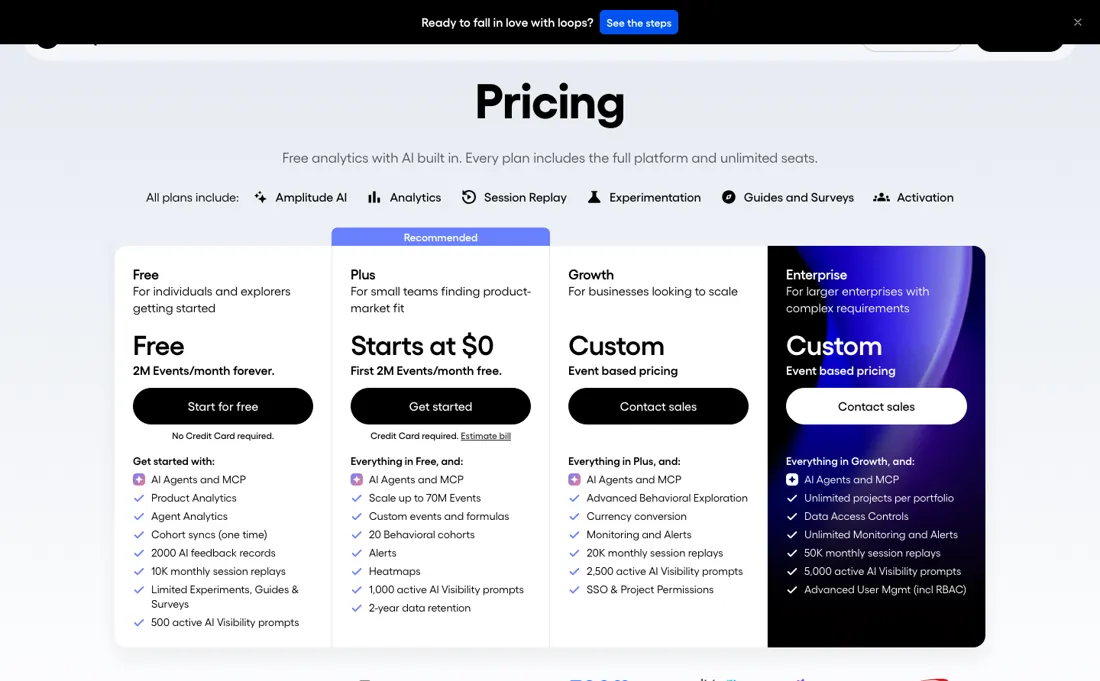
The cost lands on events instead, and events are the thing you control least: an instrumentation change or a growth spurt moves your bill without anyone choosing to upgrade. What the plan cards do not print, the page's own bill estimator does, and we read the whole Plus ladder there on 17 September 2026. What it shows is how little volume buys you: the marginal million events costs $94 a month at the bottom of the ladder and still $86.25 at the 70-million ceiling where Plus stops, and above that ceiling nothing is published.
And 'expanded packages are priced as a percentage of your platform plan' means the add-ons scale with your bill rather than with your usage of them — the more events you send, the more the extras cost, whether or not you use them more. Get the per-event rate in writing before you instrument.
What Amplitude does
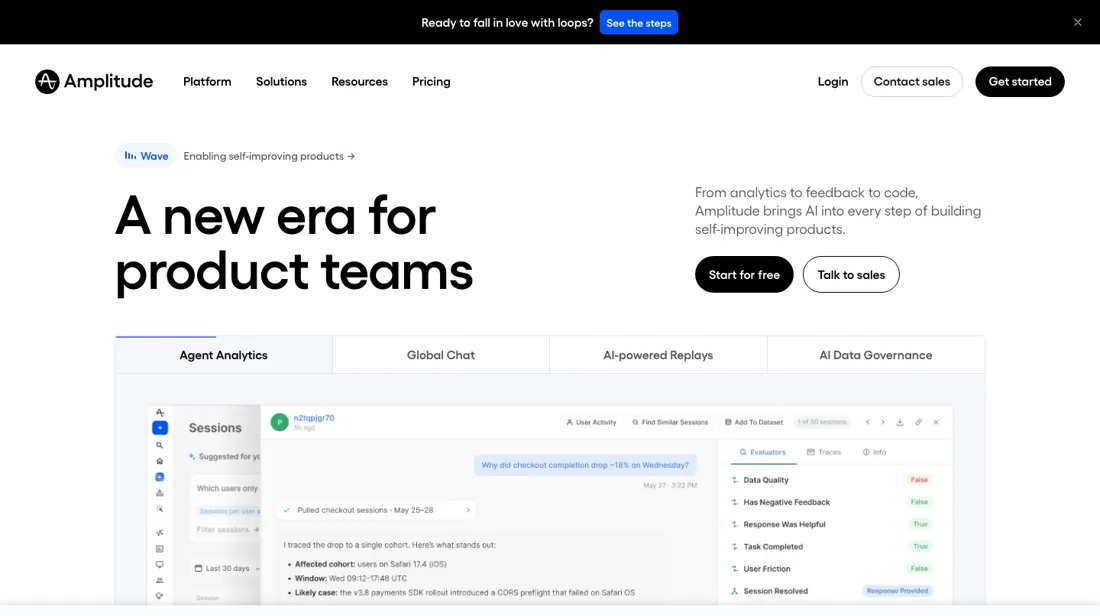
Product analytics: funnels, retention and behavioural cohorts, plus session replay and experimentation.
What buyers report about Amplitude
Recurring themes from the buyer-review sites listed at the foot of this page, read in August 2026. We have not run Amplitude ourselves, so this is other buyers' experience rather than ours. We summarise it here because the complaints are usually the part a vendor page leaves out.
- • Non-technical people genuinely get answers out of it, and the dashboards are what reviewers name.
- • The free tier is repeatedly described as generous enough to be a working plan rather than a demo.
- • Expensive at scale is the number one complaint across G2, Reddit and Hacker News — 2 to 5 times Mixpanel for equivalent usage on Growth and Enterprise. Buyers report a median enterprise contract around $64,000 a year.
- • Volume is the meter, and reviewers describe the same failure either way: a viral moment or a seasonal campaign inflates a bill nobody planned. Note that reviews written before mid-2026 describe per-monthly-tracked-user pricing, which the vendor's current page no longer uses — it now prices per event.
- • The full depth still needs engineers: backend event tracking, cross-device identity, schema maintenance. Any non-trivial question becomes a ticket.
- • Setup time and technical prerequisites are flagged regardless of company size.
Where the ratings disagree. De prijsklachten in deze steekproef gaan over het model dat Amplitude tot 2026 hanteerde (per monthly tracked user). De leverancierspagina, gelezen 18 augustus 2026, rekent per event. De strekking 'het loopt op met volume' blijft kloppen, de genoemde bedragen en eenheden niet.
When the paid plan is worth it
The free tier is the reason to look at all: 2 million events a month, no card, no time limit and unlimited seats, and their own FAQ insists it is a plan rather than a trial. Plus is the volume step. It starts at $0 with the first 2 million events free, requires a card, scales to 70 million events, and adds custom events and formulas, 20 behavioural cohorts, alerts, heatmaps and two-year retention.
What Plus does not buy is depth. SSO and project permissions start at Growth; role-based access control and advanced user management at Enterprise. Feature Experiment, Web Experiment, Guides and Surveys, Activation and account-level analytics are each marked "Available for Growth and Enterprise", so paying to leave the free tier does not unlock experimentation or B2B reporting. And neither paid-by-quote tier publishes a rate: Growth and Enterprise both read "Custom, event based pricing", with expanded packages priced as a percentage of your platform plan.
How to actually use Amplitude
The docs put four foundation steps before any chart. Create an account to open the workspace, then create a project for the product or environment you want to analyse. Plan the implementation so business questions map to the events you track, and identify users so activity joins up across sessions and devices. Only then does the first workflow start — select the events that represent meaningful actions, build a chart to answer one question or start from a template, and share the result in a space so teammates find the related charts, dashboards and notebooks.
Amplitude Academy carries a "Getting Started with Amplitude Analytics" course that covers cohorts. The planning step is the one with a bill attached: the tracking plan decides how many events you send, events are the billing unit, and loose instrumentation on the free 2 million is what makes the next tier arrive sooner than expected.
Distilled from Vendor pricing page (amplitude.com/pricing) and the vendor's own documentation index Get Started (amplitude.com/docs/get-started), both read 18 August 2026.
The natural comparison is Mixpanel or PostHog — the direct product-analytics peers — compare the per-event rate above the free tier, since that is the only number that moves.
The ex-banker filter — the same yardstick on every review (how we review): My ex-banker filter is simple: does Amplitude remove a real cost — time, errors, missed revenue — bigger than what it charges?
Frequently asked questions
What does Amplitude cost above the free 2 million events?
The plan card prints only “Starts at $0”, but the bill estimator on that same page carries the whole Plus ladder, and we read it there on 17 September 2026. Billed monthly: 3M events $94, 5M $281, 7.5M $495, 10M $720, 12.5M $945, 15M $1,170, 20M $1,575, 30M $2,450, 50M $4,140 and 70M — where Plus stops — $5,865. Billed annually those same steps are $900, $2,700, $4,752, $6,912, $9,072, $11,232, $15,120, $23,520, $39,744 and $56,304 a year, exactly 20% below the monthly rate throughout. Read as a rate it is $94 for the first extra million events and $86.25 at the top of the plan, so growing into Amplitude buys almost no volume discount. Past 70 million events there is no published number at all.
Is the free plan a real plan or a trial?
A plan, and Amplitude answers it in its own FAQ: “It's not a trial. There's no time limit.” Free carries 2 million events a month with no credit card and unlimited seats, plus 10,000 session replays, 5,000 agent sessions, 2,000 AI feedback records and one active experiment on each of feature and web experimentation. Read 17 September 2026. The care goes into the step above it rather than the free tier itself: Plus is also badged “Starts at $0” with the first 2 million events free, but it needs a card on file and the meter starts at event 2,000,001. So the question is not whether the free plan expires — it does not — but how tightly your instrumentation holds under 2 million events, because that number is set by how you tag, not by how many people you employ.
What does paying actually unlock?
Less than the ladder implies, and the parts most teams upgrade for sit two steps up. Plus buys volume plus custom events and formulas, 20 behavioural cohorts, alerts, heatmaps and two-year retention. SSO and project permissions do not arrive until Growth; role-based access control and advanced user management not until Enterprise. The published caps move in single steps too: session replays 10,000 a month on Free and Plus, 20,000 on Growth, 50,000 on Enterprise; active experiments one, then two; agent sessions 5,000, then 10,000, then 20,000. Read on their comparison table on 17 September 2026. Both upper tiers read “Custom, event based pricing”, and the same table adds that expanded packages are priced as a percentage of your platform plan — so the extras scale with your bill rather than with your use of them.
What should I weigh before buying Analytics software?
Judge it on evidence rather than adjectives. Look for a published security page, single sign-on and role controls on the plan you would actually buy (they are often gated to higher tiers), a status page with real incident history, and a clear answer on where your data is stored. If the tool will hold anything sensitive, those four answers matter more than any feature comparison.
Is this a hands-on review of Amplitude?
This is a researched assessment, not a hands-on test — where we've used a tool ourselves, we say so explicitly. We name what each tool is genuinely good and bad at, and we have no affiliate relationship with Amplitude — we earn nothing whether you sign up or not.
- Buyer reviews on G2, Gartner Peer Insights, Reddit and Hacker News, read August 2026.
- 2026-09-17, re-read on their own pricing page.
- A dated screenshot of that pricing page, kept on this site as the receipt.
Others in this category
Nothing we have reviewed in analytics does the same job as Amplitude; these are neighbours by category only:
New dossiers, cost-traps we found, and tools that earned a keep — no hype, no sponsored-disguised-as-advice. Unsubscribe anytime.
This is our researched assessment — not a paid placement. How we review →