Bright Data Review (2026)Skip It for Occasional Scrapes
 By Daan Haket · Researched and written with an AI assistant · who does what
This is enterprise-grade web data infrastructure at enterprise-grade prices — the per-GB meter looks small until you multiply by real scraping volume, and the committed tiers only pay off if your usage is steady.
data teams and enterprises with real, ongoing web-data needs (pricing intelligence, market research) that justify committed volume and pass use-case vetting.
you need occasional small scrapes (Browse.ai-class tools or datasets are far cheaper), or your use-case wouldn't survive a compliance review.
Transparency: the “Visit” links on this page are affiliate links — we may earn a commission if you sign up, at no extra cost to you. No vendor can pay for a better review or verdict. How we make money →
Pricing (2026)
✓ Pricing re-verified 2 Oct 2026
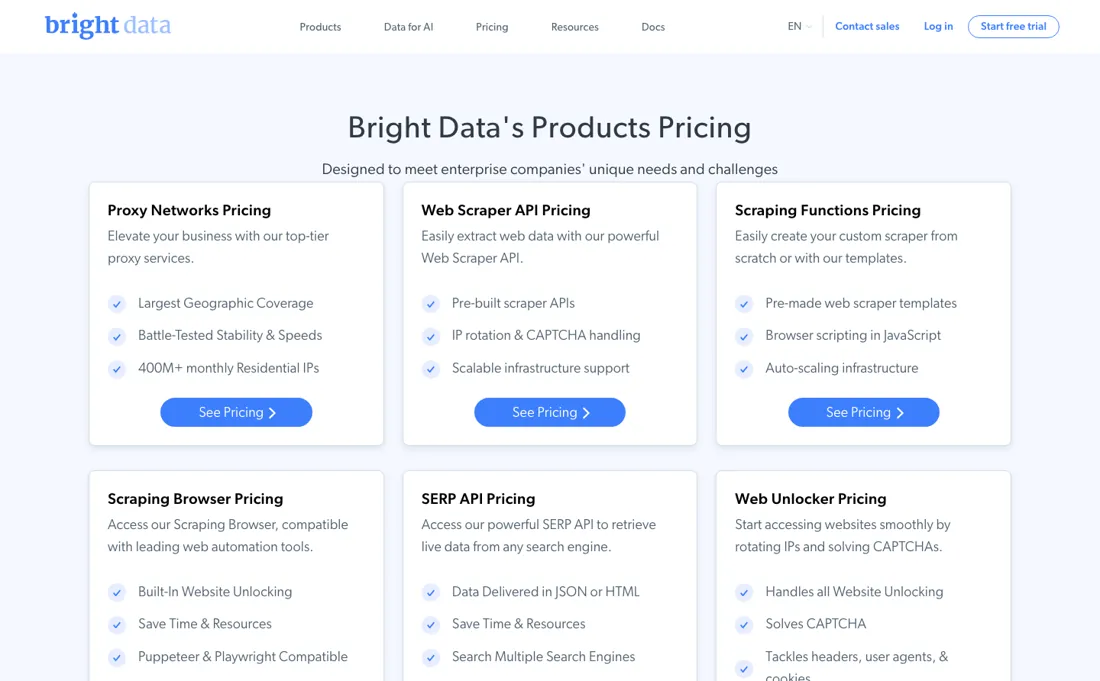
Usage-based: residential proxies start at $4.00/GB with no commitment, against a struck-through $8 — the $2.50/GB rate the overview page leads with is the $1,999/month tier, not the entry price. The committed residential tiers read $3.50/GB at $499/month (141 GB included), $3.00/GB at $999 (332 GB) and $2.50/GB at $1,999 (798 GB). Per-IP products are laddered the same way, and the headline rates are volume floors rather than starting points: datacenter runs $1.40/IP at 10 IPs, $1.00 at 100, $0.95 at 500 and $0.90 at 1,000, while ISP runs $1.80, $1.45, $1.40 and $1.30 across the same steps — so the real minimum is $14/month for ten datacenter IPs, not the $0.90 on the nav.
API side: Unlocker, Crawl and SERP APIs from $1/1k requests (free tiers available), Scraper APIs $1.50/1k records pay-as-you-go with a 5K/month free tier and a $499 Scale plan bundling 384,000 records at $1.30/1k overage, Data Firehose $0.20/1k, Datasets from $250/100k records; managed offerings from $1,500/mo (Managed Data Acquisition) and Retail Insights from $2,000/mo. Plans change — always verify the live price on their site.
Category context: IT & Productivity. Across the 39 tools in this category that we researched with a public US-dollar price, the median entry price is $15 a month (lowest paid plan as listed, per seat where the vendor prices per seat). Compare pricing conditions in the Software Cost Atlas →
Correction after re-checking: Re-read on 2026-09-11 and largely unchanged on the money, but two framings need correcting. Residential pay-as-you-go is still a struck-through $8/GB discounted to $4.00/GB, and the committed tiers still read $3.50/GB at $499/month, $3.00 at $999 and $2.50 at $1,999 — now with their included volumes printed (141 GB, 332 GB and 798 GB, which is simply the commitment divided by the rate). The Scraper, Unlocker and SERP APIs are $1.5/1K on pay-as-you-go rather than the $0.75-$1/1k the 'from' rates advertise. What is newly visible is that the per-IP 'from' rates are floors: datacenter is $1.40/IP at 10 IPs and only reaches $0.90 at 1,000, and ISP is $1.80/IP at 10 and only reaches $1.30 at 1,000. The site is also running two coupon codes on these pages — RESIGB50 for 50% off residential GB and APIS25 for 25% off Scraper API for three months — plus a first-deposit match of up to $500 (re-verified 2026-09-11). Re-read 2 October 2026: every rate and ladder above unchanged, and the first-deposit match (up to $500) and both coupon codes (RESIGB50, APIS25) still running. (re-verified 2026-10-02)
What the price did
We capture Bright Data’s own pricing page every month and keep the figures, so this is our record of the page — not a forecast, and not someone else’s summary.
Our captures of brightdata.com/pricing on 7 July, 2 August and 11 August 2026 returned an identical set of headline rates. In all three the same "50% OFF" pairing appears: a struck-through list price beside a discounted one — $5 next to $2.5/GB on residential, $1 next to $0.75/1K records on the Scraper APIs. A discount that shows up in every capture we hold is a price, not an event. The number that actually moves is the one tied to commitment, read on the residential page on 11 August 2026: $4.00/GB at no commitment, $3.50/GB at $499 a month (141 GB included), $3.00/GB at $999 (332 GB) and $2.50/GB at $1,999 (798 GB). Re-read on 2 October 2026, every amount was unchanged again: residential $4.00/GB with no commitment against the struck-through $8, then $3.50 at $499, $3.00 at $999 and $2.50 at $1,999 a month; datacenter $1.40, $1.00, $0.95 and $0.90 per IP and ISP $1.80, $1.45, $1.40 and $1.30 across 10, 100, 500 and 1,000 IPs; Scraper APIs $1.5/1K pay-as-you-go, or $499 a month for 384,000 records with $1.3/1K overage. The 50% OFF pairing was still on both pages.
What the pricing page doesn’t say
The bigger honest note is compliance: Bright Data is strict about KYC and use-cases (a feature, not a bug), and whatever you collect still has to respect the target sites' terms and applicable law. Budget legal thought alongside the gigabytes.
Watch the video review
The video version of this review, from our YouTube channel.
⚡ Short on time? Watch the 30-second verdict Short.
What Bright Data does
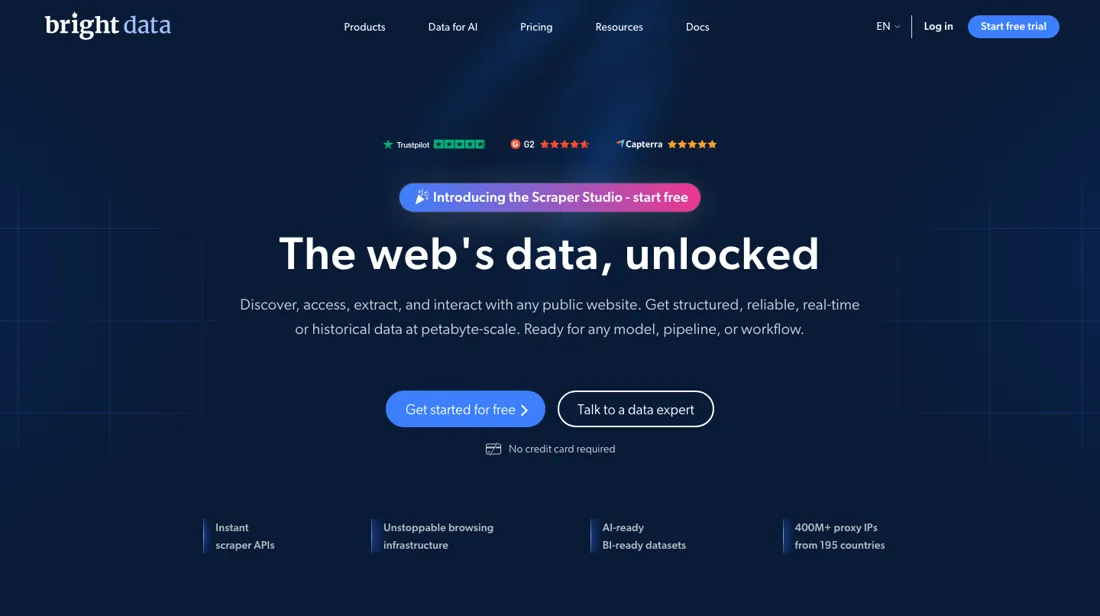
The web data platform trusted by enterprises. Collect public web data at scale with proxies, ready-made datasets and scraping APIs — fuel for your market research and AI projects.
What buyers report about Bright Data
Hands-on: not tested by usReported by buyers: Capterra and practitioner write-ups, read August 2026
Themes from the buyer-review sites listed at the foot of this page, read in August 2026. We have not run Bright Data ourselves, so this is other buyers' experience rather than ours. We summarise it here because the complaints are usually the part a vendor page leaves out.
- • Web Unlocker clears 99%+ on most commercial targets, including the hard ones. Reviewers running serious volume say nothing else matches the IP pool.
- • Targeting granularity that enterprise data teams actually need.
- • Usage-based pricing across eight separately-metered product lines makes spend very hard to forecast. Retries, heavy pages and sloppy selectors all bill.
- • Reviewers report being charged for failed requests on the proxy and unlocker products.
- • Slow support, and the AI chat support is reported to give wrong answers.
- • The dashboard is dense enough that new users lose time just finding the right product.
When the paid plan is worth it
Bright Data's clearest paid/free split is on the API products. Web Scraper API, Web Unlocker and SERP API each publish a free tier of 5K records or requests a month with no card, then Pay as you go at $1.50/1K, then Scale at $499 a month bundling 384,000 records with overage at $1.30/1K, then a custom Enterprise tier. That commitment only repays itself if your steady monthly volume beats what $499 buys at the pay-as-you-go rate; below that, no commitment is simply cheaper.
The advertised floors are not entry prices. The overview page says datacenter from $0.90/IP and ISP from $1.30/IP, but those are the rates at 1,000 IPs. Ten datacenter IPs cost $1.40 each and ten ISP IPs $1.80, so the real entry is $14 and $18 a month. Residential works the same way: $2.50/GB needs a $1,999 monthly commitment, while no-commitment is $4.00/GB. What spending more does not fix is access.
Residential proxies stay gated behind a human-reviewed KYC check at every tier, and the docs state approval is never automatic, instant or self-serve.
Our monthly capture read this vendor's pricing page every month from July 2026 to October 2026, and the amounts were the same all 4 times, including $1 and $250 from the pricing above. We keep watching — the registry records what moves.
How to actually use Bright Data
The vendor's Web Unlocker quickstart is short: 6 steps in the control panel — sign in, open the Create an API page, choose Web Unlocker API, name it, add a payment method (free trial users only), and finalize creation. The zone then exposes an API key and zone name on its Overview tab, which you send to the api.brightdata.com/request endpoint. The docs warn the API key is shown on screen only, so it has to be copied and stored straight away.
The real friction sits elsewhere. Residential proxies are not self-serve. The docs limit access to verified companies that pass a human-reviewed KYC check, and require a corporate email domain — a personal Gmail or Outlook account cannot be approved. They also require funds already on the account balance, and state KYC cannot be started from Playground or Limited Trial mode. Submission needs a company registration document plus business and use-case detail, status arrives within 48 hours, and it is tracked under Account Settings > Profile. ISP proxies, datacenter proxies and Web Unlocker skip KYC entirely.
Where this section comes from: our research notes (97 words)
Vendor material only: Bright Data's own pricing pages — brightdata.com/pricing/proxy-network for the residential, ISP and datacenter ladders and brightdata.com/pricing/web-scraper for the Scraper API tiers, both re-read on 11 September 2026 — plus the Web Unlocker quickstart, the send-your-first-request page and the residential network-access and FAQ docs on docs.brightdata.com; we found no independent walkthrough worth citing, since the setup guides that surfaced were on competing proxy vendors' and comparison sites. Both pricing pages re-read on 2 October 2026 (proxy-network rendered in a headless browser, web-scraper from the served page): all residential, ISP, datacenter and Scraper API amounts unchanged.
The natural comparison is Oxylabs or Smartproxy — the premium proxy/data peers — compare effective per-GB at your committed volume and the quality on your specific target sites.
Frequently asked questions
Is the "50% OFF" on Bright Data's pricing a real discount?
Treat the discounted number as the price. Every capture we hold of that page — 7 July, 2 August and 11 August 2026, and again on 2 October — shows the same struck-through list price beside the same discounted one, on residential proxies and on the Scraper APIs alike. A sale that is present in every observation is not an event you need to hurry for.
What does Bright Data cost to actually start?
Less than the headline suggests on the free tier and more than it suggests on proxies. New accounts get 5,000 credits a month, which Bright Data values at about $7.50, shared across Unlocker, SERP, Web Scraper and Scraper Studio; credits renew on the 1st, do not roll over, and stop hard. Proxies are not in that free tier. And the "from $2.5/GB" on the residential card is the $1,999-a-month tier: with no commitment you pay $4.00/GB against a struck-through $8 (read 11 August 2026).
Can I just sign up and use residential proxies?
No, and this is the step that catches people rather than the price. The vendor docs restrict residential access to verified companies that pass a human-reviewed KYC check: a corporate email domain is required (a personal Gmail or Outlook account cannot be approved), funds must already be on the account, and KYC cannot be started from Playground or Limited Trial mode. Submission needs a company registration document plus business and use-case detail, and status arrives within 48 hours. ISP proxies, datacenter proxies and Web Unlocker are exempt from KYC altogether.
Is this a hands-on review of Bright Data?
This is a researched assessment, not a hands-on test — where we've used a tool ourselves, we say so explicitly. We name what each tool is good and bad at, and we earn a commission only if you sign up, at no cost to you.
- Buyer reviews on Capterra and practitioner write-ups, read August 2026.
- Bright Data’s own published pricing page.
- A dated screenshot of that pricing page, kept on this site as the receipt.
Others in this category
Reviewed it & productivity tools that share ground with Bright Data — comparable in what they do, not drop-in swaps:
New reviews, price changes we recorded, and the cost conditions we found. No sponsored placements. Unsubscribe anytime.
This is our researched assessment — not a paid placement. The “Visit” links on this page are affiliate links: we may earn a commission if you sign up, at no extra cost to you, and it never changes our take. How we review →