 UltaHost Review (2026)Two Years Saves 22%, Not the 40% Badge
Transparency: the “Visit” links on this page are affiliate links — we may earn a commission if you sign up, at no extra cost to you. No vendor can pay for a better review or verdict. How we make money →
The sticker price is a term commitment: the page opens on the 2-year prices, and the 30/40/50% badges are measured from a crossed-out list price rather than from what monthly billing actually costs, so the real saving for prepaying two years is about 22% on Starter.
Visit UltaHost → 🎟️ Code ultaad2RiM — 10% off Affiliate link — we may earn a commission if you sign up; it does not change what this page says.
Watch the 2-minute review
The video version of this review, from our YouTube channel.
⚡ Short on time? Watch the 30-second verdict Short.
Pricing (2026)
✓ Pricing re-verified 1 Oct 2026
The term ladder is Monthly, Yearly -30%, 2 Years -40% and 3 Years -50%, and the page opens on the two-year term. At that term the shared plans are Starter $3.44/mo (list $6.89) for 1 domain, ~10,000 visits a month and 30 GB NVMe; Basic $5.18 (list $9.19) for 4 domains, ~15,000 visits and 60 GB; Business $10.35 (list $17.02) for unlimited domains, ~25,000 visits and 80 GB; and Pro $13.23 (list $21.62) for ~49,000 visits and 110 GB.
Monthly billing is $4.39, $6.39, $12.29 and $16.29 (badged 'Save 25%'); one year $4.03, $6.33, $12.08 and $14.94; three years $2.88, $4.37, $8.63 and $10.93. Every card states it renews at its own rate for the same term ('Renews at $3.44/mo for 2 years. Cancel anytime.'). The banner now reads 'Starting at $3.44/mo', matching the card; on 9 September it read $4.13. 30-day money-back guarantee, free SSL, free backups, cPanel. Plans change — always verify the live price on their site.
Category context: IT & Productivity. Across the 35 tools in this category that we researched with a public US-dollar price, the median entry price is $15 a month (lowest paid plan as listed, per seat where the vendor prices per seat). UltaHost’s entry price of $3.44 a month sits below that median. Compare pricing conditions in the Software Cost Atlas →
ultaad2RiM — 10% off, supplied by Ultahost's affiliate manager via PartnerStack on 9 Aug 2026 for our readers. Two things Ultahost did not say, so do not assume them: which plans or billing terms the code covers, and when it runs out — no end date was given. Read it against the way UltaHost prices: the headline rates it advertises already need a 24-month prepay, so check at checkout whether the 10% actually comes off that promotional term or only off the standard rate. for referrals, verified in the partner dashboard. Claim the deal →What the price did
We capture UltaHost’s own pricing page every month and keep the figures, so this is our record of the page — not a forecast, and not someone else’s summary.
The intro pricing held between our captures: July and August 2026 both record $3.29, $4.95, $11.95, $10.99 and $19.99. But the August capture also surfaces the renewal lines — $4.39 and $6.89 a month, 'renews at that rate, cancel anytime' — that the July one does not show. Same promotional prices, clearer disclosure of what happens afterwards. On 9 September 2026 the two-year cards read $3.44, $5.18, $10.35 and $13.23 with renewals at the same rate, while the banner advertised $4.13. On 1 October 2026 the cards were unchanged and the banner had come down to $3.44. That reading also rendered the Monthly tab: Starter $4.39 renewing monthly, not the $6.89 list our earlier text said monthly billing returns to.
What the pricing page doesn’t say
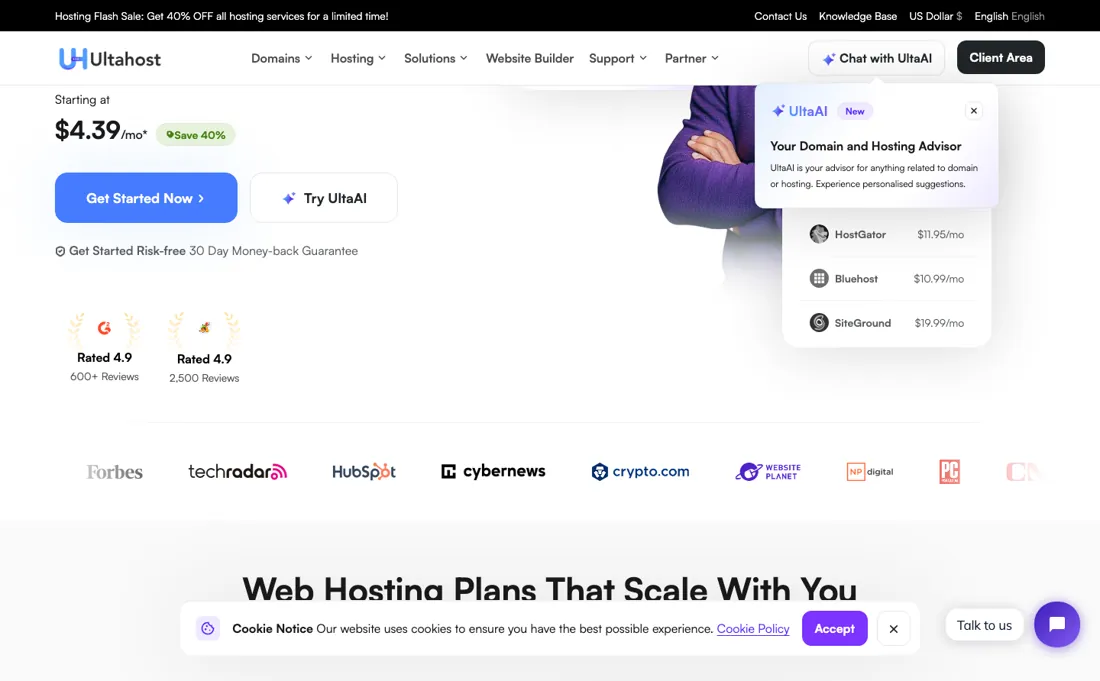
What works in its favour is the renewal: each card states it renews at the same rate for the same term, so the usual cheap-first-term-then-dear-second trap is at least written down. Read that line on the plan you actually pick. Support is generally fast but can be hit-or-miss depending on which agent picks up your ticket, and it's a smaller, less-established brand than the big managed hosts. It's a value play, not a premium-SLA one.
What UltaHost does
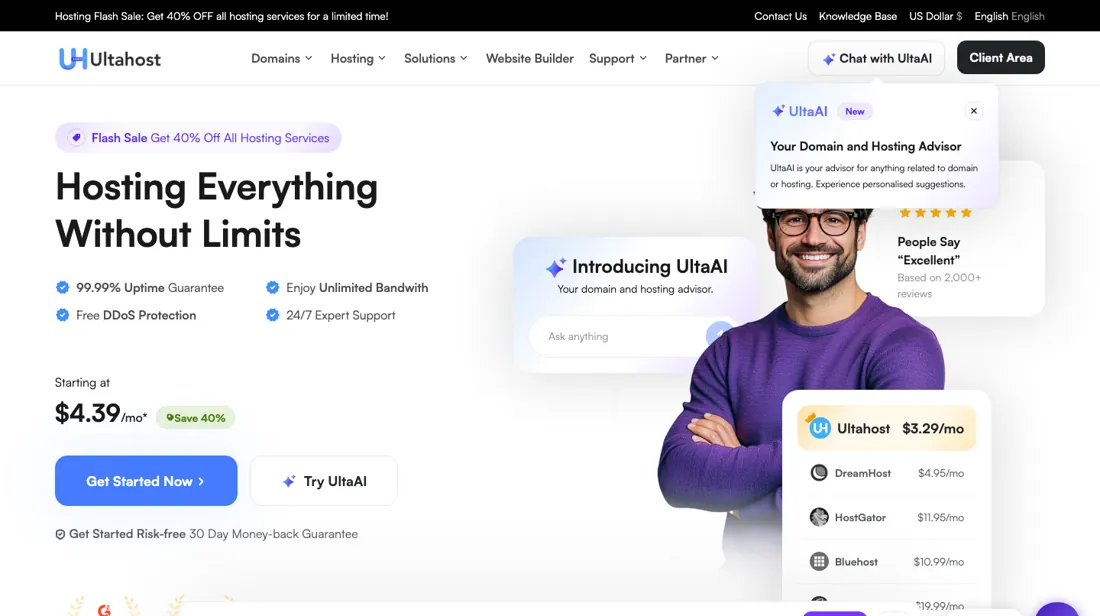
Budget-friendly web hosting across shared, VPS, WordPress and dedicated plans — NVMe SSD storage, free SSL and migration, DDoS protection and 24/7 multilingual support, from 30+ global data centers.
What buyers report about UltaHost
Recurring themes from the buyer-review sites listed at the foot of this page, read in August 2026. We have not run UltaHost ourselves, so this is other buyers' experience rather than ours. We summarise it here because the complaints are usually the part a vendor page leaves out.
- • SSL, DDoS protection, automated backups, unlimited bandwidth and free migration all come standard rather than as add-ons.
- • The renewal step is mild by hosting standards: reviewers note the plan renews at the rate you signed up on, where competitors triple or quadruple.
- • The structured review platforms and Trustpilot tell different stories. Trustpilot carries recurring complaints about service suspensions, refund disputes and inconsistent support.
- • Slow server speeds, inconsistent uptime and blacklisted IPs are reported.
- • One reviewer describes a Windows VPS forcibly rebooted with no notice, taking down a trading system and costing money. If you run anything time-critical, ask about their maintenance notification policy first.
Pages read (August 2026): Trustpilot
The badge says 40%; against monthly billing it is 22%
Read the term before the price, and measure the saving against the monthly rate rather than the crossed-out one. The page opens on the two-year term, where Starter is $3.44 a month under a 'Save 40%' badge and a $6.89 strike-through. Paying monthly does not cost $6.89, though: the Monthly tab shows Starter at $4.39, renewing at $4.39. So two years up front saves 22% on Starter against paying monthly, not 40% or 50%; on Basic ($5.18 against $6.39) it is 19%, on Business ($10.35 against $12.29) 16% and on Pro ($13.23 against $16.29) 19%.
Three years takes Starter to $2.88, 34% under monthly; one year to $4.03, 8% under. The renewal line is the good part, and it runs on every term: each card says it renews at the same rate for the same term ('Renews at $3.44/mo for 2 years. Cancel anytime.'). Four years of Starter is $165.12 at a flat $3.44. The banner that advertised 'Starting at $4.13/mo' on 9 September now reads $3.44, matching the card.
What upgrading does not fix: the cards list domains, NVMe disk (30, 60, 80 and 110 GB) and a visit ceiling as what changes, plus 'enhanced security' on Pro; nothing on them changes support. Starter covers about 10,000 visits a month on one domain, Basic about 15,000 for 51% more, Business about 25,000 and Pro about 49,000. If one post that travels would push you past the ceiling, price the VPS range now; a migration under load is the one thing a long prepaid term makes awkward.
How to actually use UltaHost
Pick the term first and compare it against the Monthly tab, not against the strike-through. Starter is $4.39 monthly, $4.03 on one year, $3.44 on two and $2.88 on three; the badges say 25%, 30%, 40% and 50% because each is measured from a list price of about $6.89 that nobody pays on monthly billing. The real saving for prepaying two years is 22% on Starter and 16-19% on the larger plans.
Read the renewal line on the card you order. On 1 October 2026 every card renewed at its own rate for the same term ('Renews at $3.44/mo for 2 years. Cancel anytime.'), and the monthly cards renew at the monthly rate. Four years of Starter is $165.12. Then size the traffic honestly. Starter covers about 10,000 visits a month on one domain, which one successful post can exceed; Basic's ~15,000 costs 51% more on the two-year term.
If you expect more, price the VPS range now rather than migrating under load, and use the 30-day money-back window to test speed before the term is sunk.
Distilled from ultahost.com/shared-hosting rendered in a headless browser on 1 October 2026, with the Monthly, Yearly, 2 Years and 3 Years tabs clicked in turn: the four shared plan cards (Starter, Basic, Business, Pro) with list price, badge, price, renewal line and resource limits per term, and the 'Starting at' banner above them. The served HTML carries no prices; they render client-side. First read on 9 September 2026. The savings against monthly are our own arithmetic on those card prices.
UltaHost vs Hostinger, side by side
Each column shows the vendor’s own published entry price, read on the date shown. Entry prices can cover different services or units, so check what each one buys. We do not average them into a score.
Both names above are affiliate links: we may earn a commission if you sign up, at no extra cost to you. Neither changes what this table says.
The natural comparison is Hostinger or SiteGround — the comparable budget-to-mid hosts — Hostinger is the better-known value pick, SiteGround leans premium-managed; judge on the renewal rate and the support you'll actually need, not the intro price.
Frequently asked questions
What does UltaHost cost?
Shared hosting on the two-year term the page opens with: Starter $3.44 a month, Basic $5.18, Business $10.35 and Pro $13.23. Paying monthly: $4.39, $6.39, $12.29 and $16.29. One year: $4.03, $6.33, $12.08 and $14.94. Three years: $2.88, $4.37, $8.63 and $10.93. Read on 1 October 2026.
What happens at renewal?
Each card states it renews at the same rate for the same term: 'Renews at $3.44/mo for 2 years. Cancel anytime.' on two-year Starter, 'Renews at $4.39 monthly' on monthly Starter. Four years of two-year Starter therefore costs $165.12. Our August reading recorded renewals at $4.39 and $6.89 against the promotional rate; the page no longer says that.
Which term should I pick?
Measured against paying monthly, prepaying Starter saves 8% for one year, 22% for two and 34% for three; the 30/40/50% badges are measured from a strike-through price instead. Most of the saving sits in the two-year step, and three years is a long time to be wrong about a host, so two years is the sensible ceiling unless you are certain.
What should I weigh before buying IT & Productivity software?
Judge it on evidence rather than adjectives. Look for a published security page, single sign-on and role controls on the plan you would actually buy (they are often gated to higher tiers), a status page with real incident history, and a clear answer on where your data is stored. If the tool will hold anything sensitive, those four answers matter more than any feature comparison.
Is this a hands-on review of UltaHost?
This is a researched assessment, not a hands-on test — where we've used a tool ourselves, we say so explicitly. We name what each tool is good and bad at, and we earn a commission only if you sign up, at no cost to you.
- Buyer reviews on Trustpilot, HostAdvice and independent hosting tests, read August 2026.
- Re-verified 2026-10-01 on ultahost.com/shared-hosting, all four term tabs rendered.
- A dated screenshot of that pricing page, kept on this site as the receipt.
Others in this category
Reviewed it & productivity tools that share ground with UltaHost — comparable in what they do, not drop-in swaps:
New reviews, price changes we recorded, and the cost conditions we found. No sponsored placements. Unsubscribe anytime.
This is our researched assessment — not a paid placement. The “Visit” links on this page are affiliate links: we may earn a commission if you sign up, at no extra cost to you, and it never changes our take. How we review →