 Xero Review (2026)$25 a Month After the Promo
Read the second number, not the first.
Watch the 2-minute review
Same honest take, in video form — from our YouTube channel.
⚡ Short on time? Watch the 30-second verdict Short.
Pricing (2026)
✓ Pricing re-verified 30 Aug 2026
(2026-08-30, read on their own US pricing page) Every headline price is a promotion: 'Get 90% off your plan for your first 6 months when you buy by 30 September 2026'. Early is $2.50 a month for the first six months and then $25. Growing is $5.50 for six months and then $55. Established is $9 for six months and then $90.
Multi-currency and project tracking are on Established only. Optional add-ons: Inventory Plus (no price shown) and Xero Payroll powered by Gusto at $36 a month plus $6 per employee or contractor. Prices shown are USD; Xero prices differently by country. Plans change — always verify the live price on their site.
What the pricing page doesn’t say
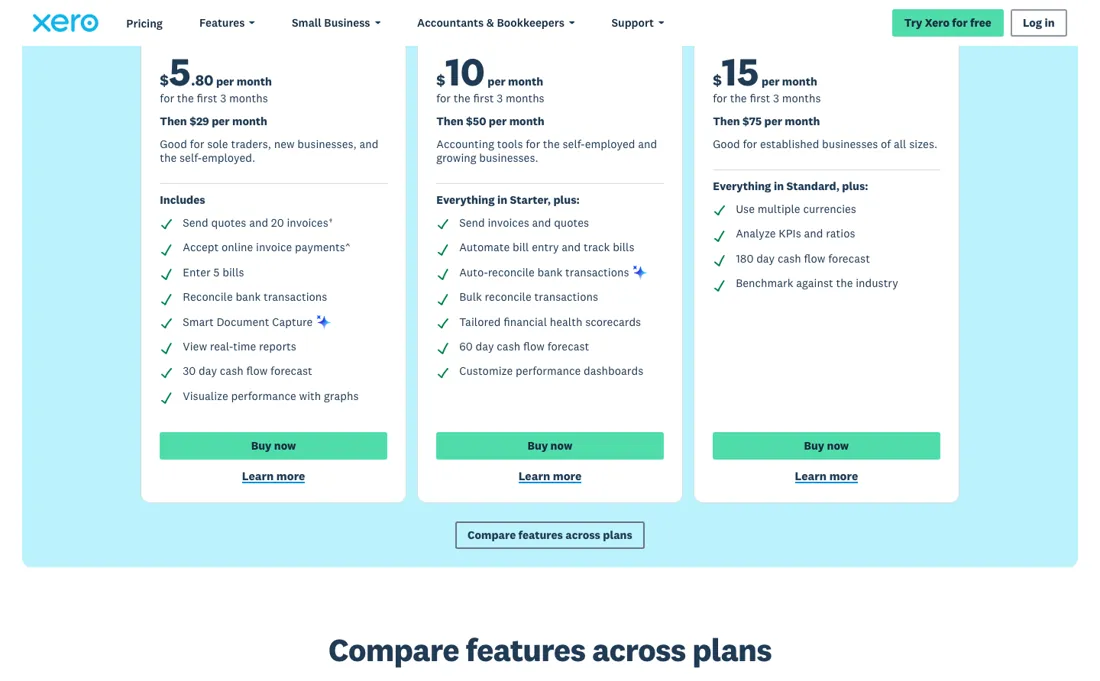
Every plan on that page is 90% off for six months, and the price that governs the rest of your first year is ten times what the button says: $25, $55 and $90. That is not hidden — it is printed right there — but it is printed smaller, and the plan people pick on the strength of $2.50 a month is the one that becomes $25. The offer is dated too: it runs until 30 September 2026.
The second thing to check before you commit is which country's page you are on, because Xero's tiers and prices differ by market and the US page is not the UK or AU one. And the entry tier is a genuine floor rather than a taster: if you need multi-currency or projects, that is Established at $90.
What Xero does
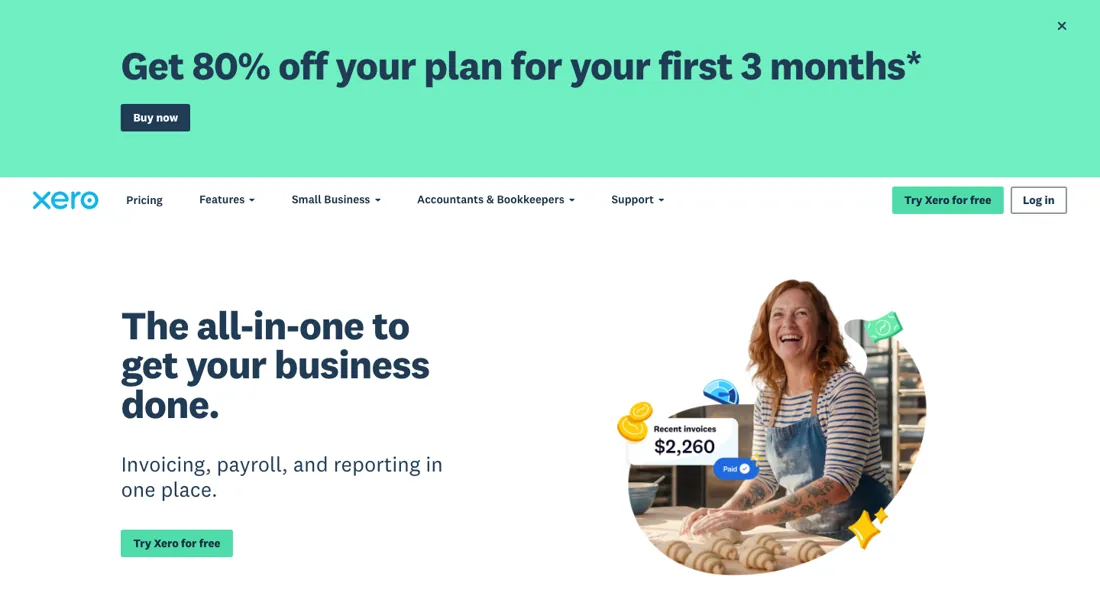
Cloud accounting for small business: bank reconciliation, invoicing, bills and reporting.
What buyers report about Xero
Recurring themes from the buyer-review sites listed at the foot of this page, read in August 2026. We have not run Xero ourselves, so this is other buyers' experience rather than ours. We summarise it here because the complaints are usually the part a vendor page leaves out.
- • Unlimited users on every tier, including the cheapest — a real advantage over per-seat competitors.
- • Non-accountants become productive in hours rather than days. Ease of use scores 9.0/10 on G2 against 8.2 for QuickBooks Online. 4.4 on both G2 and Capterra across 15,311 total reviews.
- • 46% of reviewers feel negatively about cost, and add-ons for advanced features push it out of reach for smaller teams. Established runs $90/month.
- • The forced switch from classic to new invoicing drew widespread complaints about lost functionality and a clunkier interface.
- • Manual payroll entry was removed in some regions — check yours before you migrate.
- • Support response times are a consistent complaint, alongside repeated price increases.
Where the ratings disagree. 4.4 on G2 and Capterra against 3.7 on Trustpilot. Narrower than most in this list, which itself says something: the complaints here are about price and product decisions, not about billing conduct.
Read the second number
Every headline price on Xero's US page is a promotion, and the page says so: 'Get 90% off your plan for your first 6 months when you buy by 30 September 2026'. Early is $2.50 a month for six months and then $25. Growing is $5.50 and then $55. Established is $9 and then $90. Inventory Plus is an optional paid add-on, and Xero Payroll powered by Gusto is another at $36 a month plus $6 per employee or contractor (2026-08-30, read on their own US pricing page).
So read the second number, not the first. It is not hidden — it is printed right there — but it is printed smaller, and the plan people choose on the strength of $2.50 a month is the one that becomes $25. The gap is a factor of ten. Work out what the offer is actually worth across a year, because '90% off' sounds larger than it is. Six months at 90% off is 5.4 months of free service, which across twelve months is a 45% discount on your first year and nothing thereafter.
In cash: Early costs $165 in year one against $300 at the standard rate, Growing $363 against $660, Established $594 against $1,080. Budget from the standard rate, treat the promotion as a one-off rebate, and note that it is dated — the offer is tied to buying by 30 September 2026. Two more things before you commit. Check which country's page you are looking at, because Xero prices and tiers differently by market and the US page is not the UK or Australian one — a comparison you read elsewhere may be describing a different product at a different price.
And be clear that the entry tier is a genuine floor rather than a taster: if you need multi-currency or project tracking, that is Established at $90, not Early at $25. The decision that actually matters with accounting software is not the monthly fee at all — it is that your books end up inside it, which is what makes leaving expensive a year later. Pick on whether your accountant works in it and whether it connects to your bank properly, and let the $25-versus-$55 question follow from that.
How to actually use Xero
Check which country's page you are on before you read a single price. Xero's tiers and rates differ by market, so a comparison you found elsewhere may describe a different product at a different price — and the US figures are not the UK or Australian ones. Then budget the standard rate rather than the promotional one. Every headline is 90% off for six months: $2.50 becomes $25, $5.50 becomes $55, $9 becomes $90.
Across a full year the offer is worth about 45%, not 90%, so plan from month seven — and the offer itself runs only until 30 September 2026. Pick the tier on the two features that force it rather than on price. Multi-currency and project tracking sit on Established at $90, and if you need either, the cheaper plans are not cheaper versions — they are different products. Inventory Plus is a separate paid add-on again.
Before any of that, ask your accountant or bookkeeper which package they work in, and connect your bank feed on day one. Accounting software is chosen once and lived in for years, and the two things that actually determine whether it works are whether your bank feed is reliable and whether the person doing your year-end is fluent in it. The monthly fee is the smallest part of this decision.
Distilled from Xero US pricing plans, including the promotional banner and the cross-plan feature comparison, https://www.xero.com/us/pricing-plans/ (read 2026-08-30); Xero multi-currency accounting, https://www.xero.com/us/accounting-software/use-multiple-currencies/ (read 2026-08-30).
Xero vs FreshBooks, side by side
Both columns come from the same place: each vendor’s own published pricing, read on the date shown in the sources at the foot of this page. We do not average them into a score.
The natural comparison is QuickBooks or FreshBooks — the standing comparison in small-business accounting — compare the post-promotional price on all three, because all three lead with a discounted rate.
The ex-banker filter — the same yardstick on every review (how we review): My ex-banker filter is simple: does Xero remove a real cost — time, errors, missed revenue — bigger than what it charges?
Frequently asked questions
What should I weigh before buying Financial Operations software?
The bar here is higher than features. Check who actually holds the money and under what licence, whether client funds are segregated, what audit trail and permission controls you get, and how support behaves when something goes wrong mid-transaction. Anything touching payments should be able to answer those in writing; if it cannot, that is your answer.
Is this a hands-on review of Xero?
This is a researched assessment, not a hands-on test — where we've used a tool ourselves, we say so explicitly. We name what each tool is genuinely good and bad at, and we have no affiliate relationship with Xero — we earn nothing whether you sign up or not.
- Buyer reviews on G2, Capterra, GetApp and Trustpilot, read August 2026.
- 2026-08-30, read on their own US pricing page.
- A dated screenshot of that pricing page, kept on this site as the receipt.
Others in this category
Reviewed financial operations tools that share ground with Xero — comparable in what they do, not drop-in swaps:
New dossiers, cost-traps we found, and tools that earned a keep — no hype, no sponsored-disguised-as-advice. Unsubscribe anytime.
This is our researched assessment — not a paid placement. How we review →