 Streak Review (2026)The Free CRM Tier Is Gone
The pitch — CRM living inside Gmail — is also the ceiling: everything happens in the inbox, which power users love and growing teams outgrow (reporting, permissions, cross-team process).
Visit Streak → Affiliate link — the rest of this page is the honest version, including who should skip it.
Watch the 2-minute review
Same honest take, in video form — from our YouTube channel.
⚡ Short on time? Watch the 30-second verdict Short.
Pricing (2026)
✓ Pricing re-verified 31 Aug 2026
(2026) Pro $49/user/mo annual or $59 monthly; Pro+ $69 annual or $89 monthly; Enterprise $129 annual or $159 monthly — a flat 20% annual discount, with Enterprise available on annual billing only and only to teams of 10 or more. Everyone on a team must be on the same plan. AI credits are a second meter: 20 per user per month on Pro, 150 on Pro+, 500 on Enterprise, pooled across the team and expiring each period; top-ups run $100/mo for 1,000 credits up to $1,000/mo for 25,000.
The free CRM tier was eliminated in 2024-25, but the free email tools remain — email and link tracking, snippets, Streak Share, a thread splitter, and mail merge at 50/day against 1,500/day on the paid plans. Pro+ has a 14-day free trial. Plans change — always verify the live price on their site.
What the pricing page doesn’t say
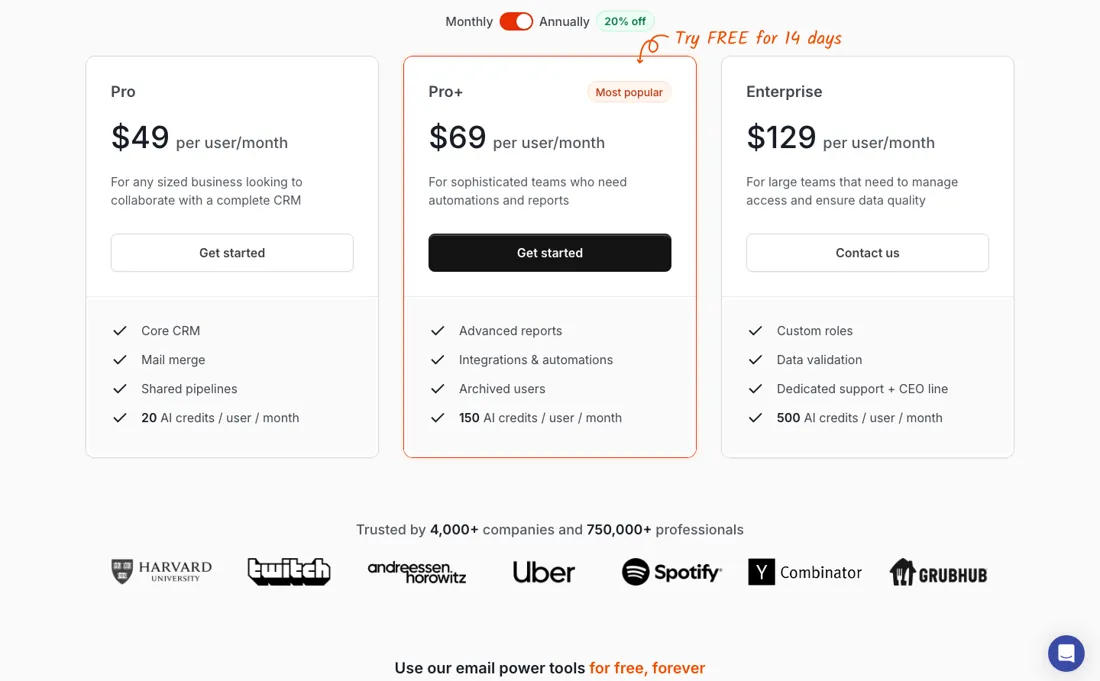
And note the trajectory: the free tier is gone and per-seat prices sit at real-CRM levels now, so the 'lightweight Gmail add-on' framing no longer matches the invoice. If the inbox is truly where your deals live, few tools feel this natural.
What Streak does
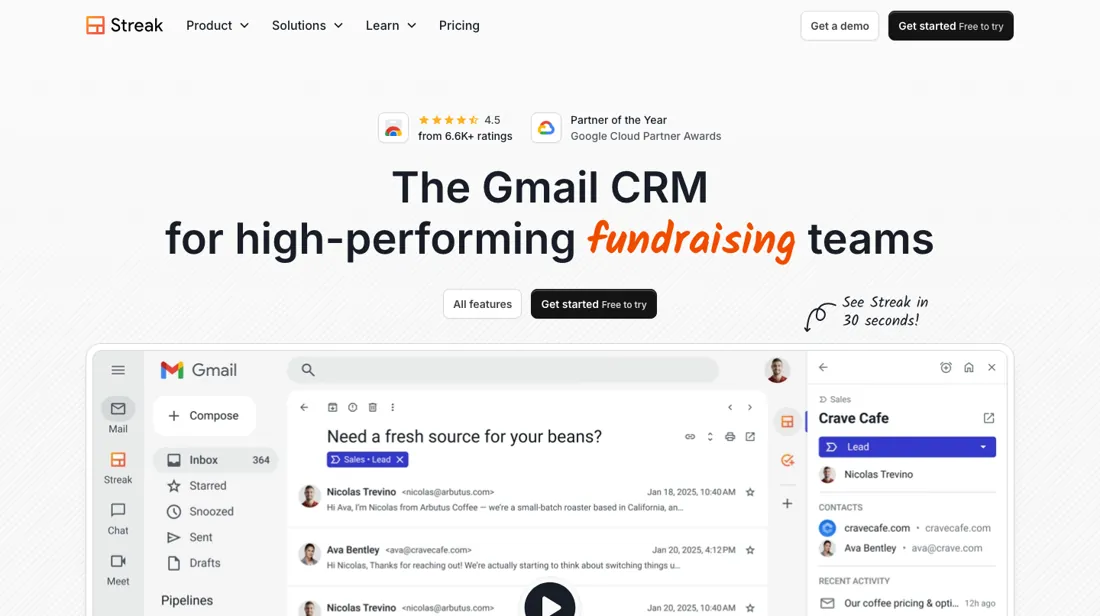
CRM built directly inside Gmail: manage pipelines, leads and deals from your inbox with email tracking, mail merge and shared views — ideal for teams that live in Google Workspace.
What buyers report about Streak
Recurring themes from the buyer-review sites listed at the foot of this page, read in August 2026. We have not run Streak ourselves, so this is other buyers' experience rather than ours. We summarise it here because the complaints are usually the part a vendor page leaves out.
- • It lives inside Gmail, so adoption is instant — reviewers describe being up and running in seconds.
- • Email tracking is well rated and is what many users stay for even without the CRM.
- • The free CRM and Solo tiers were phased out across 2024-2025. What remains free is email power tools only, and the Reddit reaction was not kind.
- • Gmail only. No Outlook, no Hotmail, no other client — if your team moves, Streak does not come with you.
- • Shared pipelines and team email sharing sit on the expensive tiers. Pro is $49 per user annually, Pro+ $69, Enterprise $129.
- • Bugs causing crashes and slowdowns are reported, and in a mail client that is disruptive.
The free tier is gone; the free tools are not
Pro is $49 per user a month on annual billing and $59 monthly; Pro+ is $69 annual and $89 monthly; Enterprise is $129 annual and $159 monthly, sold on annual billing only and only to teams of ten or more. The annual discount is a flat 20%. Annualised, that is $588, $828 and $1,548 a seat. Read those numbers next to the way this product is usually described and the mismatch is the story.
Streak is talked about as a lightweight CRM that lives inside Gmail, and $49 a seat is not a lightweight price — it is what full CRM platforms charge. A five-person team is $245 a month, or $2,940 a year, for pipelines in an inbox. The free CRM tier that made the lightweight framing true was eliminated in 2024-25, so anything you read about Streak written before then is describing a different commercial product.
What did survive may be all you wanted. The free email power tools remain: email and link tracking, snippets, a thread splitter and mail merge at 50 a day — against 1,500 a day on the paid plans. If your actual need was 'send a personalised sequence to forty people and know who opened it', that is still free and no tier above it is required. There is now a second meter, and it is where the tiers really separate.
AI features run on credits: 20 per user a month on Pro, 150 on Pro+ and 500 on Enterprise. Most actions cost one credit — a deal summary, a deal question, an autofill from the timeline — while autofill with web research costs two. So Pro buys twenty AI actions per user per month, credits are pooled across the team, and unused ones expire rather than roll over. A five-person Pro team gets 100 credits a month; the same team on Pro+ gets 750 for $100 a month more.
If the AI is why you are buying, Pro is not the tier you want, and the pricing page does not put it that way. If you do want the pipeline, the honest case is strong and narrow. For a salesperson whose deals genuinely live in email, few tools feel this natural, and a CRM nobody updates is worth nothing. The ceiling is the same fact from the other side: everything happens in the inbox, so reporting, permissions and cross-team process are what growing teams outgrow it on.
Our monthly capture read this vendor's pricing page in July 2026 and again in August 2026, and the amounts were the same both times. We keep watching — the registry records what moves.
How to actually use Streak
Check whether the free tools already solve your problem before you buy a seat. Email and link tracking, snippets, a thread splitter and mail merge at 50 a day are still free, and for a lot of people that was the entire reason they went looking for a CRM. There is no free CRM tier any more — that was removed in 2024-25 — so anything recommending 'Streak's free plan' for pipelines is out of date.
Count your AI actions before you pick a tier, because that is the meter the plan cards bury. Pro includes 20 credits per user a month, Pro+ 150 and Enterprise 500; a deal summary or a deal question costs one credit each, web-research autofill costs two, and unused credits expire at the end of the period. Twenty a month per user is roughly one summary a working day and nothing else.
If you do want pipelines, trial it on one real deal flow rather than a demo — Pro+ has a 14-day free trial. The question is behavioural, not functional: does the person who never updates the CRM update this one, because it is in the inbox they were already in? Test the exits at the same time. Try to produce the report your manager will ask for in six months, and check what an export of your pipeline looks like, before your deal history lives somewhere it is hard to retrieve from.
Distilled from Read 31 Aug 2026: streak.com/pricing — the three plan cards in both the monthly and the annual state, the 'free, forever' email-tools panel that lists mail merge at 50/day, the feature table giving 1,500/day mail merge and the per-tier AI credit allowances (20/150/500), the AI-credits section with the per-action costs and the $100-$1,000 top-up ladder, and the billing FAQ (20% annual discount, one plan per team, Enterprise annual and 10+ seats). Also streak.com/llms.txt (read 31 Aug 2026) for the plan summary.
Streak vs Capsule, side by side
Both columns come from the same place: each vendor’s own published pricing, read on the date shown in the sources at the foot of this page. We do not average them into a score.
Both names above are affiliate links: we may earn a commission if you sign up, at no extra cost to you. Neither changes what this table says: both columns come straight from the vendors’ own pricing pages.
The natural comparison is Capsule or Pipedrive — standalone SMB CRMs at similar or lower per-seat — Streak's edge is literally living in Gmail; that's the whole trade.
More on Streak
Everything we publish about Streak links back here — the review stays the honest hub:
The ex-banker filter — the same yardstick on every review (how we review): My ex-banker filter is simple: does Streak remove a real cost — time, errors, missed revenue — bigger than what it charges?
Frequently asked questions
What should I weigh before buying Growth & Revenue software?
It depends on whether you have the bottleneck it solves. Small teams get the most out of this category when one clear problem is already costing real hours or revenue; buying ahead of that just adds cost and another login. Price it against the hours or lost deals it removes, not against its feature list, and start on the smallest plan that covers the job.
Is this a hands-on review of Streak?
This is a researched assessment, not a hands-on test — where we've used a tool ourselves, we say so explicitly. We name what each tool is genuinely good and bad at, and we earn a commission only if you sign up, at no cost to you.
- Buyer reviews on Capterra, Reddit and CRM reviews, read August 2026.
- Price re-verified 2026-08-31 against the vendor's own pricing page.
- A dated screenshot of that pricing page, kept on this site as the receipt.
Others in this category
Reviewed growth & revenue tools that share ground with Streak — comparable in what they do, not drop-in swaps:
New dossiers, cost-traps we found, and tools that earned a keep — no hype, no sponsored-disguised-as-advice. Unsubscribe anytime.
This is our researched assessment — not a paid placement. The “Visit” links on this page are affiliate links: we may earn a commission if you sign up, at no extra cost to you, and it never changes our take. How we review →