 Storylane Review (2026)$50 to $625, Nothing Between
The jump from Starter to Growth is $50 to $625 a month — twelve and a half times — and the free tier is capped at one live demo, so the moment you want a second demo published you are on the ladder.
Watch the 2-minute review
Same honest take, in video form — from our YouTube channel.
⚡ Short on time? Watch the 30-second verdict Short.
Pricing (2026)
✓ Pricing re-verified 29 Aug 2026
(2026-08-01, read on their own pricing page) Free $0: 1 seat, 1 published demo live at a time, unlimited views. Starter $50/month ($40 annual), 1 seat, extra seats $40 each, unlimited demos, de-anonymises 250 visitors/month. Growth $625/month ($500 annual), 5 seats, extra seats $100 each, 2,500 visitors/month. Premium $1,500/month ($1,200 annual), 10 seats, 10,000 visitors/month. Enterprise quote-only. Their RepX chat product is separate again, starting at $2,000/month for up to 10,000 monthly visitors. Plans change — always verify the live price on their site.
What the pricing page doesn’t say
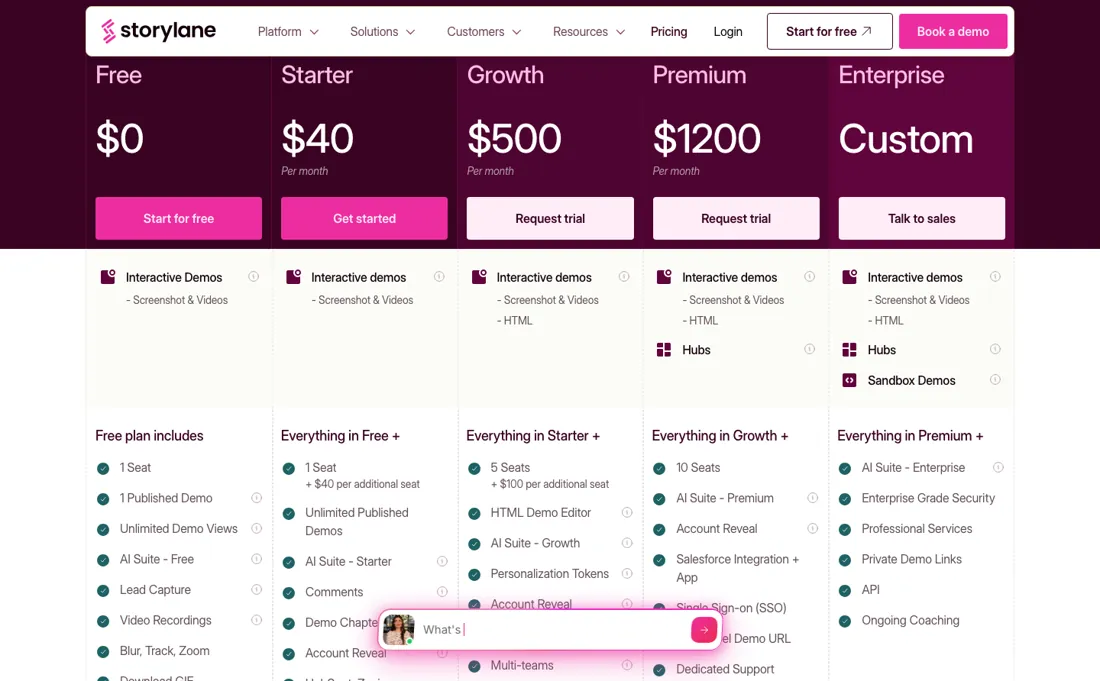
What is actually being sold at each step is visitor de-anonymisation: 250 a month on Starter, 2,500 on Growth, 10,000 on Premium. Price that against what you already pay a separate tool to do, because it is the meter that decides your tier, not the number of demos. Extra seats are charged on top at $40 to $100 each, which means a five-person sales team on Starter is not $50 a month, it is $210.
What Storylane does
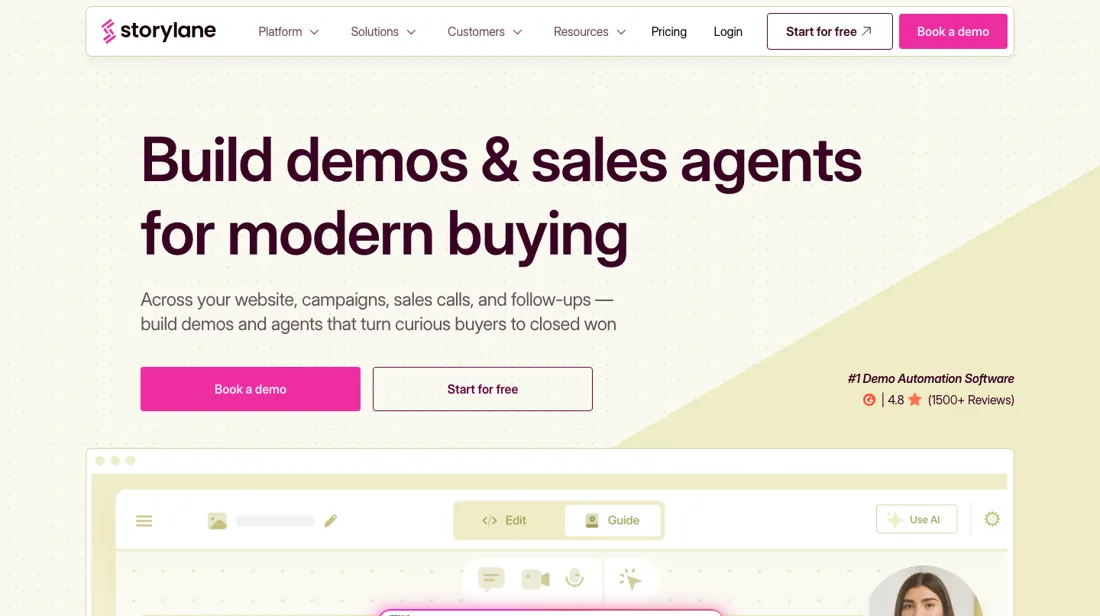
Interactive product demos you can embed, with analytics on who watched what.
What buyers report about Storylane
Recurring themes from the buyer-review sites listed at the foot of this page, read in August 2026 (the Chrome Web Store reviews we read are all dated 18 to 23 February 2026). We have not run Storylane ourselves, so this is other buyers' experience rather than ours. We summarise it here because the complaints are usually the part a vendor page leaves out.
- • Number one rated on G2 in demo automation with 4.8 across 1,343 reviews and 594 separate mentions of ease of use. It is the easiest tool in the category to learn.
- • Y Combinator-backed with 5,000+ GTM teams on it.
- • Reviewers of the capture extension say it records without lag and that the AI draft gets the demo structure right first time, with one putting the share of the work it does at three-quarters and another describing someone new to Storylane building a first demo quickly.
- • Screenshot maintenance is the recurring complaint — for a fast-moving product you are re-uploading constantly, and that never stops.
- • Design and navigation customisation are limited.
- • It starts at $40/month but real annual spend lands at $6K-$15K. Most teams doing HTML demos end up on Growth at $500 a month billed annually ($625 month to month).
- • Lily AI, demo hubs and sandboxes are separate add-ons rather than included.
- • We found no criticism on that listing at all, and we are reporting that as an observation rather than as praise. Every one of the ten most recent reviews falls inside a six-day window in February 2026 and every one is positive, which is a pattern more typical of a launch push than of accumulated use. It also covers only the Chrome capture extension, not the platform you would be paying for.
- • None of the newly read platforms answered the question buyers most need answered — what the free and Starter tiers can actually carry in practice. The published limits are one live demo on free and 250 de-anonymised visitors a month on Starter; how that holds up is not something the public reviews establish.
Where the ratings disagree. The extension listing and the platform reviews are not the same evidence. G2, Gartner and Software Advice cover the product teams buy; the Chrome Web Store covers a free recording tool, and its reviews arrived in one clustered week. Do not read a uniformly positive extension listing as a verdict on the paid product.
You are buying de-anonymised visitors, not demos
Free is $0 for one seat and one published demo live at a time, with unlimited views. Starter is $50 a month ($40 annual) for one seat and unlimited demos. Growth is $625 ($500 annual) for five seats, and Premium $1,500 ($1,200) for ten. Enterprise is quoted, and their RepX chat product is a separate subscription starting at $2,000 a month (2026-08-01, read on their own pricing page). The step from Starter to Growth is twelve and a half times, which is the largest single jump on this site's price ladders — so it is worth being precise about what causes it.
It is not demos: those are unlimited from Starter up. It is visitor de-anonymisation. Starter identifies 250 visitors a month, Growth 2,500 and Premium 10,000, and that meter is the product being sold. Price it as such, because the per-unit maths has an inversion in it. On annual billing you pay $0.16 per identified visitor on Starter, $0.20 on Growth and $0.12 on Premium — so Growth is 25% worse value per visitor than the entry tier.
You are buying the five seats and the headroom, not a better rate. Set that $0.16 to $0.20 against what you already pay a separate de-anonymisation tool, since many teams are paying twice without noticing. Seats are charged on top and they are not cheap: $40 each on Starter and $100 on Growth. A five-person sales team on Starter is therefore $210 a month, not $50 — and at that point the $500 Growth plan with five seats included and ten times the visitor allowance is a different conversation.
The free tier's real constraint is the single live demo. One published demo at a time is enough to prove the format works for your product and not enough to run a campaign, so treat it as a genuine trial with a hard edge rather than a starting plan.
How to actually use Storylane
Work out what you are actually buying before you look at the tiers, because it is not demos — those are unlimited from Starter up. It is visitor de-anonymisation: 250 a month on Starter, 2,500 on Growth, 10,000 on Premium. Estimate how many demo visitors you would want identified in a month and let that pick the plan. Check whether you are already paying for that elsewhere. Plenty of teams run a separate de-anonymisation or visitor-identification tool, and buying it twice is the most common way this subscription becomes poor value.
At $0.16 to $0.20 an identified visitor here, that comparison is straightforward. Add seats to the plan price before you compare anything: $40 each on Starter, $100 on Growth. A five-person sales team on Starter is $210 a month rather than $50, which changes the case for Growth considerably. Use the free tier to answer one question — does an interactive demo work for your product? One published demo at a time is enough for that and nothing more.
Build it for your hardest use case rather than your slickest, because the products that suit this format are the ones that are hard to explain in a screenshot.
Distilled from Storylane's pricing page (storylane.io/pricing), read 29 August 2026 on both the monthly and yearly toggle — the plan cards, the per-additional-seat lines, the Account Reveal feature rows that carry the de-anonymisation limits, and the separate RepX tiers further down the same page.
The natural comparison is Navattic or Reprise — the direct interactive-demo peers — compare the visitor-identification allowance at your tier, since that is what you are really buying.
The ex-banker filter — the same yardstick on every review (how we review): My ex-banker filter is simple: does Storylane remove a real cost — time, errors, missed revenue — bigger than what it charges?
Frequently asked questions
What does Storylane cost, and where is the cliff?
Free is $0 with 1 seat and exactly one published demo live at a time. Starter is $50 a month, or $40 billed annually, for 1 seat with unlimited published demos and extra seats at $40. Growth is $625 a month, or $500 annually, for 5 seats with extra seats at $100. Premium is $1,500, or $1,200 annually, for 10 seats. Re-read on their plans page on 15 August 2026, unchanged from our reading on 1 August. The cliff is Starter to Growth: $50 to $625 a month, twelve and a half times, and what it buys is visitor de-anonymisation going from 250 a month to 2,500.
Is the RepX product included?
No. RepX is Storylane's AI chat product and it is priced separately, starting at $2,000 a month for up to 10,000 monthly visitors and $3,000 for up to 40,000, with Enterprise above that. It does not come with a Demo Suite plan, so if a quote mentions both, check which line item is which.
What should I weigh before buying Sales & CRM software?
Most tools in this category plug in rather than replace. Check which direction the data flows and whether the sync is genuinely two-way, because a one-way push creates a second source of truth that your reps will quietly stop trusting. If it does aim to replace your CRM, price the migration honestly: history, custom fields and reporting rarely move across cleanly.
Is this a hands-on review of Storylane?
This is a researched assessment, not a hands-on test — where we've used a tool ourselves, we say so explicitly. We name what each tool is genuinely good and bad at, and we have no affiliate relationship with Storylane — we earn nothing whether you sign up or not.
- Buyer reviews on G2, Gartner Peer Insights, Software Advice and the Chrome Web Store listing for their capture extension, read August 2026 (the Chrome Web Store reviews we read are all dated 18 to 23 February 2026).
- 2026-08-01, read on their own pricing page.
- A dated screenshot of that pricing page, kept on this site as the receipt.
Others in this category
Reviewed sales & crm tools that share ground with Storylane — comparable in what they do, not drop-in swaps:
Also in sales & crm, for browsing rather than as an alternative:
New dossiers, cost-traps we found, and tools that earned a keep — no hype, no sponsored-disguised-as-advice. Unsubscribe anytime.
This is our researched assessment — not a paid placement. How we review →