 SimpleTexting Review (2026)$29/mo Plus $10 for the Number
The credit model plus US carrier (10DLC) fees and per-number/per-seat add-ons mean the sticker isn't the whole bill — and SMS marketing only works with genuine opt-in and a real offer, not blasting a cold list.
Visit SimpleTexting → Affiliate link — we may earn a commission if you sign up; it does not change what this page says.
Watch the 2-minute review
The video version of this review, from our YouTube channel.
⚡ Short on time? Watch the 30-second verdict Short.
Pricing (2026)
✓ Pricing re-verified 14 Sep 2026
Credit-based by monthly volume, and the headline is not the plan price: the page's "estimated monthly cost" bundles a $10/mo local number into every figure. The credit plans themselves are $29 (500 credits), $49 (1,000), $79 (2,000), $109 (3,000), $229 (7,500), $399 (15,000), $549 (25,000) and $899 (50,000) a month, so the printed $39 to $909 range is those figures plus the number.
SMS = 1 credit, an extended message up to 306 characters = 2, MMS = 3; incoming SMS is free and incoming MMS costs 1 credit. Extra credits beyond the plan taper with the tier, from 5.5 cents at 500 to 2 cents at 50,000. Yearly billing takes 20% off the credit portion only — the entry tier becomes $23.20 of credits plus the same $10 number, i.e. $33.20 a month billed yearly at $398.40 — and grants the year's credits as one upfront bucket (6,000 at the entry tier) instead of a monthly allowance.
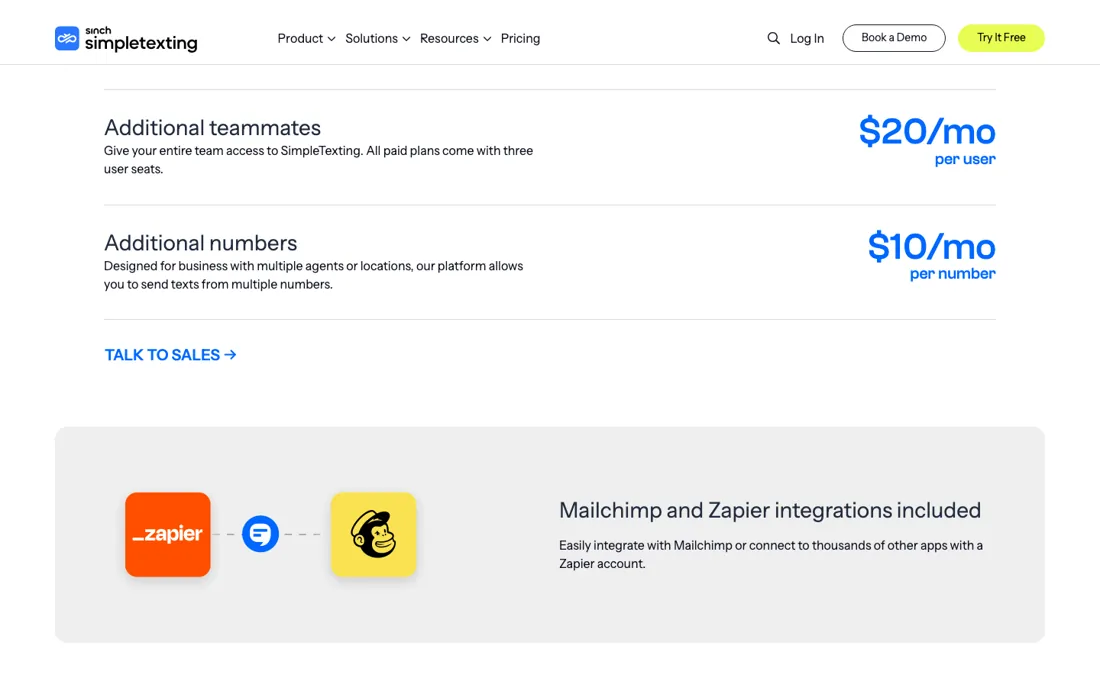
The rollover rule the page states is for monthly plans: unused plan credits roll over until the end of the following month. Every paid plan includes three user seats, with additional seats at $20/mo and additional numbers at $10/mo; a local number carries a $4 activation fee and there is a separate one-off $4 carrier (10DLC) registration. A toll-free number has no additional monthly fee but carrier approval can take up to a week; dedicated short codes begin at $1,000/mo and take 6-8 weeks to provision.
Carrier fees are passed through without markup at roughly $0.0025 per message in the US and $0.0068 in Canada. Nonprofits, churches and other tax-exempt organisations get 15% off any monthly plan, and there is a 30-day refund. Plans change — always verify the live price on their site.
Correction after re-checking: Corrected 14 September 2026. The earlier reading treated the $29 on the toll-free solution page and the $39 on the pricing page as a contradiction and told buyers to budget $39. They are not in conflict: the pricing page's own cost breakdown splits its "estimated monthly cost" of $39.00 into $29 for 500 credits and $10 for a local number. The paid floor is the $29 plan; the $10 number, its $4 activation and the one-off $4 10DLC registration sit beside it. The full credit ladder is $29/$49/$79/$109/$229/$399/$549/$899 a month at 500/1,000/2,000/3,000/7,500/15,000/25,000/50,000 credits, with overage tapering from 5.5 to 2 cents. Yearly billing discounts the credit portion by 20% only — $23.20 plus the unchanged $10, billed yearly at $398.40 — and grants the year's credits upfront.
What the price did
We capture SimpleTexting’s own pricing page every month and keep the figures, so this is our record of the page — not a forecast, and not someone else’s summary.
Stable all summer, and the stability was real even though our reading of it was not. Our July and August 2026 captures of SimpleTexting's pricing page are byte-for-byte identical: the same entry tier, the same $4 carrier registration, the same $20 per extra seat and $10 per extra number, and the same $1,000/mo starting point for short codes. The page returned those figures again on 17 August and on 14 September 2026. What changed on 14 September was our own reading: what we had recorded as a $39 entry plan is $29 of credits plus the $10 number.
SimpleTexting’s pricing page, as we read it
What SimpleTexting does
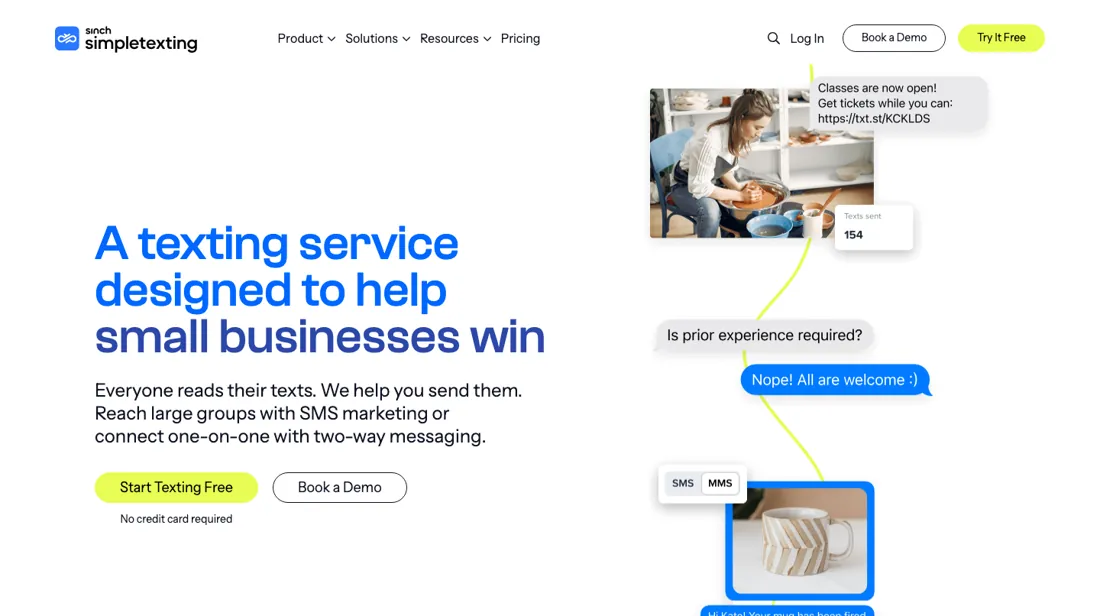
SMS marketing and business texting: run mass-text campaigns, two-way conversations and automations with compliance built in.
What buyers report about SimpleTexting
Recurring themes from the buyer-review sites listed at the foot of this page, read in August 2026. We have not run SimpleTexting ourselves, so this is other buyers' experience rather than ours. We summarise it here because the complaints are usually the part a vendor page leaves out.
- • Quick to set up and easy to run, with unlimited keywords on every tier rather than gated to the top one.
- • Reliable delivery and responsive support are the two things reviewers name most often.
- • Incoming replies are hard to see in the dashboard, and reviewers report missing customer responses because of it. That is the complaint to weigh — it defeats the point of two-way SMS.
- • Delivery delays are reported, which matters for time-sensitive reminders.
- • No permanent free plan — every tier is paid, and what you owe climbs with the tier you need.
- • Overage and MMS charges add up as lists grow, with reviewers asking for better warning before they hit.
When the paid plan is worth it
There is no permanent free plan, so the paid floor has to earn itself back — and the first thing to get right is that the pricing page's $39 is not the plan. Its own cost breakdown splits it into $29 for 500 credits and $10 for a local number, which is why a solution page quoting "$29/month for 500 outgoing SMS messages" is not a contradiction. Tiers scale on volume beside one shared feature list, so paying more buys volume, not capability.
The spend justifies itself for a business with an opted-in list that texts on a predictable rhythm: incoming SMS replies cost nothing, and a bigger bundle drops the overage rate from 5.5 cents a credit at 500 to 2 cents at 50,000. Sporadic sending is the bad fit. What upgrading does not solve is the carrier layer, because no tier removes it: the $10 number, its $4 activation, the one-off $4 10DLC registration, $20 per extra seat and roughly a quarter of a cent per message in pass-through carrier fees sit outside every plan. Annual billing saves 20% on credits only, never on the number.
Our monthly capture read this vendor's pricing page in July 2026 and again in August 2026, and the amounts were the same both times. We keep watching — the registry records what moves.
How to actually use SimpleTexting
Signup takes no credit card, and the 14-day trial is the whole evaluation window, so the number decision comes first. A local 10DLC number costs $10 a month plus a $4 activation fee, with a separate one-time $4 carrier registration on top, and the form asks for a legal company name, an EIN, a website, a customer support email and number, an opt-in method and two sample text messages. The usual stall is a mismatch between the stated use case and the submitted business details; the vendor says registration is often done in a day or less, and activation then takes minutes.
A toll-free number carries no additional monthly fee, but the pricing page warns carrier approval can take up to a week, and carriers cap unverified toll-free traffic until it clears. Once a number is live, the fastest route is a keyword opt-in with a welcome message and a compliance auto-reply. Then go to the Campaigns tab, New campaign, paste the message, choose a contact list, and send now, schedule it, or set it to repeat.
Distilled from SimpleTexting pricing page with its plan calculator read at every volume step and on both billing toggles (simpletexting.com/pricing, 14 September 2026), plus the 10DLC registration guide, the toll-free text messaging solution page and the vendor's first-SMS-campaign help article, read 4 August 2026.
The natural comparison is EZ Texting or Klaviyo SMS — other SMS-marketing tools.
Frequently asked questions
What does SimpleTexting cost?
The plan is $29 a month for 500 credits; the $39 the pricing page shows is that plan plus a $10 local number, which its own cost breakdown spells out. From there the credit tiers run $49 (1,000), $79 (2,000), $109 (3,000), $229 (7,500), $399 (15,000), $549 (25,000) and $899 (50,000) a month. An SMS spends one credit, an extended message up to 306 characters two, and an MMS three. Read on 14 September 2026.
What does it cost for a team, and for extra numbers?
Every paid plan already includes three user seats, which is more generous than most; beyond that it is $20 a month per seat. Numbers are separate: $10 a month each, with a local number carrying a $4 activation fee on top and a one-off $4 carrier registration for 10DLC compliance. Short codes are a different product entirely, starting at $1,000 a month and taking six to eight weeks to provision.
Does annual billing really save 20%?
On the credits, yes; on the bill, not quite. The 20% comes off the credit portion only — at the entry tier $29 of credits becomes $23.20 — while the $10 number is charged in full either way, so the real monthly equivalent is $33.20, billed yearly at $398.40. That is about 15% off the $39 the page prints, not 20%. Annual also hands you the whole year's credits upfront, 6,000 at the entry tier, instead of a monthly allowance: better for seasonal sending, worse if you over-estimated.
Is there a discount for nonprofits?
Yes, and it is stated on the page: nonprofits, churches and other tax-exempt organisations receive 15% off any of the monthly plans. That stacks against the 20% yearly discount as an either/or rather than both, so ask which applies before committing to a year.
What should I weigh before buying Communication & Voice software?
Generally yes, since this category is built for it, but the details that bite are timezone handling, how per-seat cost scales as the team spreads, and whether numbers, routing or coverage exist in the countries your people actually sit in. Availability varies far more by country than the marketing pages suggest, so check your specific regions before committing.
Is this a hands-on review of SimpleTexting?
This is a researched assessment, not a hands-on test — where we've used a tool ourselves, we say so explicitly. We name what each tool is good and bad at, and we earn a commission only if you sign up, at no cost to you.
- Buyer reviews on G2, GetApp and SelectHub, read August 2026.
- Re-verified 2026-09-14 on simpletexting.com/pricing.
- A dated screenshot of that pricing page, kept on this site as the receipt.
Others in this category
Reviewed communication & voice tools that share ground with SimpleTexting — comparable in what they do, not drop-in swaps:
New reviews, price changes we recorded, and the cost conditions we found. No sponsored placements. Unsubscribe anytime.
This is our researched assessment — not a paid placement. The “Visit” links on this page are affiliate links: we may earn a commission if you sign up, at no extra cost to you, and it never changes our take. How we review →