 Sentaro Review (2026)No MX Change, So You Can Test It
The category claim (AI catches what filters miss) is plausible — Microsoft/Google native filtering misses sophisticated BEC — but any vendor's accuracy percentage is measured on their own test set, not your mail flow.
Visit Sentaro → 🎟️ Code SUMMER — Three months free Affiliate link — we may earn a commission if you sign up; it does not change what this page says.
Watch the 2-minute review
The video version of this review, from our YouTube channel.
⚡ Short on time? Watch the 30-second verdict Short.
Pricing (2026)
✓ Pricing re-verified 24 Sep 2026
Priced per protected account, in USD. Pro is $6 per protected account per month after the first account, or $68 per account per year, about $5.67 a month and roughly 5.6% below monthly. The first account stays free. A Free single-user tier (one account, private or company-attached, no card, no expiry) is listed but marked 'coming soon'. Sovereign is custom annual pricing: dedicated EU tenancy, custom DPA and audit support, SIEM export and API access, and a named security engineer.
A protected account is one mailbox Sentaro watches; shared aliases and distribution lists do not count. The page states that every feature is in every plan, and Pro lists cross-vector response (block, quarantine, forced re-auth, session revocation), the admin console, audit trail and reporting, and cancel anytime. Monthly plans stop at the end of the period; purchases through Paddle carry a full refund within 14 days, renewals included.
History: no price was published until August 2026. On 5 September the site showed Professional at $6 monthly or $5.50 annual, with the same numerals offered in euros, and SSO/SCIM, API access and compliance support on a quote-only Enterprise tier; that layout is gone. Plans change — always verify the live price on their site.
SUMMER — Three months free: sign up through our link, enter the code SUMMER, and the first three months cost nothing. Sentaro supplied this via PartnerStack on 24 Aug 2026 and gave no end date for it. Read the shape of it before you count on it. It is three free months, not a discount on the rate — the normal price applies from month four, and that price is the one thing you still cannot look up, because Sentaro publishes none and sells on a quote. So the free period is worth more as a test window than as a saving, and it happens to be exactly the right shape for the test this product allows: Sentaro reads the mailbox through the Google Workspace or Microsoft 365 API rather than changing your MX records, so you can run it beside your existing filtering and count real catches against false positives before anyone signs anything. Ask for the per-mailbox rate, the term and the renewal price in writing while the three months are still running — that evidence is your whole negotiating position, and it expires when the free period does. for referrals, verified in the partner dashboard. What the pricing page doesn’t say
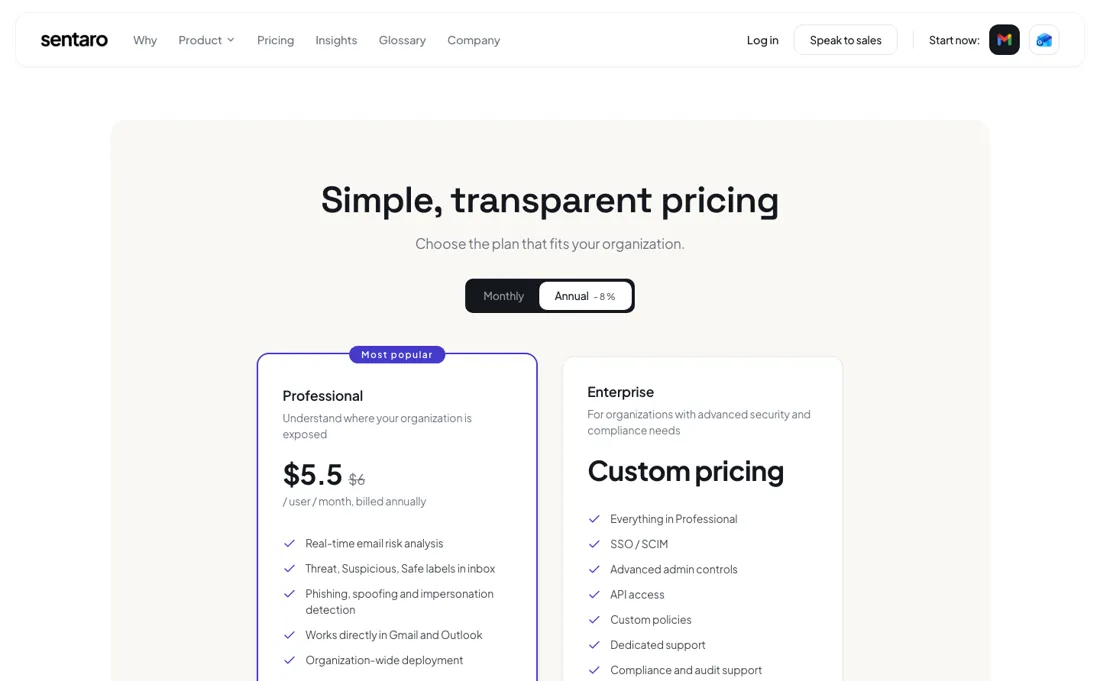
The honest procurement move: run their trial alongside your current filtering, count real catches and false positives for two weeks, and price per mailbox against the incumbents with that data in hand.
What Sentaro does
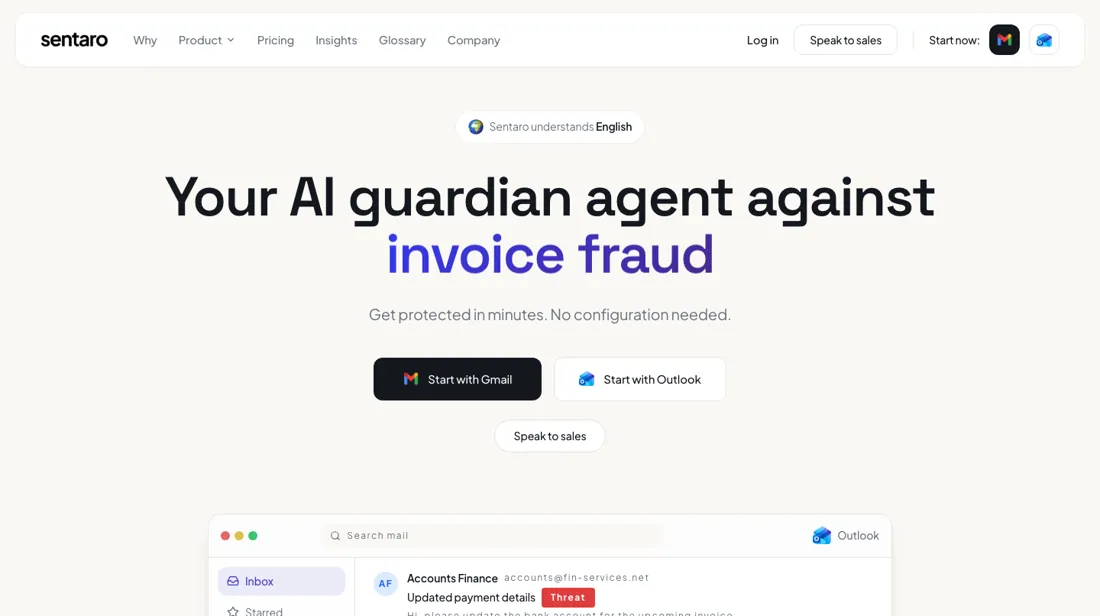
Email threat detection that flags phishing, risky and malicious messages right in your inbox. Surfaces the dangerous emails that look perfectly normal — before anyone clicks.
What buyers report about Sentaro
Recurring themes from the buyer-review sites listed at the foot of this page, read in August 2026. We have not run Sentaro ourselves, so this is other buyers' experience rather than ours. We summarise it here because the complaints are usually the part a vendor page leaves out.
- • $6 per protected account per month with no MX or DNS change required — it layers onto Google Workspace or Microsoft 365 rather than sitting in front of your mail flow.
- • Purchases through Paddle carry a full refund within 14 days, which is a real guarantee rather than a policy page.
- • The independent review base is very thin. There is not enough outside evidence here to lean on, so trial it against your own inbound mail.
- • Being a layer rather than a gateway is a design choice with trade-offs — it cannot block before delivery the way an MX-level filter can. Judge it on what it catches after arrival.
No MX change means you can actually test it
Sentaro rebuilt its pricing in September, and the new version is simpler than the one it replaced. Read 24 September 2026, Pro is $6 per protected account per month or $68 per account per year, and the first account is free. A protected account is one mailbox; shared aliases and distribution lists do not count. Annual saves $4 per account a year, about 5.6%, which is not much of a reason to commit before a trial has proved itself.
The larger change is what the $6 now covers. On 5 September, SSO, SCIM, API access and audit support sat on a quote-only Enterprise tier. The new page says every feature is in every plan, and Pro lists block, quarantine, forced re-auth and session revocation plus the admin console, audit trail and reporting. What stays on the custom-priced Sovereign plan is contractual rather than functional: dedicated EU tenancy, a custom DPA and audit support, SIEM export, API access and a named engineer.
The page no longer mentions SSO or SCIM at all, so ask whether they exist before assuming they are in the $6. What paying does not fix is what is not built yet. Two of the four vectors, Identity and Behavioral, are marked for general availability in Q4 2026, and SOC 2 and ISO 27001 are listed as in progress with an evidence pack on request. No plan buys those sooner.
If an auditor is part of why you are buying, get the dates in writing.
How to actually use Sentaro
Connect one mailbox first, then run it alongside what you already have. Sentaro connects over the Google Workspace or Microsoft 365 admin APIs in about four minutes, with no agents and no MX changes, so your existing gateway stays in place and both see the same mail. Sentaro's own FAQ says you do not have to remove a secure email gateway; most customers retire it later, once the engine has proven itself on live traffic.
Keep score for two full weeks in two columns. Real catches: messages your current filtering delivered that this one labels Threat or Suspicious, and whether a person would plausibly have fallen for each. False positives: legitimate mail it held, and how long release took. Sentaro also inventories the OAuth grants in your tenant, so read that list in week one; an abandoned integration that still reads mail is a finding in its own right.
Price it on mailboxes, not people. At $6 per protected account after the first, 50 mailboxes is $294 a month, or 49 x $68 = $3,332 a year on annual. Start monthly: annual saves only $4 per account, and a Paddle purchase has a 14-day refund window. Before you sign, confirm SSO or SCIM if you need them, since the pricing page mentions neither, and ask for the SOC 2 and ISO 27001 dates.
Distilled from Sentaro's own site, re-read 24 September 2026. The pages are now server-rendered and read in full with a plain fetch: sentaro.com/en/pricing (the Free, Pro and Sovereign plans, 'Prices in USD, per protected account', the Q4 2026 general-availability note for the Identity and Behavioral vectors, and the FAQ on what counts as a protected account, where data lives, keeping a gateway, deployment time and cancellation), the homepage (the four vectors, hosting in Sweden, per-tenant encryption keys, SOC 2 and ISO 27001 marked in progress) and sentaro.com/en/legal/refunds (a full refund within 14 days of a purchase through Paddle, renewals included, requested at legal@sentaro.com). The site was rebuilt between our two readings: the 5 September reading, in the browser panel, showed a Professional/Enterprise split, a $ / EUR switcher with identical numerals, Google CASA certification, ISO 42001 as coming soon and an 'up to 90% fewer false positives' figure. None of those appear on the 24 September pages, so none of them is repeated here.
The natural comparison is IRONSCALES or Abnormal — the established API-based email-security players — compare detected-in-YOUR-inbox counts from parallel trials, not brochure accuracy.
Frequently asked questions
Do shared mailboxes and distribution lists count as paid accounts?
No. Sentaro's pricing FAQ, read 24 September 2026, defines a protected account as one mailbox it watches and says shared aliases and distribution lists do not count, so most organisations pay for fewer accounts than they have people. The first protected account is free, and each one after it is $6 a month on Pro, or $68 a year. A team of ten people with a shared sales@ and support@ address therefore pays for nine accounts: $54 a month.
Where is our mail processed, and does anyone at Sentaro read it?
In the EU, and by software. The pricing FAQ and homepage, read 24 September 2026, say training and inference run on EU-sovereign compute hosted in Sweden, that your signals never leave Europe and are never used to train third-party models, and that nobody at Sentaro reads your mail in the course of providing the service. The one exception it names: a slice of anonymised data can be reviewed for forensic analysis, and the DPA says when and by whom, so read that clause. Data is encrypted at rest with per-tenant keys and with TLS 1.2 or later in transit. SOC 2 and ISO 27001 are still listed as in progress.
Can we get our money back if it does not work out?
Yes, within 14 days of paying. Sentaro's refund policy, read 24 September 2026, gives a full refund within 14 days of a purchase made through Paddle, with no reason required, if you email legal@sentaro.com inside that window, and it applies to renewals as well as first purchases. Separately, the pricing FAQ says you can cancel any time: monthly plans stop at the end of the period, and annual plans follow the refund policy. So on annual, the 14 days after each yearly charge are your only way back.
What should I weigh before buying IT & Productivity software?
Judge it on evidence rather than adjectives. Look for a published security page, single sign-on and role controls on the plan you would actually buy (they are often gated to higher tiers), a status page with real incident history, and a clear answer on where your data is stored. If the tool will hold anything sensitive, those four answers matter more than any feature comparison.
Is this a hands-on review of Sentaro?
This is a researched assessment, not a hands-on test — where we've used a tool ourselves, we say so explicitly. We name what each tool is good and bad at, and we earn a commission only if you sign up, at no cost to you.
- Buyer reviews on software-directory reviews, read August 2026.
- Read 24 September 2026 on sentaro.com/en/pricing.
- A dated screenshot of that pricing page, kept on this site as the receipt.
Others in this category
Reviewed it & productivity tools that share ground with Sentaro — comparable in what they do, not drop-in swaps:
New reviews, price changes we recorded, and the cost conditions we found. No sponsored placements. Unsubscribe anytime.
This is our researched assessment — not a paid placement. The “Visit” links on this page are affiliate links: we may earn a commission if you sign up, at no extra cost to you, and it never changes our take. How we review →