Payoneer Review (2026)Free Account, 1% Fee, Checked Sep 2026
 By Daan Haket · Researched and written with an AI assistant · who does what
The conversion and cross-currency withdrawal markups are where it quietly costs you — for pure currency conversion a specialist like Wise is often cheaper. Payoneer earns its keep on marketplace payouts and getting paid by international clients, less so as an FX tool. Throughout this review we weigh it against PayPal.
freelancers and sellers getting paid by international clients and marketplaces (Amazon, Upwork, Fiverr) who need local receiving accounts.
your main need is cheap currency conversion — a specialist FX account usually beats Payoneer's conversion markup.
Transparency: the “Visit” links on this page are affiliate links — we may earn a commission if you sign up, at no extra cost to you. No vendor can pay for a better review or verdict. How we make money →
Pricing (2026)
✓ Pricing re-verified 2 Oct 2026
| Plan | Price | What you get |
|---|---|---|
| Employer of Record | from $199 per employee a month | 110+ countries; pricing may vary by country, services and engagement type |
| Agent of Record | from $99 per contractor a month | 160+ countries; pricing may vary by country, services and engagement type |
| Contractor Management System | from $19 per contractor a month | pricing may vary by country, services and engagement type |
Summarised from the pricing notes below; the notes carry the conditions.
Free to open; the cost is in the fees. Receiving into a receiving account in your local currency is free, in a currency that is not your local currency 1% (minimum $1). Receiving by credit card or PayPal up to 3.99% + $0.49; by US ACH bank debit or an EU or UK bank account 1%. Withdrawing to a bank account in your own country and currency $1.50 flat; to a bank account in another country or currency 1.2%-4%, even when no conversion happens, and in some countries a minimum fee of up to $20 may apply.
Moving funds between your own Payoneer balances 0.50%. Card purchases up to 1.8% without conversion and up to 3.5% with; cash withdrawals $3.15 / €2.50 / £1.95 / C$3.15 / ¥470 on top of that percentage; annual card fee $29.95, replacement card $12.95, additional virtual cards free. Annual account fee $29.95, charged only if less than $6,000 arrives in any 12 consecutive months and not charged in the first year on paid annual plans.
Full pricing notes (2 more paragraphs)
Certain US customers, depending on registration date, instead pay a flat $1.50 per withdrawal or payment up to $50,000 a month and up to 0.5% above that. Businesses moving over $50K a month are pointed at a custom package. Workforce Management is a separate product line with its own price list, read on payoneer.com/workforce-management/ on 5 September 2026: Employer of Record from $199 per employee a month (110+ countries), Agent of Record from $99 per contractor a month (160+ countries), and the Contractor Management System from $19 per contractor a month, all three 'starts at' figures behind a demo and marked 'pricing may vary by country, services and engagement type'.
Our partner link on this page belongs to that Workforce Management programme, so it lands on the workforce partners page rather than on the free payments account. Re-read on 2 October 2026 with every fee above unchanged. The card section now also states that card purchases are free where the merchant country matches the card's issuing country, that an ATM balance check or decline costs $1.00 / €0.80 / £0.65, and that a replacement card is $12.95 / €9.95 / £9.95.
Plans change — always verify the live price on their site.
What the price did
We capture Payoneer’s own pricing page every month and keep the figures, so this is our record of the page — not a forecast, and not someone else’s summary.
Payoneer's fee page carried the same 'Last updated on 1 January 2026' stamp at both of our readings, 14 September and 2 October 2026, and no fee on it moved between them: 1% (minimum $1) to receive in a non-local currency, up to 3.99% + $0.49 by card or PayPal, $1.50 for a local withdrawal, 1.2%-4% cross-border with a minimum of up to $20 in some countries, 0.50% between balances, and $29.95 for both the annual account fee and the annual card fee. What moved was the address: the page now lives at payoneer.com/pricing/.
Payoneer’s pricing page, as we read it

Watch the video review
The video version of this review, from our YouTube channel.
⚡ Short on time? Watch the 30-second verdict Short.
What Payoneer does
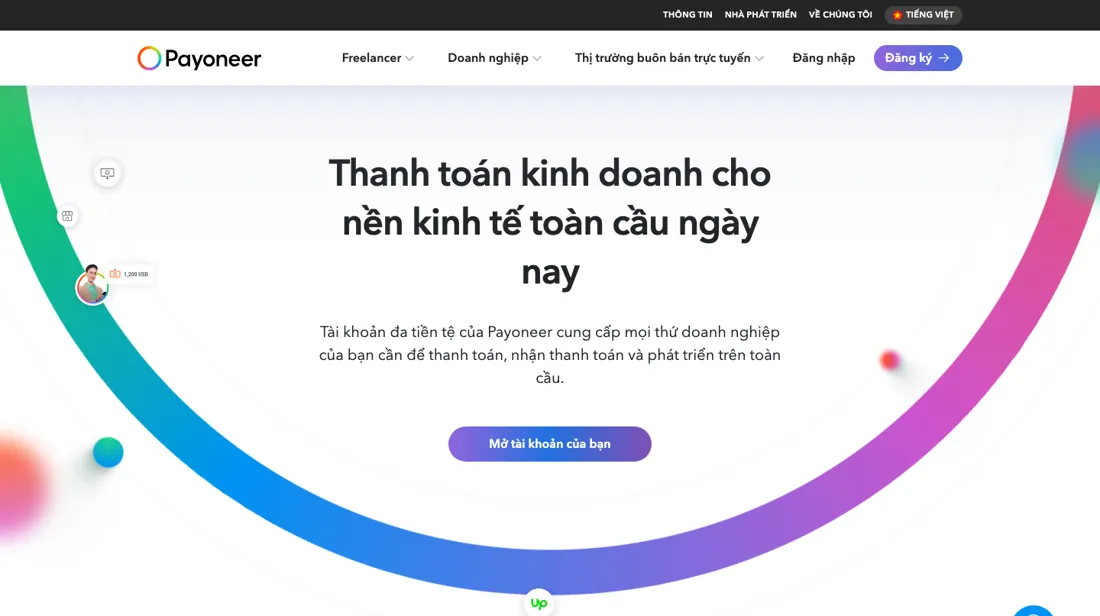
Local receiving accounts for freelancers and sellers paid by international clients and marketplaces.
What buyers report about Payoneer
Hands-on: not tested by usReported by buyers: Trustpilot, Capterra, TrustRadius, NerdWallet and SourceForge, read August 2026
Themes from the buyer-review sites listed at the foot of this page, read in August 2026. We have not run Payoneer ourselves, so this is other buyers' experience rather than ours. We summarise it here because the complaints are usually the part a vendor page leaves out.
- • Transfers land quickly and reliably when nothing is flagged, and that is what most of the 59,000+ Trustpilot reviewers are rating.
- • Getting paid from marketplaces and platforms that will not do a normal bank transfer is the job it does well.
- • On SourceForge the recurring reason to stay is reach rather than price: reviewers name Fiverr, Amazon, Upwork and Airbnb by hand as payers they could not otherwise collect from, plus the Visa card that turns the balance into spendable money without a bank in the loop.
- • Roughly 75% of negative reviewers name account freezes or blocked funds as their main complaint. Re-verification can freeze an account precisely while money is in transit, and escalations drag for weeks. Do not run your only account here.
- • The fee stack: 1% on non-local currency (minimum $1), up to 3.99% + $0.49 on card, $1.50 flat to withdraw same-country same-currency, and 1.2-4% on conversion. Annual fee $29.95, waived if at least $6,000 arrives in twelve months.
- • Early 2026 brought reports of hacked accounts and unauthorised transfers, one of $4,300. Enable every security control on offer.
- • SourceForge carries the sharpest complaint about small amounts we have read anywhere: one reviewer describes 132 euros arriving, only 101 being transferable, and 73 landing in the bank. Whatever the account specifics behind it, it is the shape of the problem — the fee floors are fixed, so the smaller the payout, the worse the percentage.
Pages read (August 2026): Trustpilot
When the paid plan is worth it
There is no plan to upgrade to — Payoneer is free to open and earns on fees, so "is it worth it" is a question about volume, not tiers. The number that decides it is the annual account fee: $29.95, charged only for a 12-month window in which less than $6,000 arrives, and not charged in the first year on paid annual plans. Against that, the fee stack on their own page: receiving into a local-currency receiving account is free, 1% (minimum $1) in any other currency, up to 3.99% + $0.49 by card or PayPal, $1.50 flat to withdraw in your own country and currency, and 1.2-4% on any cross-border withdrawal.
On $2,000 a month of card-paid work the receiving fee alone is roughly $80. What no amount of volume fixes is the floor under each fee: a cross-border withdrawal carries a minimum of up to $20 in some countries. The honest test is access rather than price. If a platform will not send a normal bank transfer to your country, the 1% is the cost of getting paid at all; if your payer can send SEPA or local ACH, an ordinary business account wins on every line.
How to actually use Payoneer
Two things are worth doing in the first week, and both are about the day something goes wrong rather than the day you sign up. First, finish verification completely before money is in transit. Account reviews and re-verification requests can land precisely while a payment is arriving, and a balance that is frozen mid-transfer is what makes them expensive. Upload every document they ask for while nothing is at stake.
Second, never make Payoneer the only route to your own money. Keep a second account that can receive the same payments, so a review that runs for weeks is an inconvenience rather than a cashflow event, and turn on every security control the account offers on day one. Then check which receiving method your payer will actually use, because it is the largest single fee lever and the payer usually chooses it, not you.
A receiving account in your own local currency costs nothing; the same account in another currency costs 1%; a card or PayPal payment costs up to 3.99% + $0.49. Ask before you invoice.
Distilled from Payoneer's own fee and pricing page (payoneer.com/about/pricing/, re-read 14 September 2026, itself stamped "Last updated on 1 January 2026") plus their published receiving-method documentation, read 2 August 2026. Fee page re-read 2 October 2026 at payoneer.com/pricing/ (served HTML for every fee section, plus a headless browser), still stamped 'Last updated on 1 January 2026'.
The natural comparison is Wise — the low-markup currency-conversion specialist. Weigh it against PayPal on the job you actually need done.
Frequently asked questions
Is Payoneer cheaper than Wise if I am not converting currency?
Not automatically, and this is the line most comparisons get wrong. On the fee page we re-read on 14 September and again on 2 October 2026, a withdrawal to a bank account in another country costs 1.2%-4% even when no conversion happens — Payoneer's own example is UK to Singapore, SGD to SGD — and in some countries a minimum fee of up to $20 applies on top of that. Only a withdrawal inside your own country and currency is the $1.50 flat fee. So the question is which corridor you are paid through, not whether currency changes hands.
What does Payoneer cost if money only arrives now and then?
The annual account fee is $29.95 and it applies only if less than $6,000 arrives in any 12 consecutive months; it is not charged in the first year on paid annual plans. Read the card line separately: the physical card carries its own $29.95 annual fee, so a light user who also holds the card can meet $29.95 twice on the same page.
Do the fees make small payouts uneconomic?
That is what the fee floors do, and it is what the sharpest reviews are about. Receiving carries a 1% fee with a $1 minimum, ATM withdrawals add a fixed $3.15 / €2.50 / £1.95 on top of a percentage, and a cross-border payout starts at 1.2% with a minimum of up to $20 in some countries. On a €100 payout those floors are a double-digit percentage; on a $5,000 one they round to nothing. Run your own number before assuming either verdict.
What is Payoneer Workforce Management, and what does it cost?
Three products for paying people abroad, read on 5 September 2026: Employer of Record hires full-time staff through Payoneer's local entity from $199 per employee a month in 110+ countries; Agent of Record engages contractors through their entity with classification and contract support from $99 per contractor a month in 160+ countries; and the Contractor Management System, where you hold the contract yourself and Payoneer runs payments, invoices and expenses, from $19 per contractor a month. All three are 'starts at' prices behind a demo, and the pages say pricing varies by country, role and engagement type — so treat $199 as the floor for an easy country, not the number on your invoice. The free payments account and its fees above are a different product.
Is this a hands-on review of Payoneer?
This is a researched assessment, not a hands-on test — where we've used a tool ourselves, we say so explicitly. We name what each tool is good and bad at, and we earn a commission only if you sign up, at no cost to you.
- Buyer reviews on Trustpilot, Capterra, TrustRadius, NerdWallet and SourceForge, read August 2026.
- Re-verified 2026-10-02 on payoneer.com/pricing/, where the older payoneer.com/about/pricing/ address now redirects; the page itself carries "Last updated on 1 January 2026".
- A dated screenshot of that pricing page, kept on this site as the receipt.
Others in this category
Reviewed financial operations tools that share ground with Payoneer — comparable in what they do, not drop-in swaps:
New reviews, price changes we recorded, and the cost conditions we found. No sponsored placements. Unsubscribe anytime.
This is our researched assessment — not a paid placement. The “Visit” links on this page are affiliate links: we may earn a commission if you sign up, at no extra cost to you, and it never changes our take. How we review →