 monday.com Review (2026)
The seat price is not the product price.
Visit monday.com → Affiliate link — the rest of this page is the honest version, including who should skip it.
Watch the 2-minute review
Same honest take, in video form — from our YouTube channel.
⚡ Short on time? Watch the 30-second verdict Short.
Pricing (2026)
✓ Pricing re-verified 26 Aug 2026
Free covers two seats. Basic is $9 per seat a month, a total of $90; Standard $12, down from $14, for $120 instead of $140; Pro $19, down from $22, for $190 instead of $220. Enterprise is quoted. The seat count is the thing to watch: the per-seat figure moves with team size, so a price read at ten seats is not what three or fifty will cost.
Yearly billing is marked as 18% off, and each paid tier carries its own monthly AI-credit allowance rather than selling AI separately. Plans change — always verify the live price on their site.
What the pricing page doesn’t say
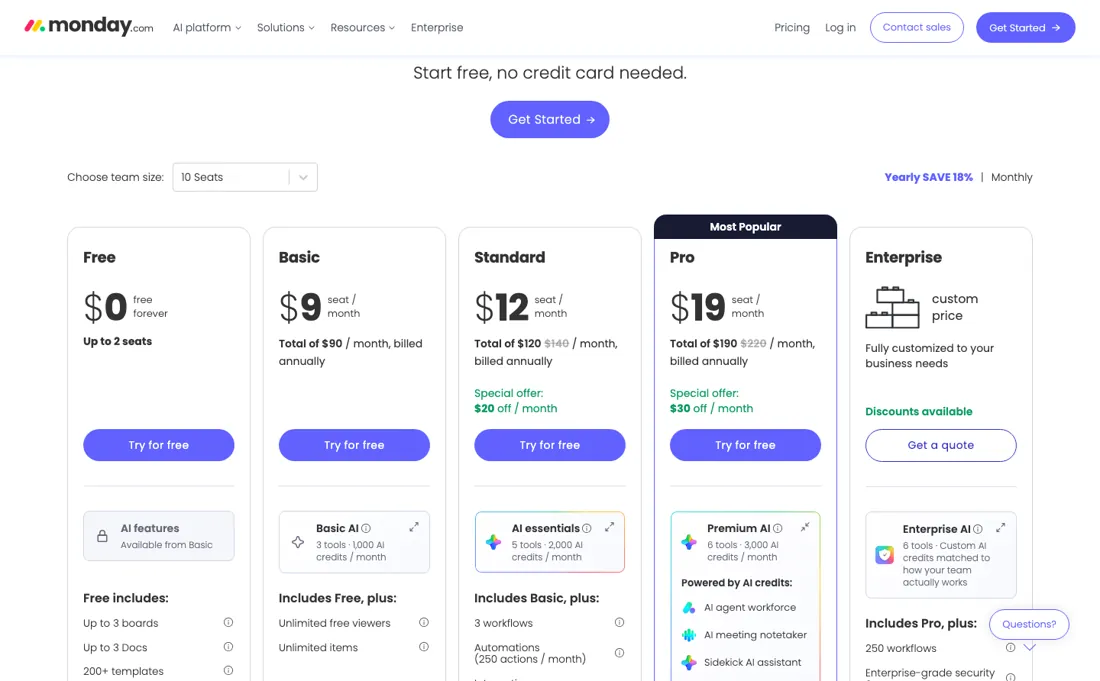
monday sells four products — Work Management, CRM, Dev and Service — each on its own subscription, and the $9 you see first is the cheapest tier of one of them. A sales team that wants the CRM is buying a second subscription on top of whatever Work Management costs, with a three-seat minimum of its own. The second number to find before you commit is the automation cap. Standard allows 250 automation actions a month across the whole account.
If you are buying monday because of the automations you saw demoed, 250 is roughly one workflow running a few times a day — and the next step up is Pro at $19 a seat against Standard's $12. Free is capped at two seats and three boards, which makes it a preview rather than a plan.
What monday.com does
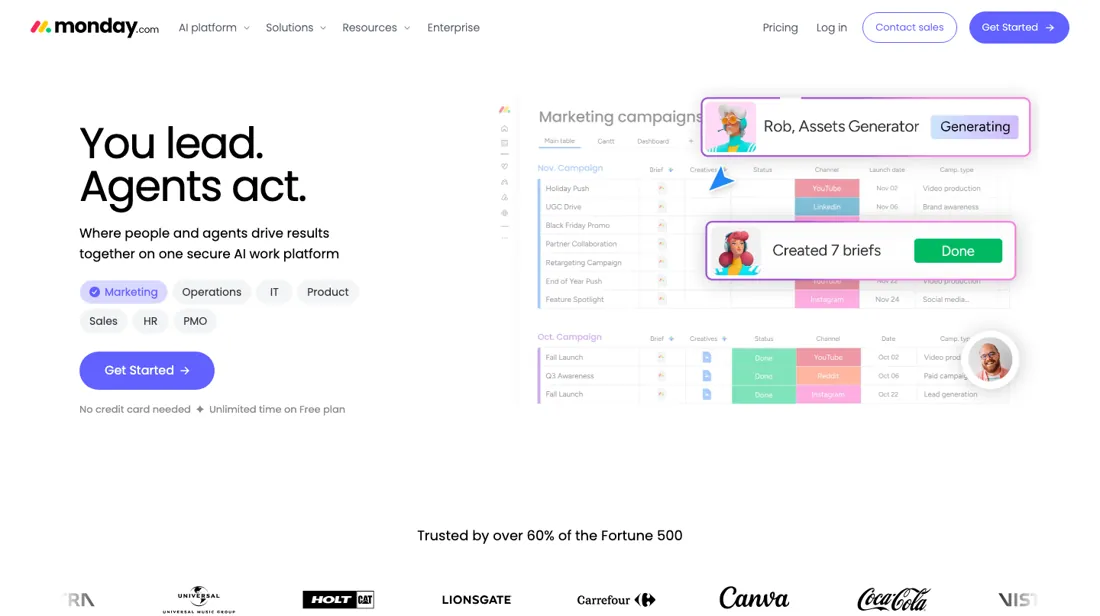
Work management platform with boards, automations and views — plus separately-priced CRM, Dev and Service products.
What buyers report about monday.com
Recurring themes from the buyer-review sites listed at the foot of this page, read in August 2026 (Product Hunt read 13 August 2026). We have not run monday.com ourselves, so this is other buyers' experience rather than ours. We summarise it here because the complaints are usually the part a vendor page leaves out.
- • Boards that non-technical teams actually adopt, and the visual layer is genuinely good — that is why it spreads inside companies.
- • The automation and integration library covers most of what a growing team needs without a developer.
- • On Product Hunt (4.8 across 41 reviews) the concrete praise is that switching between Kanban, timeline and table views does not lose data, and that automations take repetitive status updates and assignment routing off people.
- • Seats are sold in buckets, and it is the single most-criticised thing about the pricing. Minimum three seats, then multiples of five: a team of six pays for ten, a team of sixteen pays for twenty. A solo user pays for three.
- • The features most teams need are gated upward. Automations sit on Standard, time tracking and private boards on Pro — which makes the real entry price closer to $57/month (three Pro seats) than the $27 the headline suggests.
- • Monthly billing costs 18-30% more than annual.
- • Complex automations, newer board views and reporting are hard or impossible on mobile.
- • The free plan is 2 seats and 3 boards with no automations.
- • Product Hunt reviewers say they hit the Pro ceiling sooner than expected once automations and integrations get real — the same wall the automation cap describes, seen from use rather than from the price list.
- • Setup takes longer than expected, especially permissions and folder structure, and reviewers say the onboarding documentation does not front-load that.
- • Support is described there as thin and hard to reach.
When the paid plan is worth it
On Work Management the ladder is $9, $12 and $19 per seat a month billed annually, and what moves between them is automation volume rather than features you can name. Basic buys unlimited items and unlimited free viewers. Standard adds timeline and Gantt views, calendar, guest access and 3 workflows, but automations and integrations are capped at 250 actions a month. That ceiling is the reason most teams end up on Pro, where the same meters read 25,000 and workflows go to 20.
Pro also brings private boards, time tracking and 10,000 API calls a day against Standard's 1,000. The part the seat price does not cover is AI. Each tier now carries an AI credit allowance — 1,000, 2,000 and 3,000 a month — and the page prices credits as a separate line, 1,000 credits at $10 (2,000 at $20 and 3,000 at $30), each currently cancelled out by a “Special monthly discount” of exactly the same amount.
Read the totals arithmetic on the page before budgeting: when that offer lapses, AI credits become a real charge on top of seats.
How to actually use monday.com
The free tier is where to start and it is deliberately small: up to 2 seats, up to 3 boards and 3 docs, 8 column types, and the 200+ template library. That is enough to model one real process end to end, which is the only honest test. Build the first board from a template rather than blank, because the templates carry the column types and views that make the rest make sense.
Add people as viewers before you add them as seats — viewers are free and unlimited from Basic upward and have read-only access, so stakeholders who only look at status never need a paid seat. Leave automations until the process is stable: from Standard they meter at 250 actions a month, which a chatty board can burn through quickly, and the jump to 25,000 is a whole tier. Mobile apps for iOS and Android are included from Free.
Distilled from Vendor pricing page for Work Management, including its per-tier feature lists and the seat-and-credit totals arithmetic (monday.com/pricing), read 26 August 2026.
monday.com vs ClickUp, side by side
Both columns come from the same place: each vendor’s own published pricing, read on the date shown in the sources at the foot of this page. We do not average them into a score.
Both names above are affiliate links: we may earn a commission if you sign up, at no extra cost to you. Neither changes what this table says: both columns come straight from the vendors’ own pricing pages.
The natural comparison is Asana or ClickUp — the standing comparison in work management — judge on the automation cap at the tier you would actually buy, not on the headline seat price.
More on monday.com
Everything we publish about monday.com links back here — the review stays the honest hub:
The ex-banker filter — the same yardstick on every review (how we review): My ex-banker filter is simple: does monday.com remove a real cost — time, errors, missed revenue — bigger than what it charges?
Frequently asked questions
Is $9 a seat the real entry price?
Only for the cheapest tier of one of four products, and only on annual billing. Read on 26 August 2026 from a US connection: Work Management is Basic $9, Standard $12 and Pro $19 per seat a month, with the Yearly toggle marked 18% off and Free capped at 2 seats and 3 boards. The other three products we read the same day from Europe, where monday prices them in euros: monday CRM is a separate subscription at €12, €17 and €28 a seat annually (€18, €25 and €41 monthly) with a three-seat minimum; monday Dev is €9, €12 and €20; monday Service starts at €31 and runs to €45. monday prices on the visitor's IP, so read the symbol as the one you will be charged in rather than as a conversion. A team that wants projects and a CRM is buying two subscriptions, not one.
Which tier do I need if I am buying it for the automations?
Standard allows 250 automation and integration actions a month across the whole account — roughly one workflow firing a few times a day. Pro lifts that to 25,000 and Enterprise to 250,000. If the demo that sold you was an automation, price Pro at $19 a seat rather than Standard at $12, because the tier below it will run out in the first month.
Is the free plan enough to start on?
It is a preview rather than a plan: 2 seats, 3 boards and 3 docs, with no automations. A third colleague forces a paid tier, and if what you actually want is the CRM, that product starts at a three-seat minimum before you compare anything else.
What should I weigh before buying Project Management software?
Judge it on evidence rather than adjectives. Look for a published security page, single sign-on and role controls on the plan you would actually buy (they are often gated to higher tiers), a status page with real incident history, and a clear answer on where your data is stored. If the tool will hold anything sensitive, those four answers matter more than any feature comparison.
Is this a hands-on review of monday.com?
This is a researched assessment, not a hands-on test — where we've used a tool ourselves, we say so explicitly. We name what each tool is genuinely good and bad at, and we earn a commission only if you sign up, at no cost to you.
- Buyer reviews on Capterra, G2, pricing analyses and Product Hunt, read August 2026 (Product Hunt read 13 August 2026).
- Read 2026-08-26 on monday.com/pricing over a US connection, at their default of 10 seats on yearly billing.
- A dated screenshot of that pricing page, kept on this site as the receipt.
New dossiers, cost-traps we found, and tools that earned a keep — no hype, no sponsored-disguised-as-advice. Unsubscribe anytime.
This is our researched assessment — not a paid placement. The “Visit” links on this page are affiliate links: we may earn a commission if you sign up, at no extra cost to you, and it never changes our take. How we review →