 Lovable Review (2026)Hands-On Against Replit and Emergent
You do not know what a change costs until it is done. Throughout this review we weigh it against Bubble.
Pricing (2026)
✓ Pricing re-verified 26 Sep 2026
Free: 5 build credits a day, capped at 30 a month, which do not roll over; plus a monthly Cloud grant of 20 credits for hosting and backend services and 4 credits for AI features inside published apps. Pro starts at 25 euros a month for 100 credits, with a dropdown of larger credit tiers: 200 for 50 euros, 400 for 100 euros and 800 for 200 euros keep the same 25 cents a credit, and the discounts only start at 1,200 credits for 294 euros (2%), rising to 10% at 5,000 credits for 1,125 euros.
Pro adds custom domains, removing the Lovable badge, credit rollover for one month, on-demand top-ups and user roles. Business starts at 50 euros a month for the same 100 credits and adds SSO, a security center, internal-only publishing and personal projects. Enterprise is a platform fee on volume pricing. Yearly billing is advertised as two months free. What a message costs depends on the work: the documentation gives about 0.50 credits for a styling change, 1.20 for adding authentication and 2.00 for a landing page with images, and Plan mode costs 1 credit a message. Plans change — always verify the live price on their site.
What the pricing page doesn’t say
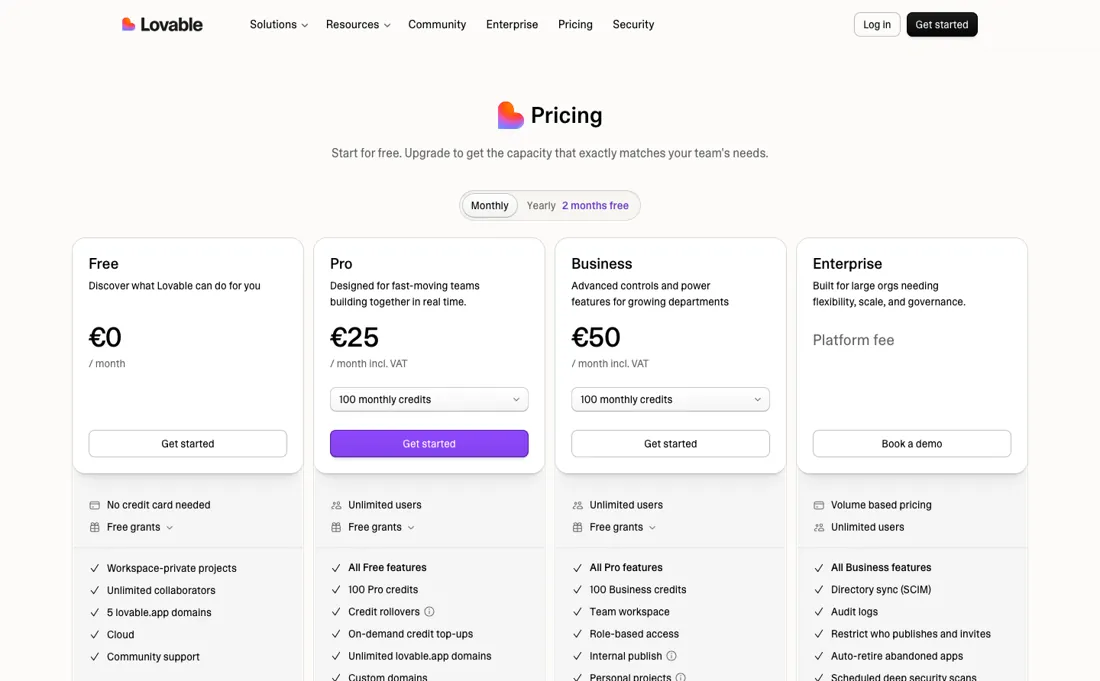
Lovable prices each build message by the work it turns out to involve, from about half a credit for a styling tweak to two credits for a page with images, so a credit budget is an estimate, not a price list. The second catch is easy to miss: the app you publish runs its database, hosting and AI features on a separate monthly Cloud grant of 20 credits. Lovable's own documentation says a published app stays live when those credits run out, but its backend services and AI features pause, so an app that works on day one can stop saving data later in the month.
The larger Pro tiers are no cheaper per credit until 1,200 credits a month, so buying ahead saves nothing below that.
What Lovable does
AI app builder that turns a written description into a web app with a database and hosting, published to a lovable.app address in one click. Billing is in credits whose cost per message depends on the work, and a published app's backend runs on a separate monthly Cloud allowance.
When the paid plan is worth it
Pay when one of three limits bites. The free plan's 30 build credits a month are enough to build and publish a small app (our booking app took 4), but not to keep changing it. A custom domain and removing the Lovable badge both need Pro. And if the app's backend runs out of the 20 free Cloud credits a month, its data and AI features pause until you top up.
Pro at 25 euros for 100 credits is the step for all three; buy the tier you actually use, because every tier up to 800 credits costs the same 25 cents a credit and the first discount is 2% at 1,200. Business costs double for the same 100 credits and is only worth it for SSO, internal-only publishing or a security center.
What we found running Lovable ourselves
On 26 September 2026 we built the same class-booking web app in Lovable, Replit and Emergent from one identical prompt, each on its free plan, and checked every result against 18 tests we wrote down before the first build. We changed no code: the builder only got our prompt. Lovable does not pay us.
- Lovable built and published the app in about ten minutes and used 4 of the 10 credits on a new account. It asked twice, to create the project and to publish, and published to a lovable.app address that stays online on the free plan with an 'Edit with Lovable' badge.
- It was the only one of the three whose first version held the limit when ten people booked an eight-spot class at the same moment: eight accepted, two refused with 'Sorry, this class is full.' The other two accepted all ten.
- It checked input on the server as well as in the form (a name of only spaces and a bad email were refused), kept the admin password out of the page and scripts, and prefixed CSV values starting with = + - or @ so a spreadsheet does not run them as formulas.
- It needed no repair round. After republishing, every test booking was still there.
What this test does not show: One run on one day on the free plan. Not a security audit or a load test, we did not measure how fast the 20 monthly Cloud credits run down, and code export was only checked in the documentation.
The full three-builder test, check by check →
Most of our reviews are researched rather than run — how we review explains which is which, and why we do not pretend otherwise.
How to actually use Lovable
Write what you want as a numbered list of requirements rather than a paragraph, and say what to leave out; in our test Lovable followed eight numbered requirements and skipped payments, email and accounts as asked. Starting from the dashboard, it asks to create a project and later asks before publishing; both are one click. Expect it to fill gaps itself: it invented a studio name, a temporary admin password and a time zone, and said so in its summary, so replace those before anyone else sees the app.
Lovable itself advises running its security scan before sharing a link widely. Then test the awkward case yourself: two people taking the last spot at the same moment, or whatever the equivalent is in your app.
Distilled from Vendor pricing page https://lovable.dev/pricing (read 2026-09-26 from a European exit: euros incl. VAT, Pro credit dropdown read in full); Lovable documentation, Plans and credits https://docs.lovable.dev/introduction/plans-and-credits (read 2026-09-26); Lovable documentation, GitHub integration https://docs.lovable.dev/integrations/github (read 2026-09-26: GitHub sync on all plans, direct code download on paid plans). Hands-on: our own build on a new free account on 2026-09-26, see /research/one-booking-app-three-ai-builders/.
Lovable vs Emergent, side by side
Both columns come from the same place: each vendor’s own published pricing, read on the date shown in the sources at the foot of this page. We do not average them into a score.
The Emergent link above is an affiliate link — we may earn a commission if you sign up, at no extra cost to you — and the other column is a plain link. Neither changes what this table says: both columns come straight from the vendors’ own pricing pages.
The natural comparison is Replit Agent, Emergent or Bolt — AI app builders that also charge per unit of work; in our one-prompt test of three of them, Lovable's first version was the only one that held a booking limit under simultaneous requests. Weigh it against Bubble on the job you actually need done.
Frequently asked questions
What should I weigh before buying IT & Productivity software?
Judge it on evidence rather than adjectives. Look for a published security page, single sign-on and role controls on the plan you would actually buy (they are often gated to higher tiers), a status page with real incident history, and a clear answer on where your data is stored. If the tool will hold anything sensitive, those four answers matter more than any feature comparison.
Is this a hands-on review of Lovable?
Yes. We used Lovable ourselves on 2026-09-26; the section above reports what we measured in the product, and says where a figure comes from the vendor's own documentation instead. Most of our reviews are researched rather than run; we say which is which. We name what each tool is good and bad at, and we have no affiliate relationship with Lovable — we earn nothing whether you sign up or not.
- Read 2026-09-26 on lovable.dev/pricing from a European exit, so shown in euros including VAT, and in Lovable's plans-and-credits documentation.
- A dated screenshot of that pricing page, kept on this site as the receipt.
- Our own hands-on session with Lovable (2026-09-26), written up in full further down this page.
Others in this category
Reviewed it & productivity tools that share ground with Lovable — comparable in what they do, not drop-in swaps:
New reviews, price changes we recorded, and the cost conditions we found. No sponsored placements. Unsubscribe anytime.
This is our researched assessment — not a paid placement. How we review →