Inworld AI Review (2026)Voice API From $0, Plans From $25
 By Daan Haket · Researched and written with an AI assistant · who does what
The bill is usage on top of the plan, counted on every input character including spaces, punctuation and tags.
developers and product teams building consumer apps with realtime voice, who want text-to-speech, speech-to-text and voice cloning through one API and can start pay as you go before committing to a plan.
you want a finished voiceover tool with an editor rather than an API; or you need guaranteed zero data retention on a mid-tier plan, which the docs tie to Enterprise.
Transparency: the “Visit” links on this page are affiliate links — we may earn a commission if you sign up, at no extra cost to you. No vendor can pay for a better review or verdict. How we make money →
Pricing (2026)
✓ Pricing re-verified 15 Oct 2026
“Payments are non-refundable, except where required by law.”Source: inworld.ai/terms, read 15 Oct 2026
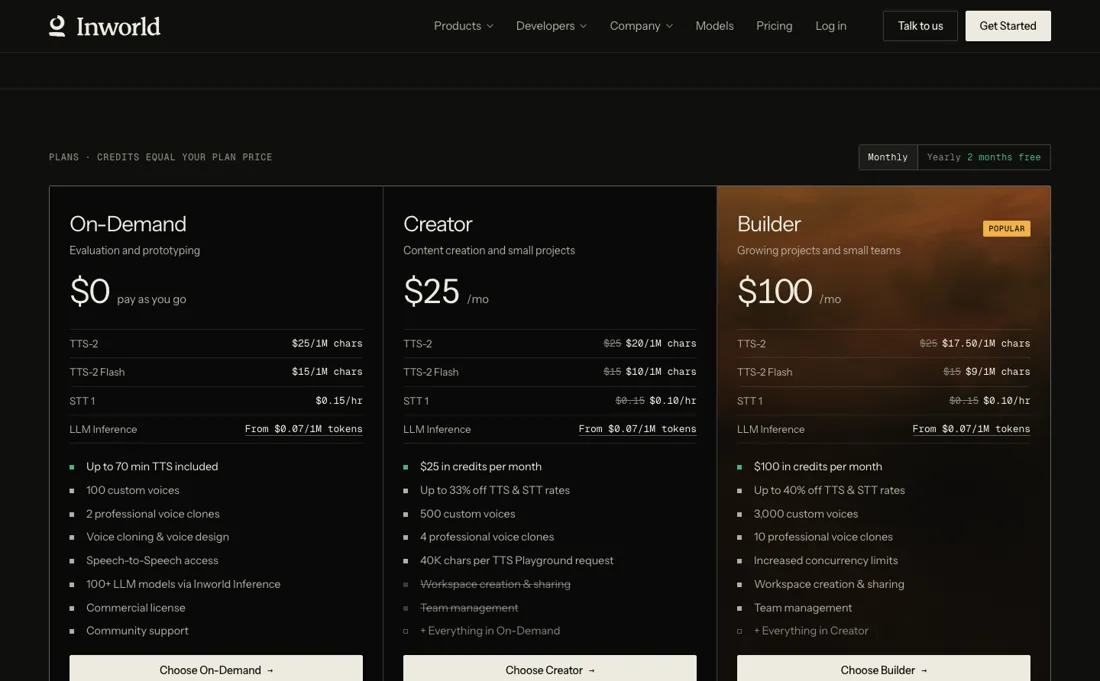
Inworld sells voice and model APIs: text-to-speech, speech-to-text and realtime conversation. On-Demand is $0 and pay as you go: the billing docs say it includes up to 70 minutes of text-to-speech and 400 minutes of speech-to-text free, after which Realtime TTS-2 costs $25 per million input characters, TTS-2 Flash $15 and STT 1 $0.15 an hour of audio. The monthly plans lower those rates and raise the limits.
Creator is $25 a month, with 500 custom voices and 4 professional clones, TTS-2 at $20 and Flash at $10 per million characters. Builder is $100 a month, with 3,000 voices and 10 clones, TTS-2 at $17.50 and Flash at $9. Developer is $300 a month, with 10,000 voices, 25 clones and priority email, TTS-2 at $15 and Flash at $8. Growth is $1,500 a month, with 30,000 voices and 40 clones, TTS-2 at $12.50 and Flash at $7, and lists zero data retention, HIPAA and a BAA as add-ons.
Full pricing notes (2 more paragraphs)
Speech-to-text is $0.10 an hour on every paid plan. Enterprise has custom prices, limits and terms. Paid plans come with credits used across API and Playground products; subscription credits roll over for up to 3 months while an eligible paid plan stays active, and extra credits, bought by hand or by auto-reload, expire a year after purchase. The pricing page also has a yearly view with lower monthly figures, which we did not confirm.
Text-to-speech is counted on input characters, including spaces, punctuation and tags that are not spoken.
Plans change — always verify the live price on their site.
What the pricing page doesn’t say
Credits roll over only while you stay subscribed, cancelling or downgrading forfeits the rest, and payments are non-refundable. The pricing page and the docs disagree on whether zero data retention is a Growth add-on or Enterprise only, and it does not cover requests sent to third-party model providers.
What Inworld AI does
Voice and model APIs for developers building consumer apps: realtime text-to-speech, speech-to-text, voice cloning and realtime conversation, pay as you go or on monthly plans.
Volume, voices and concurrency decide the plan
On-Demand is enough to build and test: no subscription, a free allowance of about 70 minutes of speech, and then the highest per-character rates. A plan is worth it once your monthly usage at On-Demand rates costs more than the plan's price at its lower rates, or when you hit a limit. Creator at $25 a month cuts TTS-2 from $25 to $20 per million characters and doubles concurrent generations from 5 to 10; Builder at $100 raises concurrency to 50, for an app that serves many users at the same moment.
Two terms change the sum. Credits roll over for up to three months only while you keep a paid plan, and cancelling or downgrading forfeits what is left at the end of the period. Payments are non-refundable. Size the plan on a month of real traffic in On-Demand first, and remember that spaces, punctuation and markup tags are billed as characters too.
How to actually use Inworld AI
Inworld's text-to-speech quickstart starts with creating an account, then a Standard API key in the API Keys area of the portal, which you keep in an environment variable on your server rather than in client code. Choose the API that fits the job: speech generation, transcription or a realtime conversation. Realtime sessions have no per-minute or per-session price; you pay for the underlying speech and model use. Before you go to production, follow the production guide: set limits and watch usage by product in the portal.
Concurrency is capped per plan, at 5 simultaneous text-to-speech generations on On-Demand, 10 on Creator, 50 on Builder, 150 on Developer and 500 on Growth. To cancel, open the billing page, click Manage plan and cancel there; it takes effect at the end of the billing period.
Distilled from Inworld's own pages: the homepage inworld.ai, the pricing page inworld.ai/pricing, the terms at inworld.ai/terms, and the documentation at docs.inworld.ai on billing, concurrency limits, zero data retention, the text-to-speech quickstart, the voice API introduction and production readiness, read on 15 October 2026. We did not create an account or an API key and did not call the API. Inworld is an affiliate partner of ours through PartnerStack. We have not used Inworld ourselves.
Inworld AI vs ElevenLabs, side by side
Each column shows the vendor’s own published entry price, read on the date shown. Entry prices can cover different services or units, so check what each one buys. We do not average them into a score.
Both names above are affiliate links: we may earn a commission if you sign up, at no extra cost to you. Neither changes what this table says.
The natural comparison is ElevenLabs — ElevenLabs is in our dossiers too and is the broader voice platform, with voiceovers, dubbing, audiobooks and conversational agents next to its API: its cheapest paid tier, Starter, was $6 a month billed monthly when we read it on 23 September 2026, the first with a commercial licence. Inworld is narrower and built for developers, priced as pay as you go from $0 or plans from $25 a month with per-character rates that fall as you move up. For creating voice content, look at ElevenLabs; for putting realtime voice into your own app at volume, compare Inworld's per-character rates..
Frequently asked questions
How much does Inworld cost?
Read 15 October 2026: On-Demand is $0 and pay as you go, Creator $25 a month, Builder $100, Developer $300, Growth $1,500 and Enterprise custom. Usage is billed on top at the plan's rates, for example Realtime TTS-2 at $25 per million input characters on On-Demand and $20 on Creator.
Is there a free tier?
On-Demand has no subscription fee, and the billing docs say it includes up to 70 minutes of text-to-speech and up to 400 minutes of speech-to-text for free. After that you pay per use.
What happens to unused credits?
Subscription credits roll over for up to 3 months while an eligible paid plan stays active. When you downgrade or cancel, the change takes effect at the end of the billing period and any remaining credits are forfeited. Extra credits you buy expire one year after purchase.
How many requests can run at once?
Inworld's concurrency page lists 5 simultaneous text-to-speech generations on On-Demand, 10 on Creator, 50 on Builder, 150 on Developer, 500 on Growth and custom on Enterprise.
Can I get a refund?
The terms say payments are non-refundable, except where required by law. Paid plans renew automatically until you cancel.
Is this a hands-on review of Inworld AI?
This is a researched assessment, not a hands-on test — where we've used a tool ourselves, we say so explicitly. We name what each tool is good and bad at, and we earn a commission only if you sign up, at no cost to you.
- Read 2026-10-15 on inworld.ai/pricing, the billing and concurrency pages of docs.inworld.ai and the terms at inworld.ai/terms; the page shows $ without naming a currency.
- A dated screenshot of that pricing page, kept on this site as the receipt.
Others in this category
Reviewed content & media tools that share ground with Inworld AI — comparable in what they do, not drop-in swaps:
Also in content & media, for browsing rather than as an alternative:
New reviews, price changes we recorded, and the cost conditions we found. No sponsored placements. Unsubscribe anytime.
This is our researched assessment — not a paid placement. The “Visit” links on this page are affiliate links: we may earn a commission if you sign up, at no extra cost to you, and it never changes our take. How we review →