ElevenLabs Review (2026)Free Has No Commercial Licence
 By Daan Haket · Researched and written with an AI assistant · who does what
Credits are the meter and retakes are the tax — you are charged per generation request, and a regeneration is only free while the content and settings are unchanged, so real usage lands well above the calculator estimate.
creators, developers and product teams that want the most realistic AI voices available — voiceovers, audiobooks, dubbing, conversational agents and a well-documented API.
you generate hours of long-form audio on a tight budget (credit math punishes volume — flat-hour tools or the TTS built into your video editor may be enough), or you need acted emotional range only a human voice actor delivers.
Transparency: the “Visit” links on this page are affiliate links — we may earn a commission if you sign up, at no extra cost to you. No vendor can pay for a better review or verdict. How we make money →
Pricing (2026)
✓ Pricing re-verified 23 Sep 2026
| Plan | Price | What you get |
|---|---|---|
| Free | $0/mo | 10k credits a month, no commercial licence |
| Starter | $6/mo | 30k credits, commercial licence, instant voice cloning |
| Creator | $22/mo | 121k credits, professional voice cloning — $11 for the first month |
| Pro | $99/mo | 600k credits, 44.1kHz PCM audio output via API |
| Scale | $299/mo | 1.8M credits, 3 workspace seats, team collaboration |
| Business | $990/mo | 6M credits, 10 seats |
| Enterprise | custom | quoted |
Every rate held again, unchanged since August. Free $0 with 10k credits/mo; Starter $6/mo (30k credits, commercial license); Creator $22/mo — first month 50% off at $11 — with ~121k credits. Then Pro $99/mo (~600k credits, 44.1kHz PCM), Scale $299/mo (~1.8M credits, 3 workspace seats) and Business $990/mo (~6M credits, 10 seats). Extra usage runs roughly $0.36 down to $0.17 per additional minute depending on tier.
Two things the plan cards do not put next to the price. Annual billing is sold as ten months rather than twelve — the FAQ writes it out as annual price = monthly price × 10, which works out to $5 for Starter, $18.33 for Creator, $82.50 for Pro, $249.17 for Scale and $825 for Business. And credits are shared across every product, so speech, music, dubbing and video all draw down the same monthly balance.
Full pricing notes (2 more paragraphs)
On a paid plan unused credits roll over for up to two months — the balance caps at three times the monthly quota — but downgrading or cancelling forfeits whatever is left at the end of the cycle, and the free plan has no rollover at all. Pay-as-you-go top-up credits sit outside that rollover cap, and upgrading carries unused credits into the next cycle.
The FAQ now lists what the shared pool costs per product: text to speech 1 credit per character, speech to text 330 credits a minute, music 900 a minute, voice changer and isolator 1,000 a minute, sound effects 200 per generation, and dubbing 2,000 to 10,000 credits a minute depending on watermark and Studio. A launch offer runs until 12 October 2026 (read 30 September 2026 on elevenlabs.io/pricing/api and the Eleven v4 launch post): API text to speech on Eleven v4 is $0.022 per 1,000 characters instead of $0.08, and on Eleven v4 Turbo $0.011 instead of $0.04, 72% off; the site banner also offers 3x credits on Creator and above until the same date. After 12 October the list rates apply.
Plans change — always verify the live price on their site.
What the pricing page doesn’t say
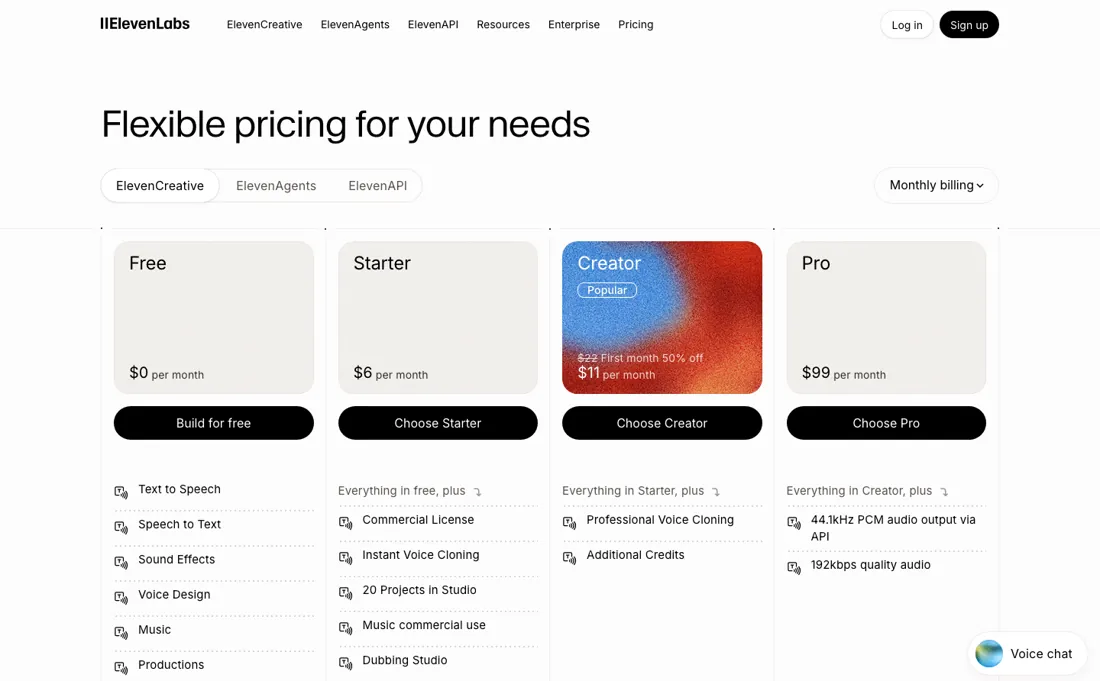
And read the free-tier fine print: $0 gets you 10k credits to play with, but no commercial license — anything you publish commercially needs at least the $6 Starter. Voice realism genuinely leads the market; niche names and jargon can still need manual retakes, so run your hardest paragraph through the free tier before subscribing.
Watch the video review
The video version of this review, from our YouTube channel.
⚡ Short on time? Watch the 30-second verdict Short.
What ElevenLabs does
Market-leading AI voice platform: hyper-realistic text-to-speech (Eleven v4 and the low-latency v4 Turbo since September 2026), voice cloning, dubbing, sound effects and conversational agents — plus a developer API and, since August 2026, a hosted MCP connector that runs inside Claude, ChatGPT and Cursor. Free tier to test voices before you pay.
What buyers report about ElevenLabs
Hands-on: not tested by usReported by buyers: G2 and Trustpilot, read August 2026
Themes from the buyer-review sites listed at the foot of this page, read in August 2026. We have not run ElevenLabs ourselves, so this is other buyers' experience rather than ours. We summarise it here because the complaints are usually the part a vendor page leaves out.
- • Voice quality is the reason it dominates — G2 ratings sit at 4.5+ and reviewers name output quality and ease of use first.
- • The $11/month Creator plan carries most serious content production without needing a bigger tier.
- • Credits forfeited on downgrade or cancellation is the single most repeated complaint. If you scale back, you lose what you already paid for.
- • Failed generations are charged.
- • Credits roll over on paid plans for two billing cycles only, then expire.
- • Long calls and the Multilingual v2 model burn quota faster than teams expect — overage typically bites in month two or three after deploying an agent.
Where the ratings disagree. 4.5+ on G2 against 3.0 on Trustpilot across roughly 1,005 reviews. The gap is billing, not the product — nobody disputes that the voices are good.
Pages read (August 2026): Trustpilot
When the paid plan is worth it
The credit discount stops working about halfway up, which changes where the sensible stopping point is. Per thousand credits: Starter is $6 for 30k (20 cents), Creator $22 for about 121k (18.2 cents), Pro $99 for about 600k (16.5 cents) and Scale $299 for about 1.8M (16.6 cents). Pro and Scale cost effectively the same per credit -- Scale is a fraction dearer. So the volume discount runs from Starter to Pro and then flattens entirely; above Pro you are buying capacity and seats, not a better rate.
The step that actually gates something is the first one. Free gives 10k credits a month but the commercial licence starts at Starter, so if the audio is going anywhere near a customer, $6 is the real floor regardless of volume. Above that: Pro adds 44.1kHz PCM output, Scale adds three workspace seats, and Business at $990 adds low-latency text-to-speech, which matters only if you are generating speech inside a live interaction.
Overage is metered per minute and it does taper: roughly $0.36 down to $0.17 depending on tier. That taper is worth checking against your own overrun pattern, because on the cheaper tiers a habit of running over can cost more than the next plan up. And note that Creator advertises 50% off the first month ($11), which is a discount on month one only -- budget the $22.
How to actually use ElevenLabs
Run your hardest paragraph through the free tier before you pay for anything. Not your cleanest sentence — the one with the product names, the acronyms, the surname nobody pronounces right and the number that could be read three ways. Voice realism here genuinely leads the market, and the place it still stumbles is exactly that material. While you do it, count your retakes, because that is the number that prices this product.
Credits are the meter, and you are charged per generation request rather than per download. The FAQ does allow a limited number of free regenerations, but only while the content and certain settings stay unchanged, and the page tells you before you press the button whether this one is free — change a word and you pay again. Divide the credits you actually spent by the finished minutes you kept, and you have a real credits-per-minute figure rather than the one the calculator assumes.
Read the free tier's licence before you publish anything. Ten thousand credits a month costs nothing but carries no commercial licence, so anything that goes out commercially needs at least the $6 Starter — this is the step people miss, and it is a licensing problem rather than a quality one. When you do upgrade, note that Creator's first month is half price at $11. Testing free, then taking a discounted Creator month, is a cheaper route to finding your real usage than jumping to Pro on an estimate.
Test on the newest model. On 28 September 2026 ElevenLabs launched Eleven v4 and a low-latency Eleven v4 Turbo, available in ElevenCreative, ElevenAgents and the API. The launch post says both support more than 90 languages, follow inline audio tags such as [laughs] or a described delivery more closely than earlier models, handle IPA pronunciations more reliably, and can make an instant voice clone from 10 seconds of audio. Those are the vendor's claims, and the hard paragraph above is the way to check them on your own material.
Distilled from the ElevenLabs pricing page — the ElevenCreative plan cards, the "Compare plans" table with the per-minute overage column, and the pricing FAQ on credits, rollover and annual billing — at https://elevenlabs.io/pricing, plus elevenlabs.io/llms.txt. Both read 3 September 2026 from a Netherlands exit; the pricing page, its compare table and the FAQ (per-product credit costs, rollover and downgrade rules, regeneration charges) read again 23 September 2026. The page now splits into ElevenCreative, ElevenAgents and ElevenAPI tabs; the figures here are the Creative tab.
ElevenLabs vs Murf, side by side
Each column shows the vendor’s own published entry price, read on the date shown. Entry prices can cover different services or units, so check what each one buys. We do not average them into a score.
Both names above are affiliate links: we may earn a commission if you sign up, at no extra cost to you. Neither changes what this table says.
The natural comparison is Murf or Descript — Murf counters with studio workflow and per-language breadth, Descript bundles voice into a full video/podcast editor — ElevenLabs' edge is raw voice realism and the developer API.
Frequently asked questions
How many minutes of audio does the $22 Creator plan actually give me?
It depends which product you spend the credits on, because they all draw on one pool. Read 23 September 2026, Creator's 121,000 monthly credits come out at about 121 minutes of text to speech in the plan table, since speech costs 1 credit per character. The same FAQ prices speech to text at 330 credits a minute, music at 900, the voice changer and isolator at 1,000, and dubbing at 2,000 credits a minute for automatic dubbing with a watermark up to 10,000 for Dubbing Studio without one. So 121,000 credits is roughly 134 minutes of music or 12 to 60 minutes of dubbing. And every retake is a new generation charge unless the page tells you beforehand that this one is free, so budget below the headline minutes.
If I buy a bigger plan and use it slowly, do I lose the unused credits?
Not straight away. Read 23 September 2026, the pricing FAQ says unused credits on a paid plan roll over for up to two months, so your balance can reach at most three times the monthly quota, as long as the subscription stays active. The catch is on the way down: downgrading or cancelling keeps the plan until the end of the cycle, then drops you to Free and expires every unused paid credit. The free plan has no rollover. Upgrading is the safe direction, since unused credits carry into the next cycle, and pay-as-you-go top-up credits are kept outside the rollover cap. So start on the smaller plan and move up; a big plan you later step down from loses whatever it banked.
Is paying yearly worth it for ElevenLabs?
Only if you are sure of the tier. Read 23 September 2026, annual billing is ten months for twelve (the FAQ writes it as monthly price times 10), which is $5 a month for Starter, $18.33 for Creator, $82.50 for Pro, $249.17 for Scale and $825 for Business. The saving is real, but the credit rules punish guessing high: stepping down forfeits unused paid credits at the end of the cycle. Creator's first month at $11 is also a monthly-plan offer. A cheaper way to find your level is a month or two on monthly billing, counting credits per finished minute, then switching the tier you actually use to yearly. Running over is priced in the plan table at about $0.20 per extra minute on Starter, $0.18 on Creator and $0.17 from Pro upward.
Is this a hands-on review of ElevenLabs?
This is a researched assessment, not a hands-on test — where we've used a tool ourselves, we say so explicitly. We name what each tool is good and bad at, and we earn a commission only if you sign up, at no cost to you.
- Buyer reviews on G2 and Trustpilot, read August 2026.
- Re-verified 23 Sep 2026 on elevenlabs.io/pricing.
- A dated screenshot of that pricing page, kept on this site as the receipt.
Others in this category
Nothing we have reviewed in content & media does the same job as ElevenLabs; these are neighbours by category only:
New reviews, price changes we recorded, and the cost conditions we found. No sponsored placements. Unsubscribe anytime.
This is our researched assessment — not a paid placement. The “Visit” links on this page are affiliate links: we may earn a commission if you sign up, at no extra cost to you, and it never changes our take. How we review →