 ChatGPT AI Product Description Review (2026)
Transparency: the “Visit” links on this page are affiliate links — we may earn a commission if you sign up, at no extra cost to you. No vendor can pay for a better review or verdict. How we make money →
'ChatGPT AI Product Description' describes a category, the app's own listing copy now calls itself Descrii AI Product Descriptions, and Shopify shows a different app by a different developer under a nearly identical name on the same page.
Visit ChatGPT AI Product Description → Affiliate link — we may earn a commission if you sign up; it does not change what this page says.
Watch the 2-minute review
The video version of this review, from our YouTube channel.
Pricing (2026)
✓ Pricing re-verified 20 Sep 2026
| This tool | $19 | 29th cheapest of 48 |
| Cheapest | $2.99 | MX AI |
| Median | $14.50 | |
| Most expensive | $450 | Attribuly |
Lowest paid entry price per account a month, billed monthly, in USD, among the 48 e-commerce growth apps we have researched (read between 2026-08-19 and 2026-10-04). Only tools priced in the same unit and on the same billing are compared — not a market survey, and cheapest is not best.
Four tiers, priced in credits per month, all amounts unchanged since 19 August 2026. Free Trial: 100 credits a month. Basic $19 a month or $190 a year (save 17%): 2,000 credits, product descriptions, titles and meta descriptions, formatted descriptions, automatic descriptions on import. Standard $49 or $399 a year (save 32%): 11,000 credits, same features. Pro $249 or $1,990 a year (save 33%): 110,000 credits, same features plus priority video-call support.
Every paid card repeats 'Only $1 per 100 Descriptions', which only holds at the bottom of the ladder: $19 for 2,000 credits is 95 cents per hundred, $49 for 11,000 is 45 cents, $249 for 110,000 is 23 cents. The listing never says what a title, a meta description or an alt text costs in credits. It also carries the standard line that recurring AND USAGE-BASED charges are billed every 30 days, and no usage rate or threshold is published anywhere on the page.
The app's own copy now calls it 'Descrii AI Product Descriptions' while the listing title still reads 'ChatGPT AI Product Description'; the Works-with row names Claude, Gemini, GPT-5, gpt 5 mini and grok. Developer Profitonium, Adugodi, Bangalore; launched 12 March 2021; Built for Shopify badge; 4.9 from 529 ratings. Plans change — always verify the live price on their site.
What the pricing page doesn’t say
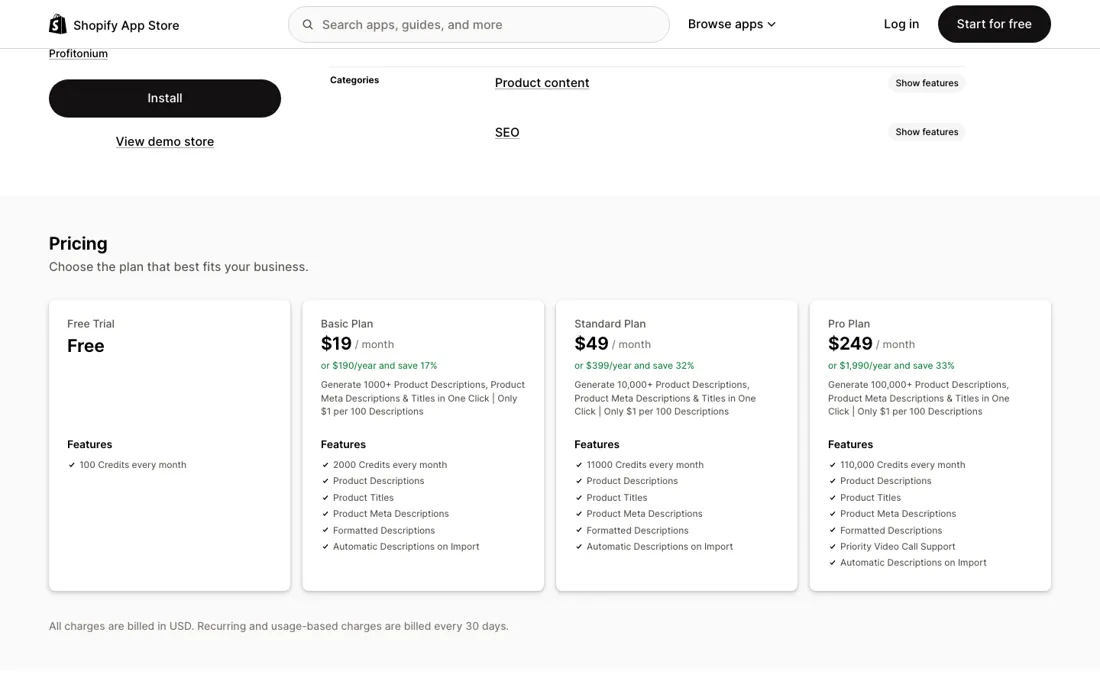
Check the developer is Profitonium before you install. Second, the credit is undefined and it is the only thing you are buying. Four tiers, one variable, no definition — and the '$1 per 100 descriptions' line repeated on all three paid plans is not the rate on two of them. Worse, the plan price may not be the whole bill: the listing carries Shopify's usage-based-charges line, and a merchant of twelve months, in a review edited 30 July 2026, itemised charges of $586.79, $487.49, $282.69 and $483.16 on top of a stated $149 a year plus $49 a month, marked 'billing cycle ended' and 'fee threshold reached'.
That is one public account and the developer has not answered it on the listing, but nothing on the page lets you rule it out either. Third, and the one that costs real money: this app edits your live store. Its permissions cover product descriptions and titles, Online Store pages and theme, files, locales, Shopify Markets settings, translations and navigation, and nothing on the listing describes versioning, a preview queue or a rollback.
On 15 September 2026 a merchant of five months reported that it changed titles to products the store does not carry; the developer replied the next day that he had paused automatic generation for that store and was adding safeguards. The 529 ratings are strong — 504 five stars — but three are one star and they are the ones that describe undoing. Export your product CSV before the first bulk run. That is your rollback.
What ChatGPT AI Product Description does
Bulk copy generator for Shopify from Profitonium: product descriptions, titles, meta tags and image alt text for thousands of products at once, in 30+ languages, with custom instruction templates and automatic descriptions on import. Live since 2021.
What buyers report about ChatGPT AI Product Description
Recurring themes from the buyer-review sites listed at the foot of this page, read in August 2026. We have not run ChatGPT AI Product Description ourselves, so this is other buyers' experience rather than ours. We summarise it here because the complaints are usually the part a vendor page leaves out.
- • Bulk is what buyers actually credit. A US store with a catalogue above 30,000 SKUs (July 2026, nine months in) says it does in hours what freelancers took days over, and an SEO agency (Canada, May 2026) values that one pass covers descriptions, titles, meta descriptions and image alt text rather than descriptions alone.
- • Non-English output gets specific praise from a German store more than a year in (July 2026): the wording lands exactly as briefed, and the time saved is rated highly — though the same reviewer notes the translation occasionally reads stiff.
- • Support people are named repeatedly, including on pre-purchase questions answered in live chat before installing.
- • Consistency across similar products is the recurring failure. A US laser-art store (edited November 2025) says that with multiple near-identical items the titles and descriptions drift out of line with the prompt in a way ChatGPT itself does not; they rate it improved since their first review and still not reliable enough for their work.
- • A Dutch merchant (May 2026, seven days in) reports the same inconsistency and adds that it was hard to reach an actual person; the developer replied publicly the next day and offered to look at the descriptions.
- • It rewrites the title but not the URL handle: a UK merchant (July 2025) found products kept the messy keyword slug after the title had been cleaned up. The developer later said this was fixed — we have not verified that.
- • One Australian merchant (October 2024) puts it in four words: good, but expensive for high-volume stores.
Where the ratings disagree. 466 reviews averaging 4.9, with 447 at the top rating and not a single one-star — but read who is writing. A large share of the five-star reviews come from merchants minutes or hours after installing, so they are rating the setup and the first output; the mixed reviews are from the people with months or a year on the app. There is also a naming problem worth checking before you read any of it: the App Store lists a near-identically named app from a different developer with a similar score on the same page, so confirm the listing you are reading is the Profitonium one.
Pages read (August 2026): Shopify App Store
When the paid plan is worth it
The credit maths is where this ladder is unusually generous in the middle and unusually punishing at the top. Basic gives you 2,000 credits for $19. Standard gives you 11,000 for $49 — five and a half times the credits for two and a half times the money, the single best step on the page. Pro gives you 110,000 for $249, ten times Standard's credits for five times its price, which is again good value per credit but only if you genuinely have tens of thousands of SKUs.
Run it against your own catalogue rather than the tier names. A store with 800 products that regenerates descriptions, titles and meta once has a one-off job in the low thousands of credits and then a trickle for new products — that is Basic, possibly Free for the trickle. A store with 30,000 SKUs doing a full pass is a Standard-to-Pro job for a month or two and can drop back down afterwards, which the 30-day billing cycle allows.
The honest caveat: you cannot do that maths precisely, because the listing never defines the credit. The headline on each plan — '1000+ descriptions' on 2,000 credits, '10,000+' on 11,000, '100,000+' on 110,000 — implies roughly one credit per description with headroom. But a description with image analysis and web search is plainly not the same work as a meta title, and the page prices them identically at zero information.
Generate a hundred items of the mix you actually need on the free tier and read the credit counter before you pick a plan.
How to actually use ChatGPT AI Product Description
Export your products to CSV before the first bulk run — there is no rollback described anywhere on the listing, and a bad pass over 5,000 SKUs is otherwise permanent. Then use the 100 free monthly credits as a measuring device rather than a trial. Generate the exact mix you plan to buy — say twenty descriptions, twenty titles, twenty meta descriptions, twenty alt texts — and watch what each one costs in credits.
That ratio is the only way to size a plan, and the page does not publish it. Write your custom instructions once and properly; consistent formatting across a catalogue is where this class of tool earns its money and the default house style is generic. Turn 'automatic descriptions on import' off until you trust the output, otherwise new products go live with unreviewed copy. And if you are running the multilingual side, have someone who speaks the language read ten of them — the one lukewarm review on the page is a German merchant saying the translations are occasionally stiff.
Distilled from apps.shopify.com/automated-description-writing, read 19 August 2026.
Visit ChatGPT AI Product Description →
Frequently asked questions
Can the bill be more than the plan price?
The listing says it can, and one merchant has published what that looked like. Under the four plan cards the App Store prints the standard line that recurring and usage-based charges are billed every 30 days, and nothing on the page defines the usage rate or the threshold that triggers one. In a review edited 30 July 2026, a merchant of twelve months' standing itemised charges on top of a stated $149 a year plus $49 a month: $44.97 on 22 May, $586.79 on 1 June marked 'billing cycle ended', $487.49 on 25 June marked 'fee threshold reached', $282.69 on 1 July, $483.16 on 20 July, and four one-off charges between $9.90 and $10. That is a single public account, the developer has not answered it on the listing, and none of the four plan cards mentions a usage line — so treat it as a reason to check rather than as a published rate. Before any bulk run, open your Shopify billing and look at the app's usage charges and approval thresholds, not only at the plan card. Read 20 September 2026.
How risky is 'automatic descriptions on import'?
It is the setting most likely to cost you an afternoon, and there is now a dated example. On 15 September 2026 a merchant who had used the app for five months reported that it changed product titles and replaced them with products the store does not carry, leaving a catalogue to repair. The developer replied the next day: he had identified the issue, paused automatic generation for that store, and was adding safeguards. Fast and honest, but the repair was still the merchant's. A second reviewer, in a review edited 30 July 2026, described bulk-publishing without reviewing closely enough and finding descriptions with invented or misleading claims, then spending hours building a restrictive prompt to stop it. Nothing on the listing describes versioning, a preview queue or a rollback. So: export your product CSV first, keep automatic generation off until your custom instructions have survived a sample of twenty, and switch it on last.
The rating is 4.9 from 529 reviews — is the dissent worth reading?
It is, because the complaints are consistent and narrow. The distribution on 20 September 2026 is 504 five stars, 16 four, five three, one two and three one. The low ratings say four things: the default output is generic and will not rank (December 2025, from a reviewer who had the app installed for four minutes); translations read stiffly in German (July 2026, from a merchant of over a year who is positive overall); bulk publishing without guardrails produced unsupported claims; and one merchant simply could not work out how to use it. The developer answers almost every one personally, usually within a day, and his replies point at the same three settings each time — custom instructions, brand voice, and your own fine-tuned model. Read that as the honest summary: the output is as good as the instructions you write, and the house default is not.
What should I weigh before buying Design & Content software?
Up to a point, and that point is usually set by your plan. Check whether brand kits, custom fonts, colour locking and template controls sit on the tier you would actually buy, since these are common upsells. Test it with your own assets during the trial rather than the demo content, which is always chosen to flatter the output.
Is this a hands-on review of ChatGPT AI Product Description?
This is a researched assessment, not a hands-on test — where we've used a tool ourselves, we say so explicitly. We name what each tool is good and bad at, and we earn a commission only if you sign up, at no cost to you.
- Buyer reviews on Shopify App Store, read August 2026.
- Re-verified 2026-09-20 on apps.shopify.com/automated-description-writing.
- A dated screenshot of that pricing page, kept on this site as the receipt.
Others in this category
Reviewed design & content tools that share ground with ChatGPT AI Product Description — comparable in what they do, not drop-in swaps:
New reviews, price changes we recorded, and the cost conditions we found. No sponsored placements. Unsubscribe anytime.
This is our researched assessment — not a paid placement. The “Visit” links on this page are affiliate links: we may earn a commission if you sign up, at no extra cost to you, and it never changes our take. How we review →