 Blocky Review (2026)
Transparency: the “Visit” links on this page are affiliate links — we may earn a commission if you sign up, at no extra cost to you. No vendor can pay for a better review or verdict. How we make money →
The App Store header says a free plan is available; that free plan is Development Stores, for development and partner stores only, and it starts charging the moment the store goes live.
Visit Blocky → Affiliate link — we may earn a commission if you sign up; it does not change what this page says.
Watch the 2-minute review
The video version of this review, from our YouTube channel.
Pricing (2026)
✓ Pricing re-verified 5 Oct 2026
Four tiers, each paid one with a 7-day free trial, and every amount unchanged since 22 August 2026. Development Stores is free but only for development and partner stores; it carries all Pro features and starts billing on upgrade. Basic $9.99 a month or $83.92 a year, a 30% saving: enforcement inside the checkout page, unlimited country blocking, a fully customisable blocked page and online support.
Advanced $16.99 a month or $142.71 a year adds unlimited IP blocking for IPv4 and IPv6, an IP whitelist and a geolocation country redirector. Pro $19.99 a month or $167.92 a year adds blocking by email, name, address and phone, the Bot Killer for TOR, proxy and VPN traffic, an add-ons blocker, a right-click blocker and unlimited visitor analytics traffic logs. All three paid tiers carry the same restriction in their own plan text: all stores except for Shopify Plus stores.
All charges are billed in USD and recur every 30 days. Developer Effective Apps, 13 Max Nordau, Ashdod, 7722119, Israel; the app launched 7 April 2021, still carries Shopify's “Built for Shopify” badge and is available in eleven languages. The review record keeps moving: 355 reviews averaging 4.7 on 5 October 2026, up from 324 on 22 August and 346 on 18 September, distributed 89% five-star (317), 5% four-star (16), 1% three-star (3), 0% two-star (1) and 5% one-star (18).
All nine reviews added since 18 September were five-star, after three one-star additions in the month before. The developer replies to reviews on the listing, including an August 2026 reply explaining what the Basic plan is meant to cover. Plans change — always verify the live price on their site.
Category context: E-commerce. Across the 36 tools in this category that we researched with a public US-dollar price, the median entry price is $19 a month (lowest paid plan as listed, per seat where the vendor prices per seat). Blocky’s entry price of $9.99 a month sits below that median. Compare pricing conditions in the Software Cost Atlas →
What the price did
We capture Blocky’s own pricing page every month and keep the figures, so this is our record of the page — not a forecast, and not someone else’s summary.
Three dated readings, no movement on price. On 22 August, 18 September and 5 October 2026 the App Store listing read Basic $9.99 a month or $83.92 a year, Advanced $16.99 or $142.71 and Pro $19.99 or $167.92, each paid tier with a 7-day trial, beside the free Development Stores plan for stores that are not yet live. Only the review count moved: 324, then 346, then 355.
What the pricing page doesn’t say
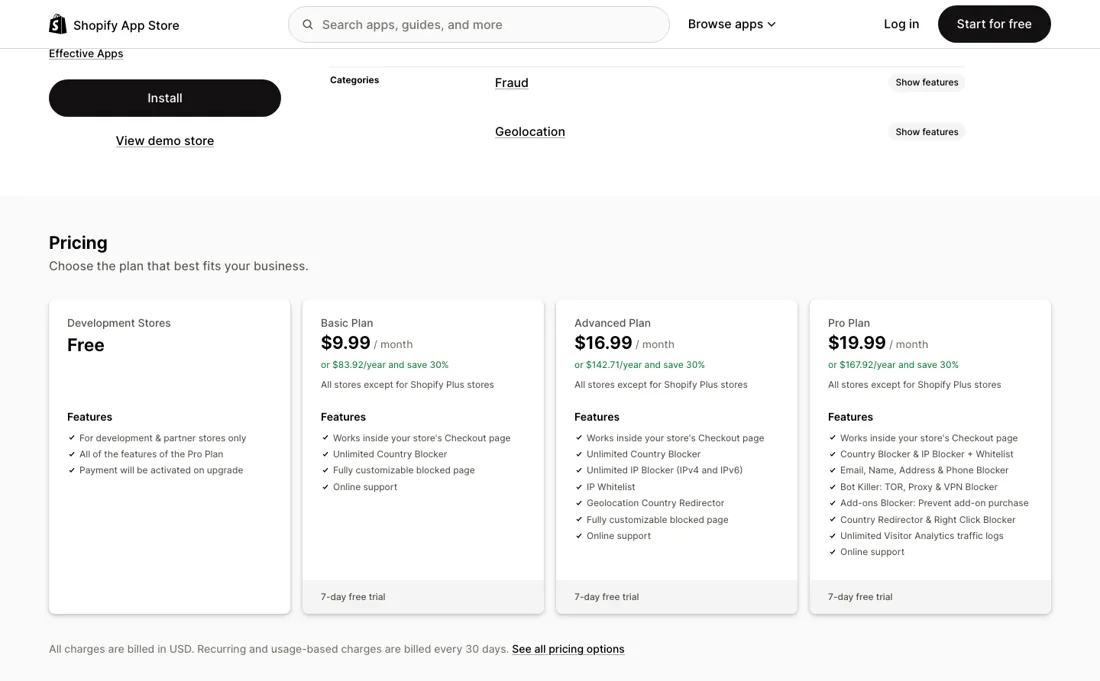
All three paid tiers then carry the line 'all stores except for Shopify Plus stores', so if you are on Plus this app is not sold to you. Check that with the developer before you plan around it. A blocker is a blunt instrument, and the review distribution shows it: 355 reviews read on 5 October 2026, 89% of them at the top rating and 5% at the bottom — eighteen one-star reviews, three of them added between late August and mid-September.
Rules that stop fraud also stop customers. A blocked country catches the expat who genuinely wanted to buy; a VPN rule catches the privacy-minded shopper. The tuning is yours to do, continuously, using visitor analytics that only the Pro tier includes. And it prevents rather than recovers. Nothing here disputes a chargeback that has already landed or claws back an order that already shipped. For that you need a separate dispute tool, which is a second subscription on top of this one.
What Blocky does
Shopify fraud filter that blocks visitors and orders by country, IP (v4 and v6), email, name, address and phone, with an AI bot blocker for TOR, proxy and VPN traffic that gets past reCAPTCHA, country redirects, a right-click blocker and visitor analytics. Not sold to Shopify Plus stores.
What buyers report about Blocky
Recurring themes from the buyer-review sites listed at the foot of this page, read in August 2026. We have not run Blocky ourselves, so this is other buyers' experience rather than ours. We summarise it here because the complaints are usually the part a vendor page leaves out.
- • The numbers merchants quote are the concrete part: over 4,800 blocked hits for a US store a year in (July 2026), and over 5,000 bots inside a week for a Spanish store (April 2026).
- • Card-testing fraud is the specific win. A US soap maker seven months in (July 2026) credits it with stopping card testing, and another US store (August 2026) values being able to block a particular person who had tried to defraud them rather than only a country.
- • It reads cheap against the category: a US lighting store (June 2026) switched from a competitor at $139 a month and rates both the blocking and the support higher.
- • It is not airtight against a determined evader, and the sharpest reviews come from the longest-tenured merchants. A US store two years in (September 2025) had blocked every country except the US and switched VPN blocking on, and still took fraudulent orders from blocked countries — paying the non-refundable card processing fee on each one they cancelled. A Canadian store three years in (July 2025) reports bots still getting through and the right-click protection not working at all, and a Pakistani merchant (February 2026) says VPN traffic beat it on all three of their stores.
- • Feature gating irritates people on install day: two merchants (July 2025 and August 2026) uninstalled within the day or the week because each capability they wanted sat on a higher tier. The developer replied to one of them that country blocking is included in Basic.
- • The advertised free plan is the other install-day complaint (Australia, December 2025; US, July 2026): merchants expected one and found only paid options. That matches the listing rather than contradicting it — the free tier is for development and partner stores, and it starts billing when the store goes live.
- • One US merchant (January 2026, seven days in) says they were charged close to $200 in the first week and asked for a refund. That does not square with published tiers of $9.99 to $19.99 a month and the developer left no public reply, so read it as unexplained rather than as the rate.
Where the ratings disagree. 324 reviews averaging 4.7, and the distribution says more than the average does: 89% at five stars, 5% at one, and almost nothing in between. That is the signature of a blunt instrument. For most stores the rules work on the first day, which is when a lot of the five-star reviews are written; for the minority facing someone who rotates IP addresses and VPNs it does not, and those reviews are written years in. Decide which of the two you are before you read the average.
Pages read (August 2026): Shopify App Store
When the paid plan is worth it
Ten dollars separates the cheapest paid tier from the dearest, and that is the whole pricing story. Basic at $9.99 blocks countries. Advanced at $16.99 adds IP blocking and an IP whitelist. Pro at $19.99 adds the parts most people install a fraud filter for: blocking by email, name, address and phone, and the Bot Killer aimed at TOR, proxy and VPN traffic that reCAPTCHA lets through. So the tiers do not scale with your size, they scale with how many ways you want to say no.
If your problem is genuinely one region, Basic is the honest answer and it is cheap. If your problem is bots placing orders or one determined person changing IP addresses, Basic and Advanced will not touch it and you are on Pro, where the difference from Basic is ten dollars a month — less than the fee on a single chargeback. Annual billing takes 30% off at every level: $167.92 against $239.88 for a year of Pro.
How to actually use Blocky
Trial the tier that matches your actual problem, not the cheapest one. If bots or repeat fraudsters are the issue, the plan you want to test is Pro, because the Bot Killer and the email, phone and address filters do not exist below it. Then spend the seven days watching before you block. Turn the visitor analytics on first and read a week of your own traffic — country, IP, browser — so your first rules come from your logs rather than a hunch about which country is trouble.
Block the narrowest thing that fixes it: one IP range before one country, one email domain before all of them. Write every rule down with the reason you added it, and re-read that list once a month. The reason blockers collect angry reviews is that nobody remembers the rule that quietly turned away real customers for a year.
Distilled from apps.shopify.com/blocky-simple-country-blocker — plan cards and their own plan text, feature lists, developer details and the review distribution. First read 22 August 2026, re-read 18 September 2026. Re-read 5 October 2026 (served HTML): $9.99/$83.92, $16.99/$142.71, $19.99/$167.92, all paid tiers "All stores except for Shopify Plus stores", Built for Shopify, 355 reviews at 4.7 (317/16/3/1/18), launched 7 April 2021.
Frequently asked questions
Which Blocky plan do I need?
The one that matches the kind of fraud you have, not the cheapest one. Read on 18 September and again on 5 October 2026, unchanged since 22 August: Basic $9.99 a month blocks countries and nothing else. Advanced $16.99 adds unlimited IP blocking for IPv4 and IPv6, an IP whitelist and a country redirector. Pro $19.99 adds the parts most people install a fraud filter for — blocking by email, name, address and phone, the Bot Killer aimed at TOR, proxy and VPN traffic that gets past reCAPTCHA, an add-ons blocker, a right-click blocker and unlimited visitor analytics logs. Ten dollars separates cheapest from dearest, which is less than the fee on a single chargeback, so if your problem is bots or one determined person rotating IP addresses, start at Pro. Each tier is also sold by the year at a 30% discount, which puts a year of Pro at $167.92.
Is there really a free plan?
Only for stores that are not selling yet. The listing header says a free plan is available, and it is called Development Stores: its own plan text says “for development & partner stores only”, carries all of the Pro features, and adds “payment will be activated on upgrade”. So it is a way for a developer or agency to build and test the configuration, not a tier a live shop can sit on. Every paid tier does carry a 7-day free trial, which is the actual way to try it on a real store. One more restriction that matters more than the free plan: all three paid tiers state “all stores except for Shopify Plus stores”, so if you are on Plus you need to ask the developer before planning around this app at all.
Will blocking cost me real customers?
Some, and the review record is where you can see it. As read on 5 October 2026 the listing carries 355 reviews averaging 4.7, with 89% at five stars and 5% at one — eighteen bottom-rated reviews, the same eighteen as on 18 September, after three were added in the month before that. That is the ordinary shape of a tool whose job is to turn people away: a country block catches the expat who genuinely wanted to buy, and a VPN rule catches the privacy-minded shopper. The mitigation is in the product but only on the top tier, because unlimited visitor analytics traffic logs are a Pro feature. The sensible order is to turn the analytics on first, read a week of your own traffic, then write the narrowest rule that fixes the actual problem — and re-read your rule list monthly, because the expensive mistake is the rule nobody remembers adding.
What should I weigh before buying E-commerce software?
Check your platform and version specifically. Shopify support is close to universal in this category, while WooCommerce, BigCommerce, Magento and headless setups vary a lot, and 'supported' sometimes means a generic API rather than a maintained app. A listing in your own platform's app store, with recent reviews there, is a better signal than the vendor's logo wall.
Is this a hands-on review of Blocky?
This is a researched assessment, not a hands-on test — where we've used a tool ourselves, we say so explicitly. We name what each tool is good and bad at, and we earn a commission only if you sign up, at no cost to you.
- Buyer reviews on Shopify App Store, read August 2026.
- Re-read 2026-09-18 and again on 2026-10-05 on apps.shopify.com/blocky-simple-country-blocker.
- A dated screenshot of that pricing page, kept on this site as the receipt.
Others in this category
Reviewed e-commerce tools that share ground with Blocky — comparable in what they do, not drop-in swaps:
New reviews, price changes we recorded, and the cost conditions we found. No sponsored placements. Unsubscribe anytime.
This is our researched assessment — not a paid placement. The “Visit” links on this page are affiliate links: we may earn a commission if you sign up, at no extra cost to you, and it never changes our take. How we review →