 Aircall Review (2026)
Two structural catches: the 3-seat minimum makes the real starting price triple the sticker, and the annual-vs-monthly gap is steep (Professional: $50 vs $70). Throughout this review we weigh it against RingCentral.
Visit Aircall → Affiliate link — the rest of this page is the honest version, including who should skip it.
Pricing (2026)
✓ Pricing re-verified 29 Aug 2026
Essentials is $30 per license a month and Professional $50, both on annual billing, which the page marks as 25% off monthly. Flip that toggle and the monthly rates read $40 and $70 per license (3 licenses for $120 and $210), checked 29 August 2026 from a US connection. The discount is not uniform either: Essentials really is 25% off, but Professional lands closer to 29%, so price the plan you will actually buy rather than trusting the badge; the same cards quote 3 licenses at $90 and $150 a month.
Custom starts at 25 licenses. Aircall AI is not in those numbers: voice runs from $0.19 a minute with bundles at $175 for 500 minutes and $725 for 2,500, or $0.49 a minute pay-as-you-go dropping to $0.39 above 2,500. AI conversations are $0.35 each, $0.29 after the first thousand, or bundled at $250 for 1,000 and $1,500 for 10,000. Smaller add-ons sit at $9, $10, $15, $30 and $49 per license a month, so the license fee is a floor rather than the bill. Plans change — always verify the live price on their site.
What the pricing page doesn’t say
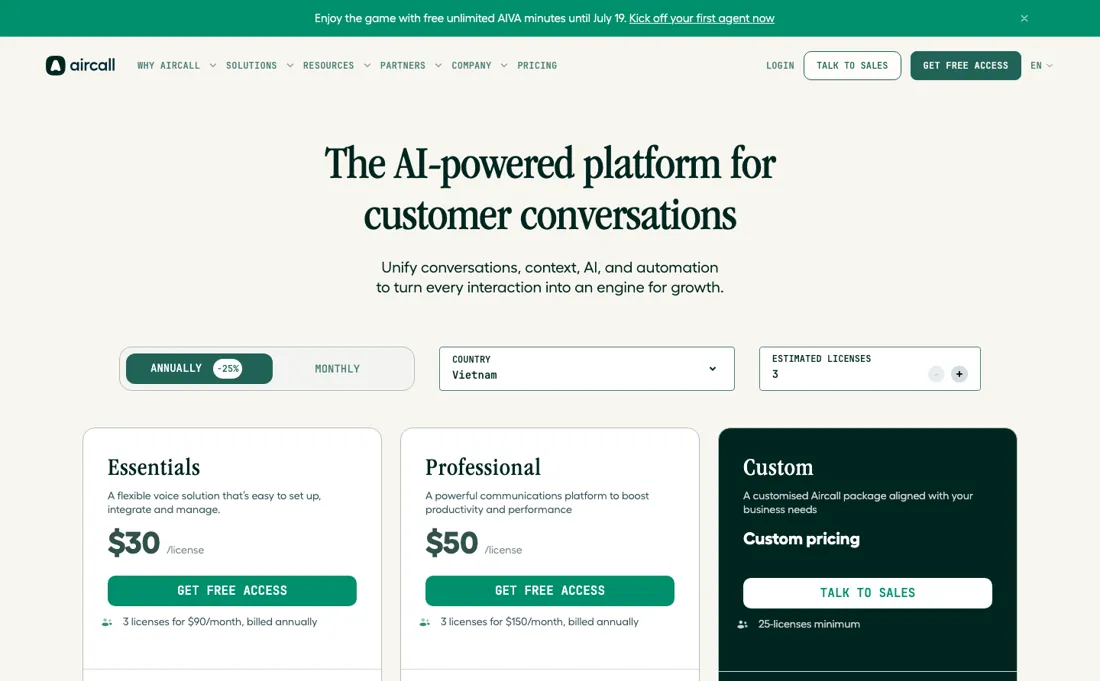
'Unlimited calling' covers listed regions — check yours — and AI features increasingly live in add-ons or higher tiers. It's polished and integration-rich; just price the seats you'll actually have, on the billing cycle you'll actually choose.
What Aircall does
Cloud phone system for sales and support teams: call routing, analytics and CRM integrations. A three-licence minimum applies, so entry is effectively about $90/month; Essentials is roughly $30/user/month annual against $40 month-to-month.
What buyers report about Aircall
Recurring themes from the buyer-review sites listed at the foot of this page, read in August 2026. We have not run Aircall ourselves, so this is other buyers' experience rather than ours. We summarise it here because the complaints are usually the part a vendor page leaves out.
- • CRM integration with HubSpot and Salesforce is what reviewers rate highest, along with how quickly a team gets running. 4.4 on G2.
- • The interface is genuinely good — that part is not in dispute.
- • TrustRadius reviewers single out the thing the sales page undersells: country-specific numbers from one device, so an international outbound team calls locally without local hardware. Salesforce sync and accurate call transcripts get named alongside it.
- • Connection issues (71 mentions) and call quality (58) are consistently flagged on G2. For a phone system, weigh those first.
- • Auto-renewal is the loudest complaint. Accounts over 10 seats need 30 days' written notice before renewal, and there are no refunds for early termination. Diarise it.
- • Charges after cancellation and surprise invoices come up repeatedly on Trustpilot.
- • A three-user minimum, and reviewers on small teams call it expensive regardless.
- • Support is slow by most accounts.
- • Call quality is the complaint that crosses platforms rather than staying on one. TrustRadius reviewers report inbound calls occasionally not connecting, inconsistent sound quality and dropped calls — the same theme G2 carries at volume.
- • A 2024 reviewer asks for an automatic dialler and automated voicemail drop; both now exist, but on Professional rather than Essentials, so the answer to that gripe is a tier upgrade rather than a feature release.
Where the ratings disagree. 4.4 on G2 against 3.0 on Trustpilot across roughly 1,025 reviews. The G2 reviews are about the product; the Trustpilot ones are almost entirely renewal and billing. TrustRadius adds a third data point to the split we already saw: its reviews are about the product and mention no billing dispute at all, while Trustpilot's are dominated by renewal and cancellation. Where TrustRadius and G2 do agree is call quality, which is the complaint to take seriously.
When the paid plan is worth it
Aircall has no free tier. Its own pricing page does not display dollar figures, because prices render dynamically per country and seat count. The reference points come from a third-party marketplace, Vendr, which lists Essentials at $30 per user per month and Professional at $50, both on annual billing; your negotiated price may differ. The real decision is between those two tiers. Essentials covers a functioning cloud phone system for a team that mainly needs to place and receive calls.
Professional earns its extra cost once your reps live inside a CRM all day and you need deeper routing, analytics and integration depth; at that point the per-seat gap is small next to the time saved. It does not pay for itself for a small team doing light call volume, and the 3-license minimum on both plans means you buy at least three seats regardless of headcount, so a solo operator overpays from day one.
How to actually use Aircall
First value comes fast if you start with a fresh Aircall number: pick a plan, create the number in the dashboard, then configure routing, voicemail, users and your CRM integration, with no phone hardware required.
Distilled from https://support.aircall.io/hc/en-gb/articles/10375356152605-Aircall-porting-guide
Common Aircall setup mistakes
Where Aircall setups actually go wrong, and what it costs you when they do. Same sources as the setup notes above — not from a walkthrough we ran ourselves.
The friction starts when you try to bring your existing business line across.
- Porting is blocked on trial accounts, so you must already be a paying customer, meaning you commit money before your real number works.
- From there the Letter of Authorization has to be signed, and your losing carrier can reject the request over mismatched account details or because your number sits in a range that must all be ported together.
- After a successful port, SMS can take up to 3 business days to switch on, and any reschedule or cancellation needs 2-3 business days' notice.
- So between the notice period and SMS reactivation, a botched date can cost you the better part of a week.
Aircall vs CloudTalk, side by side
Both columns come from the same place: each vendor’s own published pricing, read on the date shown in the sources at the foot of this page. We do not average them into a score.
Both names above are affiliate links: we may earn a commission if you sign up, at no extra cost to you. Neither changes what this table says: both columns come straight from the vendors’ own pricing pages.
The natural comparison is CloudTalk or JustCall — close CRM-integrated telephony rivals that undercut on price — Aircall's edge is integration polish; compare per-seat totals at your size. Weigh it against RingCentral on the job you actually need done.
More on Aircall
Everything we publish about Aircall links back here — the review stays the honest hub:
The ex-banker filter — the same yardstick on every review (how we review): My ex-banker filter is simple: does Aircall remove a real cost — time, errors, missed revenue — bigger than what it charges?
Frequently asked questions
What is the real entry price for Aircall?
Not the per-licence figure. Aircall requires three licences, so Essentials starts at €90 a month billed annually (€120 monthly) and Professional at €150 (€210 monthly), read on their own pricing page on 17 August 2026 from an EU address. A two-person team pays for three seats.
Is there an Aircall discount code?
We have found none, and that is worth saying because it is one of the things people search for before buying. What the page does publish is the annual discount — €30 against €40 per licence on Essentials, €50 against €70 on Professional — which is a 25% to 29% saving for committing to a year. That, plus the 50 free AI Voice Agent minutes every account gets each month, is the whole of the public offer as we read it.
What do the AI voice agents cost on top?
They are a separate meter from the seat. Every account gets 50 AI Voice Agent minutes a month free, with 100 extra at sign-up; after that it is €175 for 500 minutes or €725 for 2,500, custom bundles from €0.19 a minute above 10,000 minutes, or pay-as-you-go at €0.49 a minute (€0.39 over 2,500). Read on 17 August 2026. Budget these alongside the licences rather than assuming they are included.
What should I weigh before buying Communication & Voice software?
Generally yes, since this category is built for it, but the details that bite are timezone handling, how per-seat cost scales as the team spreads, and whether numbers, routing or coverage exist in the countries your people actually sit in. Availability varies far more by country than the marketing pages suggest, so check your specific regions before committing.
Is this a hands-on review of Aircall?
This is a researched assessment, not a hands-on test — where we've used a tool ourselves, we say so explicitly. We name what each tool is genuinely good and bad at, and we earn a commission only if you sign up, at no cost to you.
- Buyer reviews on G2, Trustpilot, TrustRadius and Reddit, read August 2026.
- Read 2026-08-26 on aircall.io/pricing over a US connection, with their own country selector on United States.
- A dated screenshot of that pricing page, kept on this site as the receipt.
Others in this category
The communication & voice tools closest to Aircall that we have also reviewed. They overlap rather than match:
New dossiers, cost-traps we found, and tools that earned a keep — no hype, no sponsored-disguised-as-advice. Unsubscribe anytime.
This is our researched assessment — not a paid placement. The “Visit” links on this page are affiliate links: we may earn a commission if you sign up, at no extra cost to you, and it never changes our take. How we review →