Thordata Review (2026)$0.65/GB Is the 5,000 GB Price
 By Daan Haket · Researched and written with an AI assistant · who does what
Everything is a meter — per GB, per IP, per 1K responses — so the bill scales with usage.
data teams scraping at scale — price intelligence, SERP tracking, AI-training data — who want proxy infrastructure plus ready-made scraping APIs at aggressive per-unit rates.
you need predictable flat pricing, or your use case skirts site terms — residential proxying carries compliance questions no discount fixes.
Transparency: the “Visit” links on this page are affiliate links — we may earn a commission if you sign up, at no extra cost to you. No vendor can pay for a better review or verdict. How we make money →
Pricing (2026)
✓ Pricing re-verified 23 Sep 2026
(2026) Usage-metered, with free trials on the APIs. Every ladder is unchanged since 1 Sep 2026, and every advertised "from" rate is still the largest package on its ladder: residential $0.65/GB at 5,000 GB ($3,250) against $2.00/GB at 1 GB, $1.80 at 10 GB, $1.50 at 50 GB, $1.00 at 150 GB, $0.80 at 350 GB, $0.73 at 1,000 GB and $0.70 at 2,000 GB; mobile $2.20/GB at 500 GB against $5.00 at 1 GB; SERP API $0.70 per 1K at 1M responses against $1.20 at 15K; Web Scraper API $0.50 per 1K at 3M against $1.00 at 30K, with a 5,000-credit step the page's structured data prices at $0.00; the unblocker, now listed as "Webpage" (it was "Web Unlocker" on 1 Sep), $1.00 per 1K at 200K against $1.30 at 10K; Scraping Browser $2.50/GB at 500 GB against $5.00 at 1 GB.
Static ISP and datacenter proxies advertise $0.75/IP against a $1.50 list, while the ISP packages themselves list at $1.50 and $4.50 an IP. New on the page: High Bandwidth Proxies sold by time, not volume -- 1 day $280, 7 days $900, 30 days $2,370, 60 days $4,140 -- with no bandwidth or IP count stated. The residential rows up to 350 GB carry struck 'original' prices ($2.85, $2.75, $1.95, $1.50, $1.70) that do not form a ladder: the struck price at 350 GB is higher than at 150 GB.
The card grid lower on the page prints SERP at $0.80 per 1K while the menu and the ladder say $0.70. Refund policy: within 7 days of the first purchase of a product, only if no more than 30% of the package and no more than 2 GB has been used, not for crypto payments, and not once a bundle bought in the dashboard has started transmitting data; an expired package period is not refundable. Plans change — always verify the live price on their site.
What the price did
We capture Thordata’s own pricing page every month and keep the figures, so this is our record of the page — not a forecast, and not someone else’s summary.
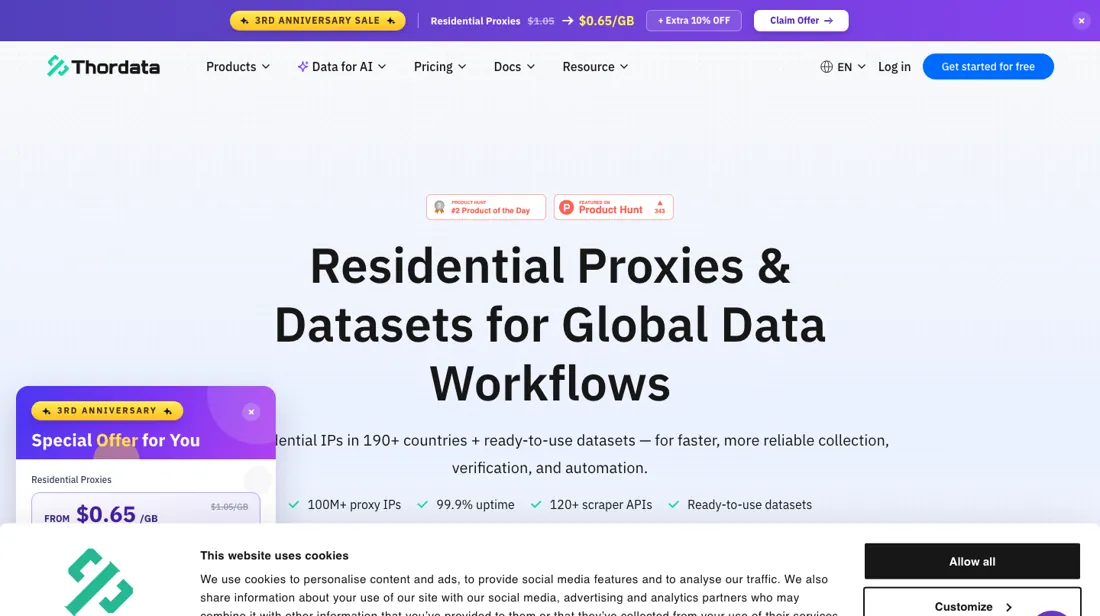
No movement in the headline rates. Thordata first appears in our August 2026 capture, and both the August and September captures carry residential proxies from $0.65/GB, the SERP API from $0.70 per 1K responses and the Web Scraper API from $0.50 per 1K results. Our own readings on 1 and 23 September 2026 found every ladder unchanged, so the from-rates have held for as long as we have measured them.
What the pricing page doesn’t say
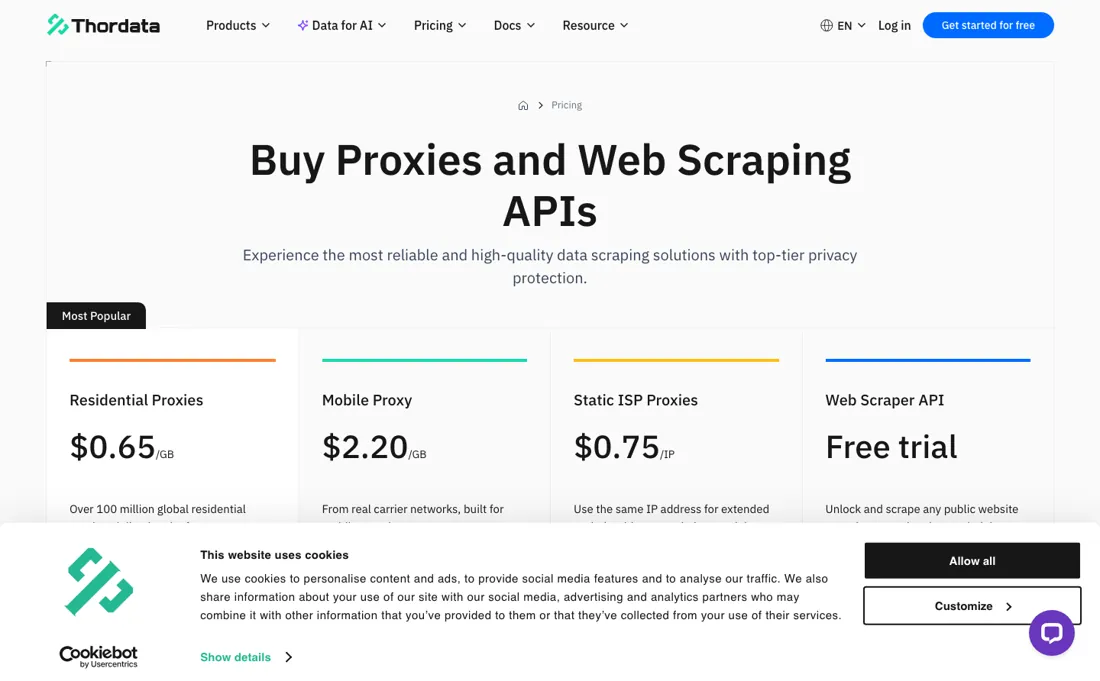
And every rate the site advertises is the largest package on its ladder: $0.65 a GB means buying 5,000 GB, while 1 GB of the same product costs $2.00. Budget at your own volume, not at the headline. Plus the category-wide caveat we'd give any residential-proxy vendor: those '100M+ real residential IPs' come from consumer devices, so check sourcing ethics and your target sites' terms before building on it.
Watch the video review
The video version of this review, from our YouTube channel.
⚡ Short on time? Watch the 30-second verdict Short.
What Thordata does
Proxy infrastructure and scraping stack — residential, mobile, ISP and datacenter proxies plus SERP/web-scraper APIs, priced per GB, IP or 1K requests.
What buyers report about Thordata
Hands-on: not tested by usReported by buyers: Trustpilot, G2 and proxy-comparison sites and SourceForge, read August 2026; SourceForge read September 2026
Themes from the buyer-review sites listed at the foot of this page, read in August 2026; SourceForge read September 2026. We have not run Thordata ourselves, so this is other buyers' experience rather than ours. We summarise it here because the complaints are usually the part a vendor page leaves out.
- • Residential traffic is genuinely cheap — around $2.00/GB at 1GB falling to $0.65-$0.73 above 1,000GB, with a 1GB free trial on request.
- • For high-volume scraping the per-GB rate undercuts the established providers substantially.
- • SourceForge carries a single written review (read September 2026), and it frames Thordata the way the pricing does: many proxy types at the lowest prices in the market, 'a perfect cheap version of Oxylabs'.
- • Trustpilot made Thordata's rating unavailable after removing fake reviews and flagging a guidelines breach. That is the single most important thing on this page — it means the public review signal for this vendor cannot be trusted at face value.
- • Reviewers on Trustpilot and G2 report data expiring prematurely, unhelpful support, refused refunds and false advertising. Billing surprises are named specifically.
- • Third-party listings put the residential network at roughly 60M IPs against the advertised 100M+.
- • Static residential IPs and SOCKS5 support are not clearly documented, and network performance is reported as unstable.
- • That same SourceForge review names one limit: the country selection for static residential proxies is relatively small, with support saying more locations were being added.
Pages read (August 2026; SourceForge read September 2026): Trustpilot
Every advertised rate is the largest package
Everything here is a meter — per GB, per IP, per 1,000 responses — and every rate the site advertises is the price of the largest package on that ladder, not an entry price. Residential proxies are $0.65 a GB only at 5,000 GB, which is $3,250 up front; at 1 GB the same product is $2.00, at 50 GB $1.50 and at 350 GB $0.80. The pattern repeats everywhere: the SERP API is $0.70 per thousand at a million responses against $1.20 at fifteen thousand, and the Scraping Browser $2.50 a GB at 500 GB against $5.00 at one.
Budget at your own volume, then, which on a first project is roughly three times the advertised rate. Like for like, the anti-bot premium is smaller than the headlines suggest too: at 200,000 responses the unblocker (listed as Webpage since September) is $1.00 per thousand against the Web Scraper API's $0.83 at 150,000 — a fifth more, not double. What buying a bigger package does not fix: it will not tell you your bandwidth per page, and that is the number that sets your bill.
Measure it on the free API trials, on your own targets. Nor does it settle sourcing — those residential IPs come from consumer devices, so how the network was built and what your targets' terms say are questions for the start of the project.
How to actually use Thordata
Measure your bandwidth per page before you compare any rate. Use the free API trials on your own targets and record how many megabytes a typical page costs — that figure times the per-GB rate is your actual bill, and without it no proxy vendor's pricing can be compared to another's. Then price at your own volume rather than at the headline. Every advertised "from" rate is the largest package on its ladder: $0.65 a GB means buying 5,000 GB.
Find the row that matches what you will actually buy and quote the project there. Route by target rather than by habit. Send only the sites that genuinely need anti-bot handling through the unblocker the page now lists as Webpage, and only the ones that need JavaScript rendering through the Scraping Browser — at comparable purchase sizes that path costs about three times the residential rate per gigabyte and burns more gigabytes per page.
Before any of that, check the sourcing. Residential IPs come from consumer devices, so ask how the network was built and read your target sites' terms.
Where this section comes from: our research notes (94 words)
thordata.com/pricing -- the product cards, the menu prices, the "Thordata pricing packages" ladders, the structured-data offers and the FAQ beneath them -- read 2026-09-23 (previously 2026-09-01), and thordata.com/refund-policy read the same day for the 7-day, 30%-and-2-GB refund conditions. thordata.com/llms.txt, read on 1 Sep, now returns an empty JavaScript shell or HTTP 403. Vendor sources only; no independent tutorial or user thread was consulted for this section. The buyer reports elsewhere on this page are not vendor sources: they come from Trustpilot, G2 and proxy-comparison sites and SourceForge, read August 2026; SourceForge read September 2026.
Thordata vs Bright Data, side by side
Each column shows the vendor’s own published entry price, read on the date shown. Entry prices can cover different services or units, so check what each one buys. We do not average them into a score.
Both names above are affiliate links: we may earn a commission if you sign up, at no extra cost to you. Neither changes what this table says.
The natural comparison is Bright Data — Bright Data is the enterprise incumbent with strict compliance vetting; Thordata undercuts hard on per-unit price — decide whether compliance depth or unit cost matters more for your pipeline.
Frequently asked questions
To get $0.65 a GB I have to buy 5,000 GB. Can I get my money back if it does not work on my targets?
Barely. Read 23 September 2026, Thordata's refund policy allows a refund only within 7 days of your first purchase of that product, only if you have used no more than 30% of the package and no more than 2 GB, and not if you paid in crypto. On a 5,000 GB package the 2 GB cap is what bites: the window closes after 0.04% of what you bought. The same policy also lists, among the cases it will not refund, a bundle bought through the dashboard that has started transmitting data, which reads as closing even that small window once traffic flows. So do not test at the headline size. The 1 GB step is $2.00 and 10 GB is $18.00; measure your bandwidth per page there, then buy the package your real volume needs.
The residential prices are shown as a sale. Is the discount real?
Read the unit price and ignore the strike-through. Read 23 September 2026, the residential ladder shows struck 'original' prices of $2.85 at 1 GB, $2.75 at 10 GB, $1.95 at 50 GB, $1.50 at 150 GB and $1.70 at 350 GB, against selling prices of $2.00, $1.80, $1.50, $1.00 and $0.80. The struck price at 350 GB is higher than the one at 150 GB, so that column is not a price list anyone could have bought from in order. The selling prices are identical to what we read on 1 September, so nothing has moved in three weeks either way. The high-volume rows from 1,000 GB up carry no struck price at all: $0.73, $0.70 and $0.65.
What are the High Bandwidth Proxies, and are they cheaper than paying per GB?
There is no way to tell from the page. Read 23 September 2026, they are sold by time rather than volume: 1 day for $280, 7 days for $900, 30 days for $2,370 and 60 days for $4,140, which falls from $280 a day to $69 a day at the longest term. The menu places them under solutions for large-scale video data collection. What the pricing page does not state is how much bandwidth, how many IPs or which proxy type a day buys, so you cannot set them against the residential rate of $0.65 to $2.00 a GB. Ask for the throughput in writing before comparing, and check it against the refund terms, which are written around gigabytes used.
Is this a hands-on review of Thordata?
This is a researched assessment, not a hands-on test — where we've used a tool ourselves, we say so explicitly. We name what each tool is good and bad at, and we earn a commission only if you sign up, at no cost to you.
- Buyer reviews on Trustpilot, G2 and proxy-comparison sites and SourceForge, read August 2026; SourceForge read September 2026.
- Price re-verified 2026-09-23 against the vendor's own pricing page.
- A dated screenshot of that pricing page, kept on this site as the receipt.
Others in this category
Reviewed developer tools that share ground with Thordata — comparable in what they do, not drop-in swaps:
New reviews, price changes we recorded, and the cost conditions we found. No sponsored placements. Unsubscribe anytime.
This is our researched assessment — not a paid placement. The “Visit” links on this page are affiliate links: we may earn a commission if you sign up, at no extra cost to you, and it never changes our take. How we review →