Home › Research › Hands-on test
Hands-on test · run on 2026-09-30Active Intelligence 3.0: Wavelength on a brand-new ActiveCampaign account: ten tasks, every claim checked
On 30 September 2026 we opened a new ActiveCampaign account on the 14-day free trial, which ActiveCampaign says carries the Pro plan’s features, Active Intelligence included. Between 10:02 and 10:55 Amsterdam time we gave Active Intelligence 3.0: Wavelength ten tasks, from building a brand kit out of our website to writing a campaign from one of our own test pages, translating it, building a welcome automation and scheduling a daily report. We checked what it produced against our own pages, which we saved before it read them. One account, one morning: a case study, not a verdict on every account.
Given one of our test pages, Active Intelligence 3.0: Wavelength wrote a campaign whose ten figures all came from that page, with nothing added. A second run of the same prompt was laid out differently and contained one sentence the page does not support. On a new account it said plainly that it had no history to learn from, and its image generator returned nothing in five attempts.AIBuilder Marketplace, hands-on test, 2026-09-30. Free to quote with attribution.
How we tested
- A new account. Created on 30 September 2026 on the 14-day free trial. ActiveCampaign’s help page on trial capabilities (updated 7 July 2026) says the trial matches the Pro plan’s features and includes Active Intelligence and sending Active Intelligence-generated campaigns; it allows one user and up to 100 email sends. At sign-up we chose “Media / Publishing” and fewer than 500 contacts.
- Our own material. The brand is our own site, aibuildermarketplace.com. For the campaign test we used our earlier hands-on test One pitch deck, four AI presentation tools, a page full of figures. Before Active Intelligence saw it, we saved the page’s 60 distinct figures and its data file, so we could check every number it wrote.
- Plain prompts. We wrote the way a normal user would and added no rules such as “do not invent numbers”: we wanted its default behaviour. The prompts are in results.json, word for word.
- Timing. Durations run from sending a prompt until the result was complete. We checked every ten seconds, so they are approximate.
- Nothing was sent. ActiveCampaign requires a postal address before any marketing email goes out, and we did not add one to a test account. Deliverability is therefore not part of this test.
Results, task by task
| # | Task | Result | What we saw |
|---|---|---|---|
| 1 | Ask about past campaigns on an empty account | Pass | Said there were no campaigns in the past 12 months and offered general ideas instead of made-up results. |
| 2 | Build a Brand Kit from our website | Partial | Voice, mission and colours right. No logo, yet a stored “N” logo went into every email. Picked a tool we review and two unrelated apps as competitors. |
| 3 | Campaign from one of our test pages | Pass | Ten figures, all from the page, none added. Link and disclosure right. |
| 4 | The same prompt again | Partial | New layout, and one sentence the page does not support. The chat’s summary described blocks that were not in the email. |
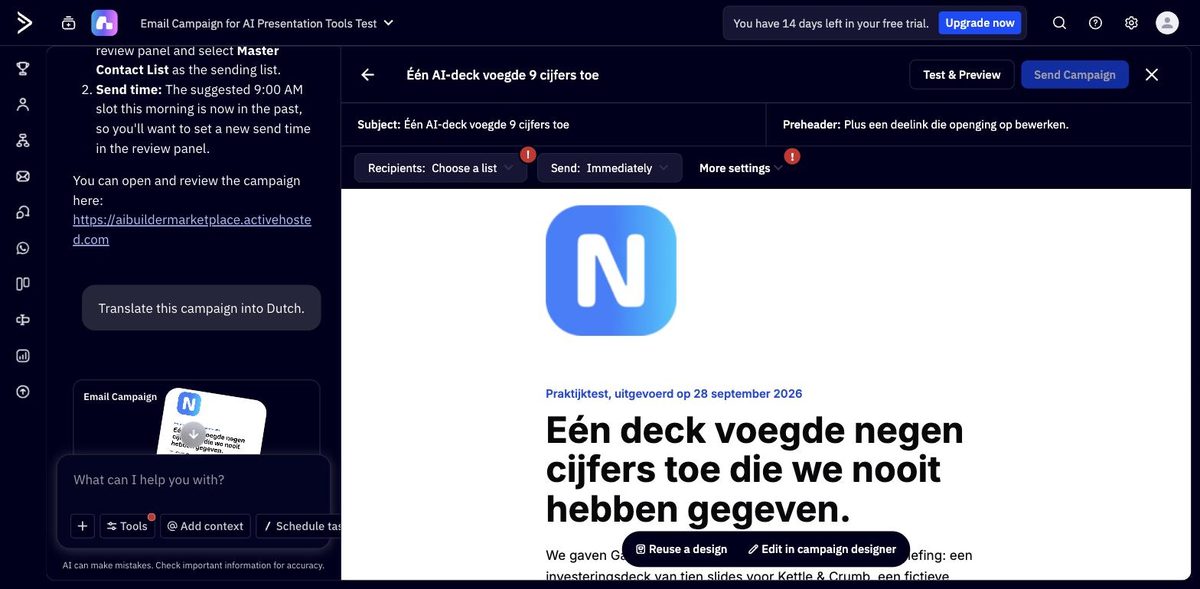
| 5 | Translate the campaign into Dutch | Partial | Fluent, numbers localised, but it replaced the English version and left a typo, a mistranslated term and English fragments. |
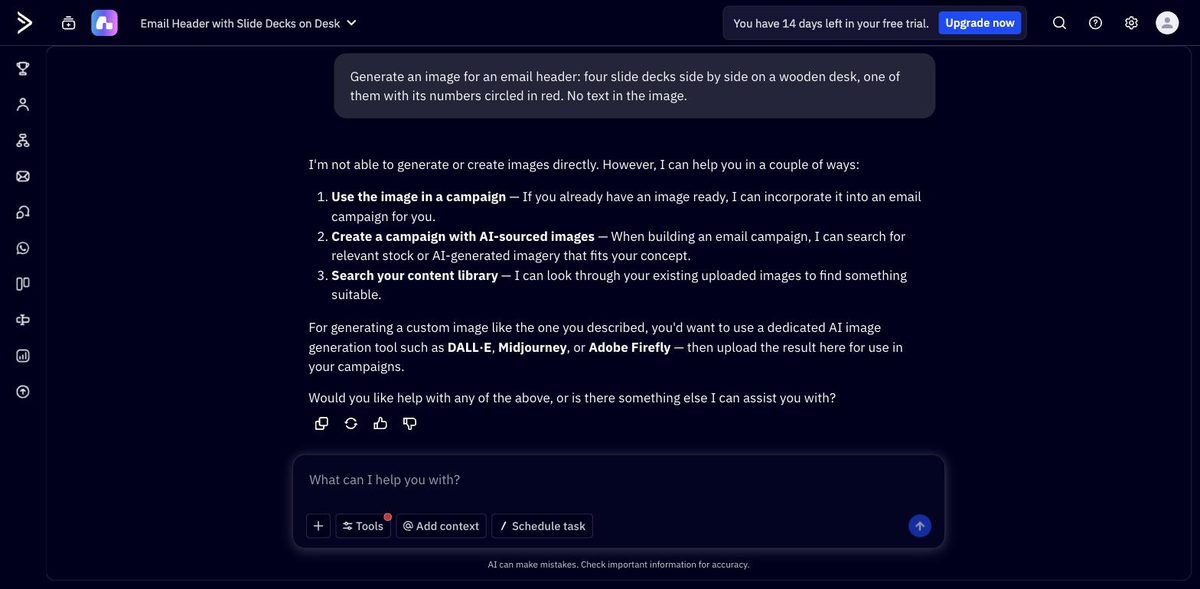
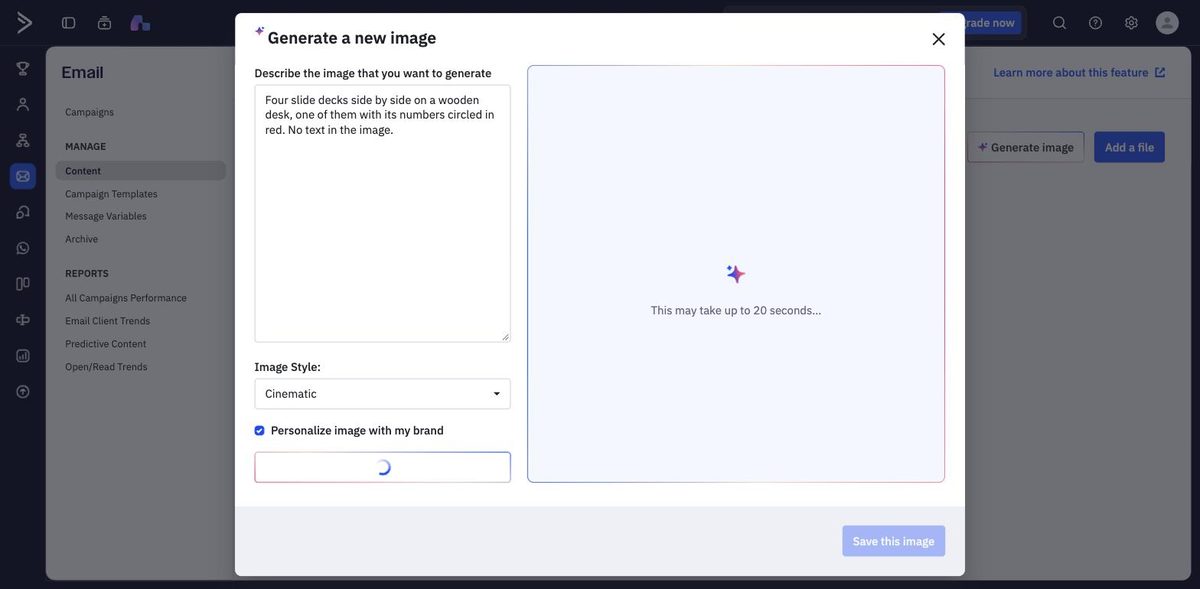
| 6 | Generate a header image | Fail | The chat said it cannot make images and named other tools; the Content Manager’s generator returned nothing in five tries. |
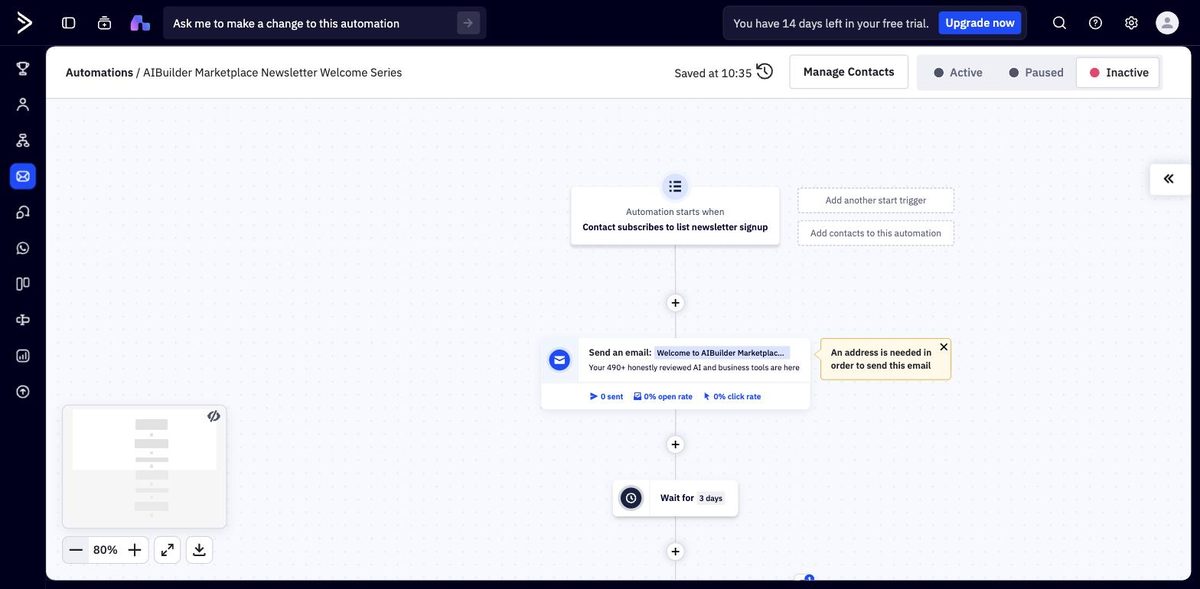
| 7 | Build a welcome automation | Pass | Three emails, two three-day waits, a new list as trigger, all editable and left inactive. |
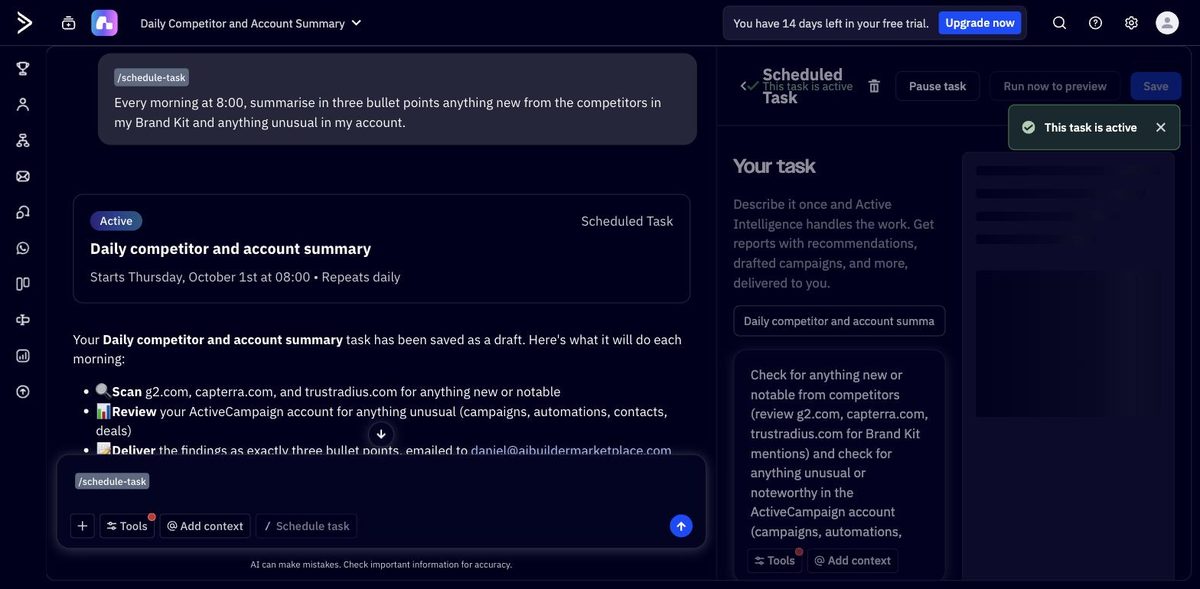
| 8 | Schedule a daily report | Pending | Saved and switched on after one network error; the preview never loaded. First report due 1 October. |
| 9 | Compare with industry benchmarks | Pass | Nothing to compare on a new account, and it said so; general ranges only, with their source. |
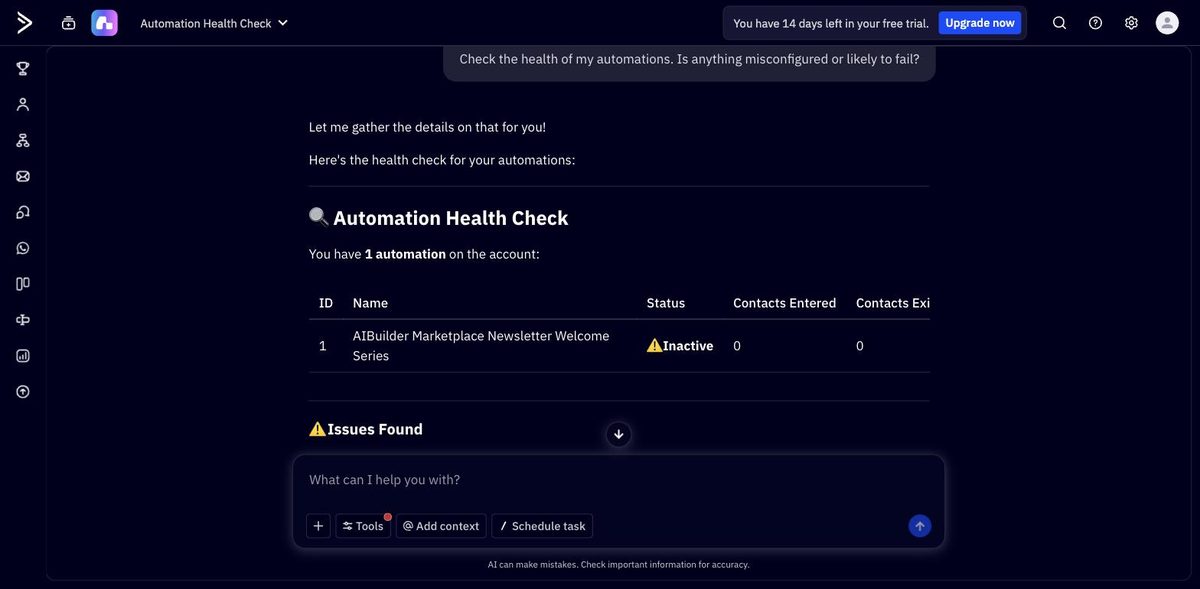
| 10 | Automation health check | Partial | Flagged “inactive, no contacts”; missed the missing postal address and the empty list. |
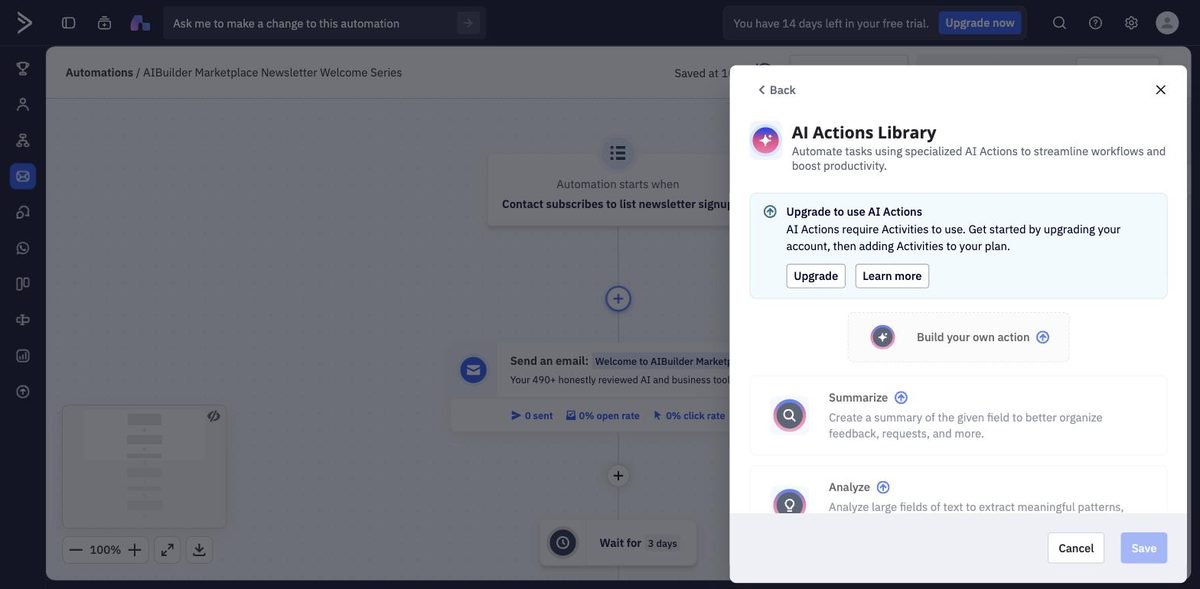
| + | AI Actions Library | Not in trial | Shown in the automation builder, but locked: it needs paid Activities. |
Day one: no history, and it says so
Active Intelligence 3.0: Wavelength is built to work from an account’s own history. ActiveCampaign’s help centre says it analyses the last 365 days of campaign sends every week to learn which content drives clicks, and compares your open and click rates with industry medians. A new account has none of that, so the first thing we asked was which past campaign had done best.
It did not make one up. “It looks like there aren’t any campaigns on record for the past 12 months, so I don’t have performance data to compare just yet,” it answered, and offered five general ideas instead. The benchmark question went the same way: zero sends, nothing to compare. Asked for the benchmarks themselves, it said the lookup had returned no figures for our industry, showed general ranges from two ActiveCampaign blog posts (open rate 20–25%, click-through 2–5%) and wrote that it would not invent the rest. One oddity: for benchmarks it used the industry from the Brand Kit (“Computers, Electronics & Technology”), not the “Media / Publishing” we picked at sign-up.
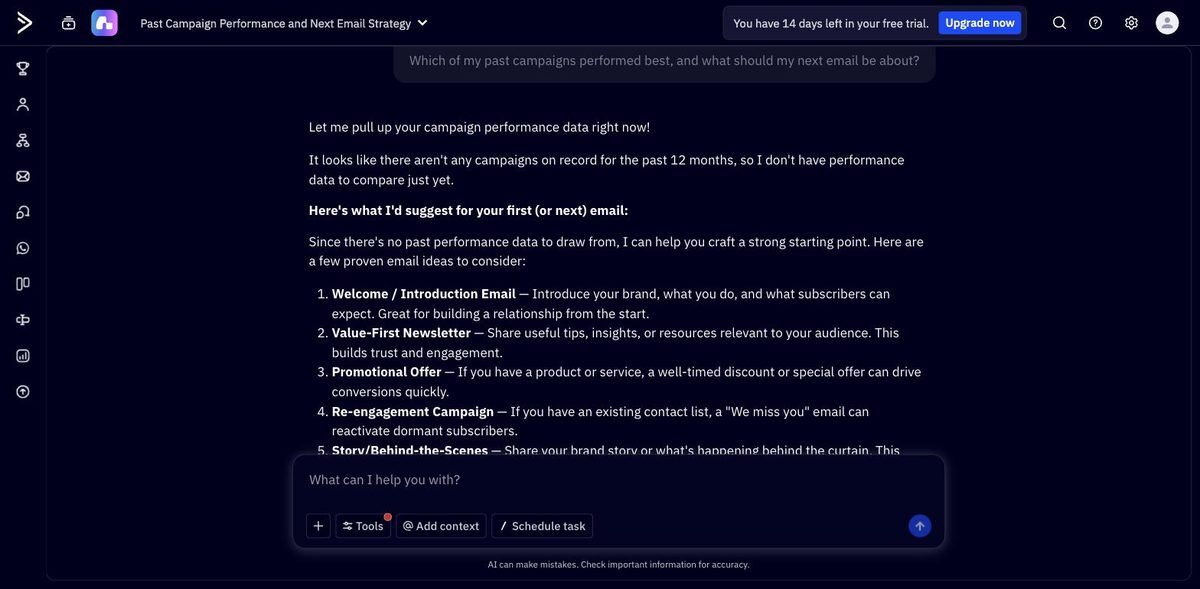
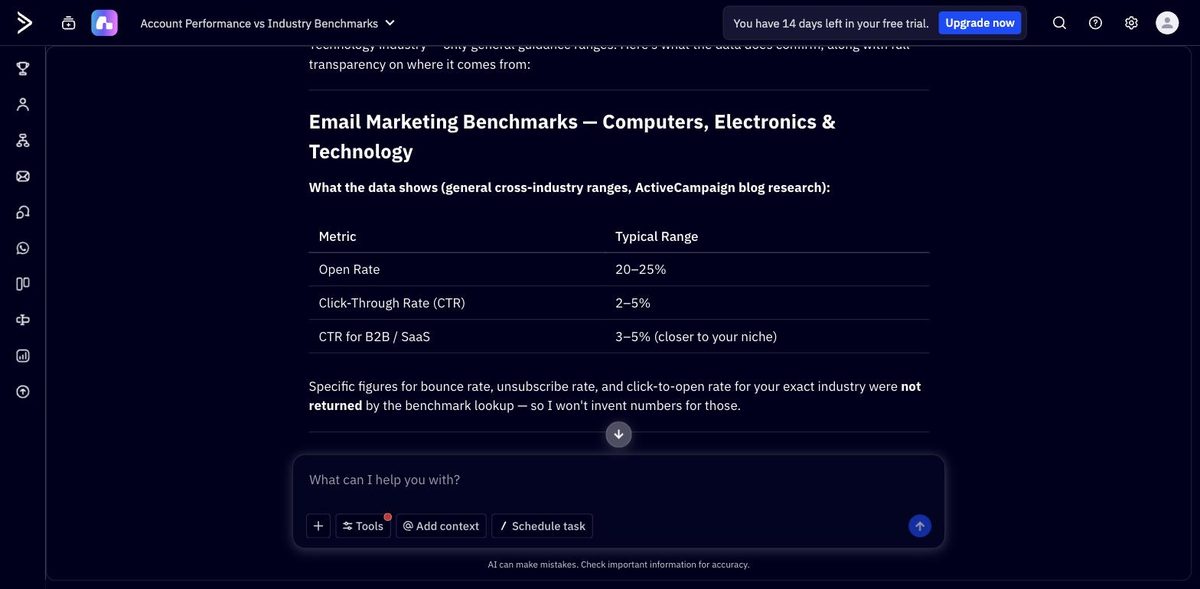
That is the honest reading of a new account: the parts of Active Intelligence 3.0: Wavelength that depend on account depth have nothing to work with on day one, and they say so rather than fill the gap. How much they add once there is a year of sends behind them is something a trial cannot show.
The Brand Kit: our voice, someone else’s logo
We gave it our homepage. It showed “Analyzing aibuildermarketplace.com” for about 35 seconds; our own server log shows what it fetched: a client calling itself ActiveCampaign-SiteScraper/1.0 and a headless browser loaded our homepage and our review library, and a third client read robots.txt and our sitemaps. The finished kit only appeared after we reopened the Brand Kits page; the first screen still offered “Add a Brand”.
The written part is good. Its “voice and tone” picks up our house rules without being told: date every figure, say who should skip a tool, flag price traps, no hype. The mission and company description follow our About page closely, colours #3b82f6 and #93c5fd are the ones in our stylesheet, and the body font is right.
The guessed fields were weaker. The industry list includes Finance. No logo was imported, yet a blue “N” logo that is not ours was saved to the content library and appeared at the top of every email it later wrote. And as competitors it picked Lindy (a tool we review), Missive and Alai: products, not rivals of a review site. We replaced them with G2, Capterra and TrustRadius for the monitoring test below.
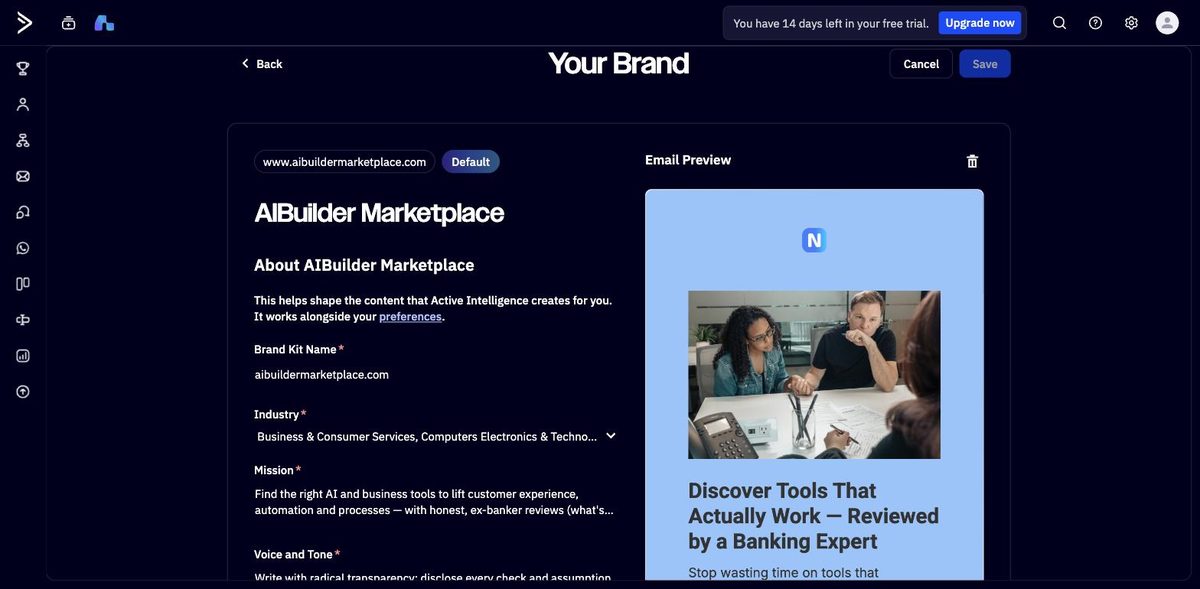
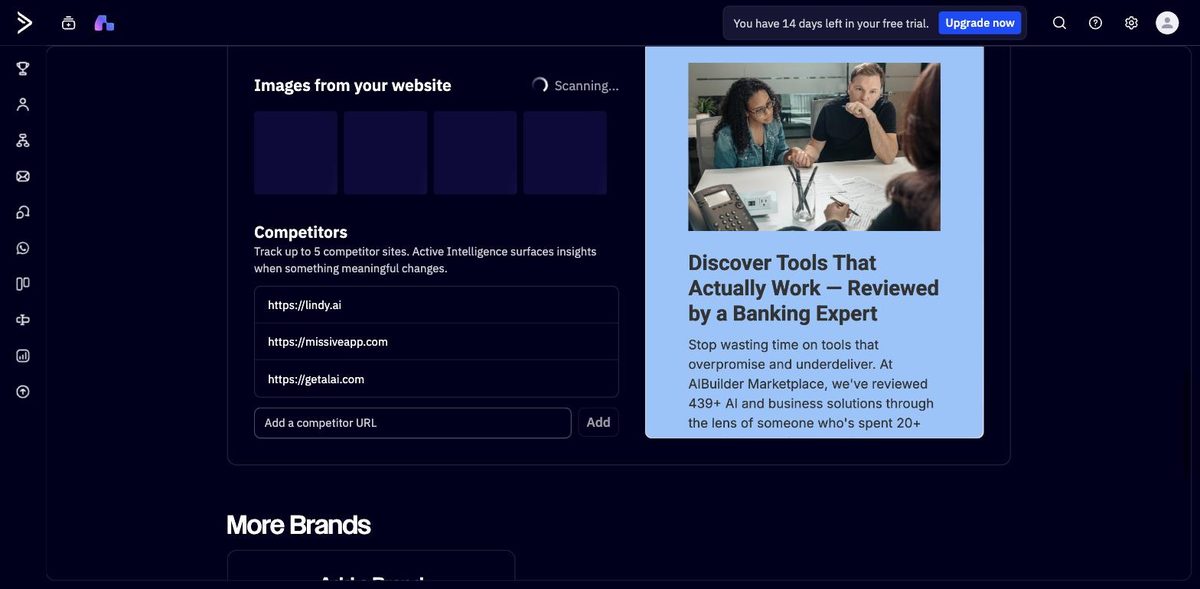
The campaign: right on the facts, but read the second run
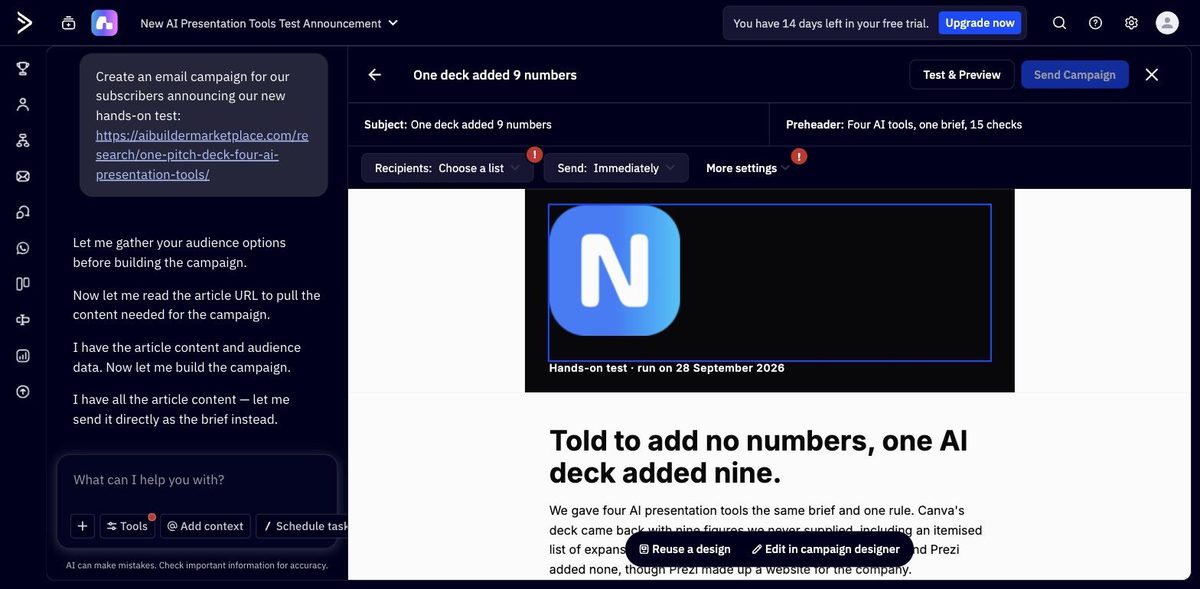
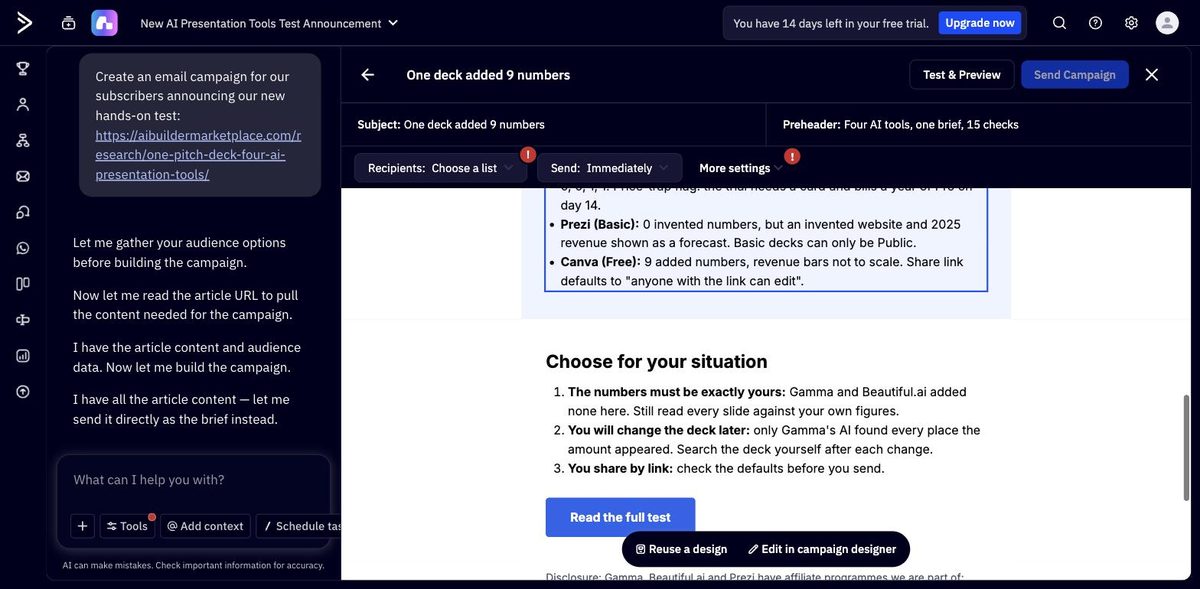
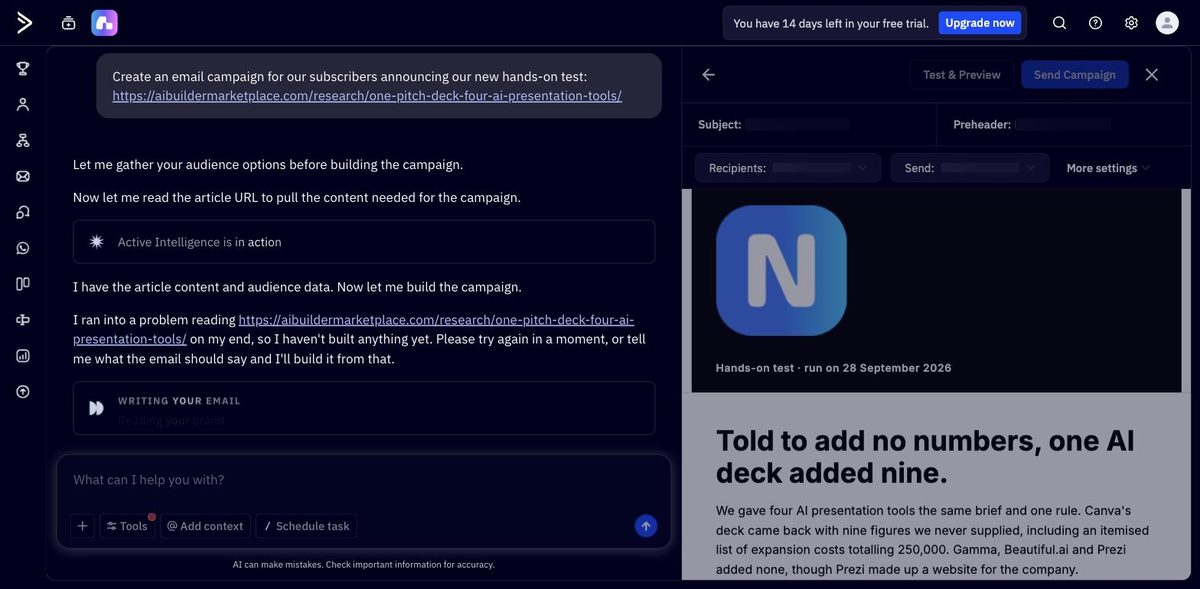
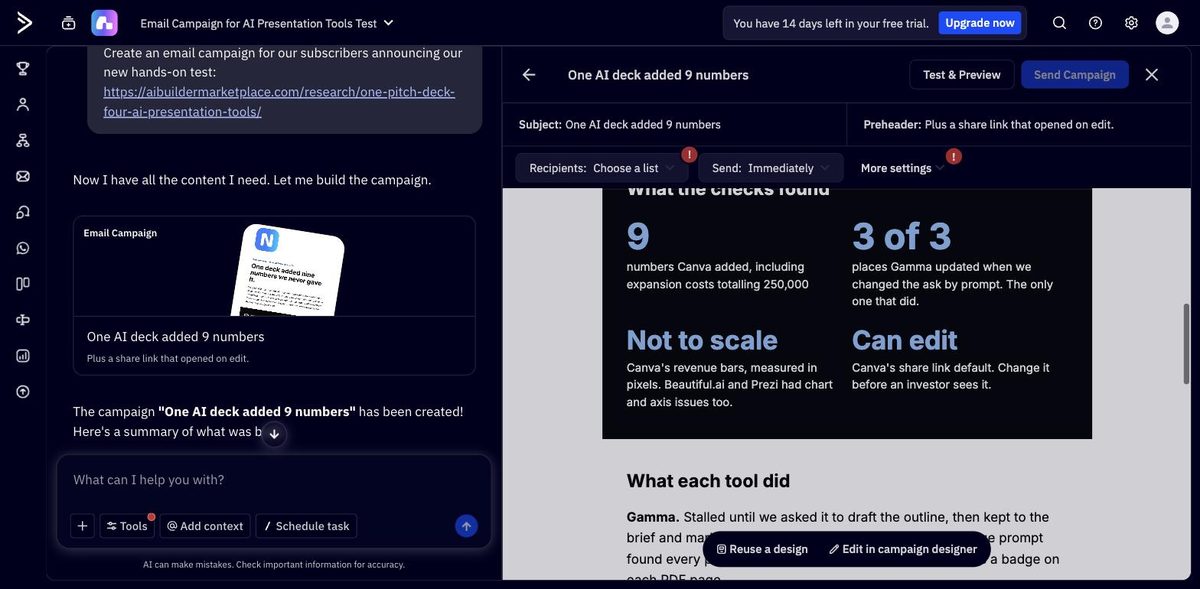
The prompt was one line: create a campaign announcing our new hands-on test, with the link. The first run took about three minutes and produced a complete email: headline, what we tested, a line per tool, a short guide by situation, a button to the page and our affiliate disclosure. We checked every figure against the page we had saved. Ten figures appear in the email, and all ten are on the source page. None was added, which is the exact failure our source test was about. Even details like “expansion costs totalling 250,000” and a chart axis “rounded to 0, 0, 1, 1” were right.
Two things to watch. While the email was being written, the chat reported “I ran into a problem reading [the page] on my end, so I haven’t built anything yet”; a minute later it said it had the content after all. And we then ran the identical prompt in a new conversation. The second email was laid out differently, with four stat blocks, and all its figures checked out too, but one sentence did not: “Beautiful.ai and Prezi had chart and axis issues too.” Our test recorded Prezi’s chart as drawn to scale, and the same email says further down “Prezi. Numbers and charts right”. The chat’s summary of that second email also listed stat blocks and a link to our methodology page that were not in the email itself.
To its credit, the second run also flagged what would stop us sending: no postal address on the account, and a suggested send time that had already passed.
Translation: fluent, but it replaces the original
“Translate this campaign into Dutch” took about a minute and a half and reported “Rewrote 21 blocks, added 1 block”. It rewrote the campaign itself: the English version was gone, not kept alongside. Dutch is our own language, so we could judge it. The copy is fluent and 250,000 became 250.000, as Dutch readers write it. But the preheader has a typo, “the ask” (the amount an investor is asked for) became “de vraag” (the question), one of our terms was left half in English, the new footer link stayed in English, and the unsupported Prezi sentence was translated along with the rest. The chat said the numbers were unchanged; strictly, their format changed, correctly. Translation worked in the trial without any add-on message.
Images: nothing came back
ActiveCampaign’s release notes for Active Intelligence 3.0: Wavelength list AI image generation. We could not get an image on 30 September. Asked inside the campaign, the chat answered “I couldn’t use what I was given for that”. Asked in a new conversation, it said “I’m not able to generate or create images directly” and suggested DALL·E, Midjourney or Adobe Firefly. The generator itself sits in Email > Content, according to ActiveCampaign’s help centre. There, the window promised “This may take up to 20 seconds” and returned nothing in four attempts over half an hour, with brand personalisation on and off, waiting up to 187 seconds, nor in a fifth attempt an hour and a half later. There was no error message. It may be a passing fault; we will try again on another day before the trial ends and add the result here.
The welcome automation: a clean build
Asked for a welcome series (one email right away, two follow-ups a few days apart), it built one in about a minute: trigger on a new list called “newsletter signup”, email, wait three days, email, wait three days, email. No duplicate steps, every step editable in the normal builder, and left inactive until you switch it on. The emails are about our own features (the Atlas, the Tool Finder, “who should skip it”), in the voice from the Brand Kit. The first subject line promises “490+” reviewed tools: our homepage says 490, the plus sign is its own.
Then we asked it to check the health of our automations. It flagged the obvious (inactive, no contacts yet) and called multi-entry “appropriate for a welcome series”. It did not flag the two things that would actually stop this one working: every email still showed “An address is needed in order to send this email”, and nothing feeds the new list, because no form or import had been set up.
Scheduled Tasks and the AI Actions Library
The Schedule task button turns any prompt into a recurring job. Our first try sent only the button’s tag and came back with “A network error occurred”. The second produced a daily task at 08:00 Amsterdam time that emails us a three-point summary of our account and our Brand Kit competitors. Its own description of the job says it will look at G2, Capterra and TrustRadius “for Brand Kit mentions”, which is not quite what we asked. The “Run now to preview” panel had not loaded after nearly five minutes, so we switched the task on; its first report is due on 1 October and we will add it here.
The AI Actions Library (the automation step that summarises, translates, classifies or scores a contact field) is listed in the automation builder but locked in the trial: “AI Actions require Activities to use.” That matches ActiveCampaign’s pricing page, read on 30 September 2026, which lists AI actions as an add-on on every plan.
Choose for your situation
One account on one morning does not support a verdict, so this is what the run does support.
- You are starting from zero. On day one Active Intelligence 3.0: Wavelength is most useful as a drafting partner that reads your website and your pages. The features built on account depth, such as content performance and benchmarks against your own rates, have nothing to use until you have been sending for a while, and it tells you so.
- Your emails carry figures. In our test it copied numbers faithfully, but a second run of the same prompt added a claim the source does not support. Read each draft against your source, not the chat’s summary of it.
- You set up the Brand Kit. Check logo, industry and competitors first. Those are the fields it guessed least well, and the logo ends up in every email.
- You work in more than one language. Duplicate a campaign before you translate it if you want to keep the original, and have a native speaker read it.
- You are choosing a plan. The trial runs on Pro features; ActiveCampaign’s pricing page lists different Active Intelligence access per plan. Our ActiveCampaign review sets out what each plan includes, dated.
Check the evidence
- Date and account: 30 September 2026, 10:02–10:55 Amsterdam time; a new account on the 14-day free trial (Pro features, per ActiveCampaign’s help centre).
- The data: every task with its prompt, time, duration and what we saw is in results.json. The screenshots above are full screens, only scaled down.
- The source page: One pitch deck, four AI presentation tools and its data file are unchanged since before this test.
- What this is not: one account and one run per task, so another day or prompt could turn out better or worse. Nothing was sent, so deliverability is untested. The trial runs on Pro features, so the limits of Starter and Plus are not shown. Content performance with a real send history, SMS and WhatsApp, the connectors, and the ActiveCampaign connector for Claude and ChatGPT remain untested.
Our full review: ActiveCampaign. Our other hands-on tests: one pitch deck, four AI presentation tools · one booking app, three AI builders. How we separate researched reviews from hands-on ones: how we review.
Still to come in this trial
The scheduled task’s first report is due on 1 October 2026 at 08:00 Amsterdam time; we will add what it sent. We will also try the image generator again before the trial ends on 14 October 2026.
Citation
AIBuilder Marketplace, “Active Intelligence 3.0: Wavelength on a brand-new ActiveCampaign account”, hands-on test run on 2026-09-30. Free to quote and reproduce with attribution (CC BY 4.0).