Developer tools · Hands-on build review · 26 October 2026
XSDHub Review: XML Validation Tested, with Its Limits in Plain View
A browser workbench for finding broken XML, checking it against local XSD 1.0 projects or optional server-based XSD 1.1 and Schematron XPath 1.0 rules, and formatting it. The free check is the useful starting point; paid plans add repeat-work features.
The practical verdict
XSDHub is useful when you have an XML file in front of you and need a specific answer: is it well-formed, does it match this XSD, or can I make it readable? It separates a syntax pass from a schema pass. That distinction matters: a document can be valid XML while its element order, namespace or date format is wrong for the receiving system.
The free workbench needs no account. Paste XML, add an XSD if needed, and run the check. Errors include line information when the underlying engine supplies it. The practical guides load a failing example or its correction into the editor, making them useful for learning the reason for a failure.
We would start with Free and a representative file from your own workflow. Pro makes sense when repeated batches and saved schemas save you time. Team is aimed at a small group using the same schema library. Neither paid plan changes the validation engine or removes the format restrictions.
Watch the updated walkthrough
XML syntax and schema examples, USD plans, cloud projects, public schema imports and advanced validation modes. Ava provides AI-generated narration. This is our own product demonstration.
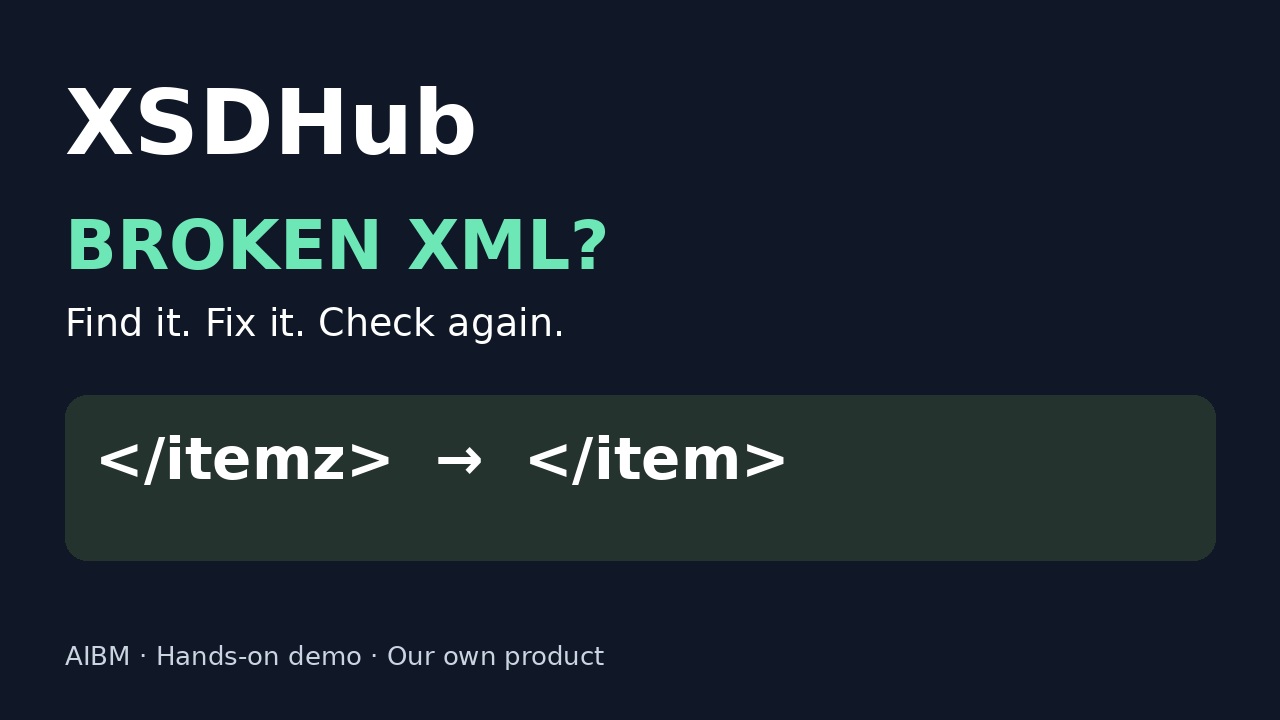
Watch on YouTube — 3 minutes 48 seconds, with English captions. The feature overview distinguishes local processing from server modes that require upload permission.
Hands-on screenshots: failure, correction and limits
Captured from the live XSDHub website in Chrome on 26 October 2026 using synthetic examples. Click a screenshot to enlarge it. Images are cropped to the relevant interface and compressed; the displayed results have not been edited.
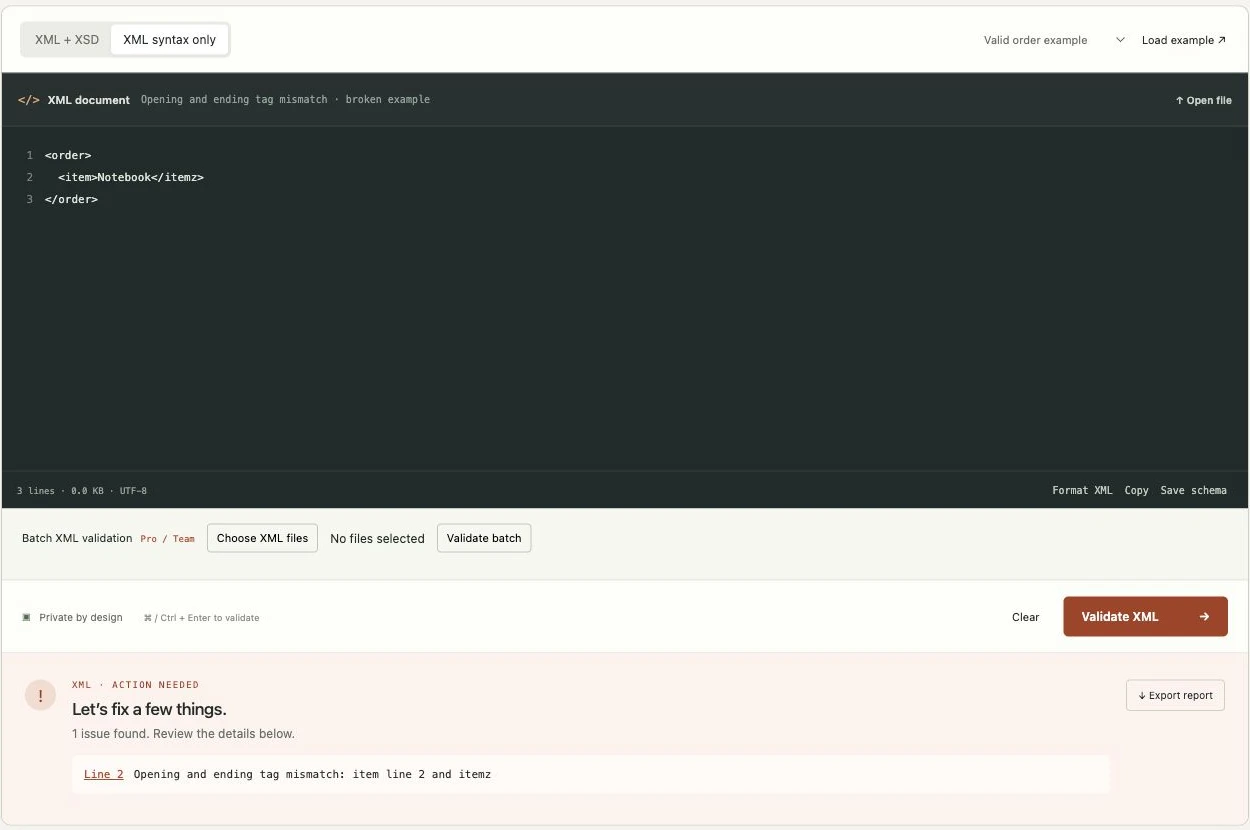
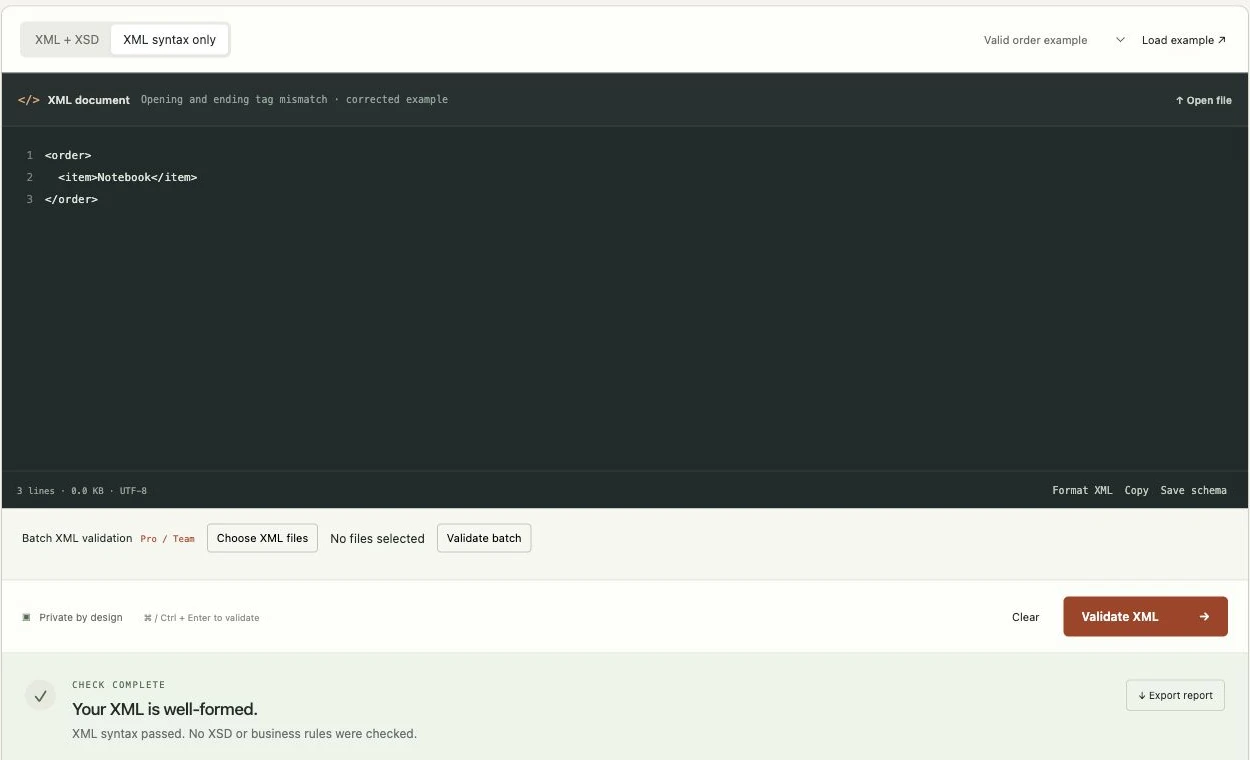
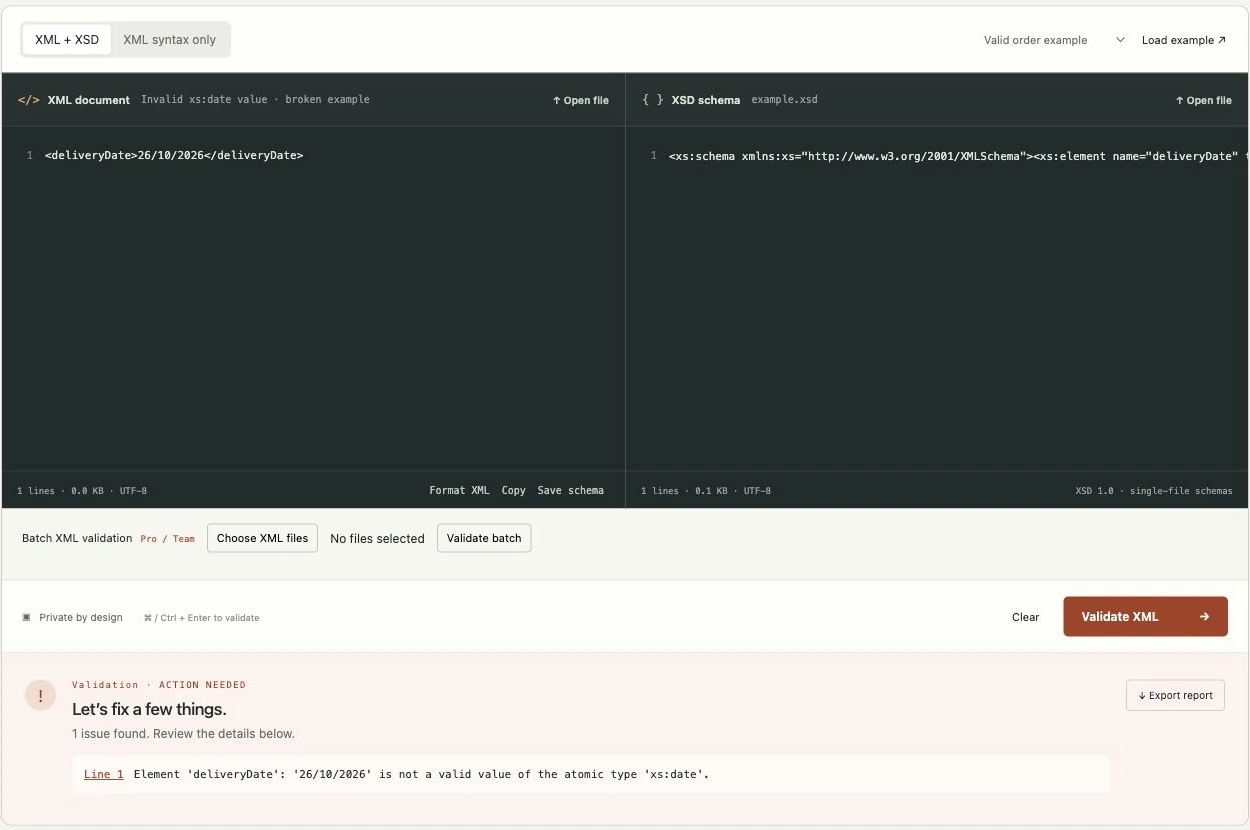
What these screenshots do not prove
These examples show syntax and single-file schema feedback, plus published prices. They do not demonstrate every supported schema, paid batch limits, a new real-money purchase, a refund or a full subscription lifecycle. See the test evidence and limitations below.
Five failures we reproduced and corrected
We ran these synthetic examples through the same libxml2/WebAssembly validation code shipped by XSDHub. Each broken example failed and each correction passed. These are bounded, reproducible cases, not a claim that every XML dialect or schema is supported.
| Problem | What failed | What fixed it |
|---|---|---|
| Tag mismatch | An item closed as itemz. | Matching the closing tag. Run the example |
| Ampersand | A raw & in company text. | Encoding it as &. Run the example |
| Namespace | A root element without the schema's target namespace. | Adding the expected default namespace. Run the example |
| Element order | price before quantity in a schema requiring the reverse. | Following the declared sequence. Run the example |
| Date format | 26/10/2026 for an xs:date. | 2026-10-26. Run the example |
One example, without the marketing
This is malformed XML. A syntax check is enough to catch it; no XSD is needed.
<order>
  <item>Notebook</itemz>
</order>
The engine reported Opening and ending tag mismatch: item line 2 and itemz. Changing the closing tag to </item> made the same input pass. A pass here confirms syntax only; it does not validate an order's business rules.
What the wider checks covered
At the end of the second audit, 39 automated tests passed. They covered these examples, additional XML edge cases, payment-signature validation, account-linking safeguards, subscription state selection and restricted measurement payloads. Fourteen live HTTP checks verified refusal of anonymous or forged identities, invalid request origins, unsigned payment notifications and malformed measurement requests. These counts are engineering evidence, not a security certification.
Unicode, CDATA and escaped characters passed the syntax tests. Duplicate attributes, unbound namespace prefixes, multiple roots and unknown entities failed. Formatting preserved the tested mixed-content sentence, including its Unicode text. We also checked the desktop pricing view and representative 390-pixel layouts, and verified that monthly/yearly pricing changes correctly.
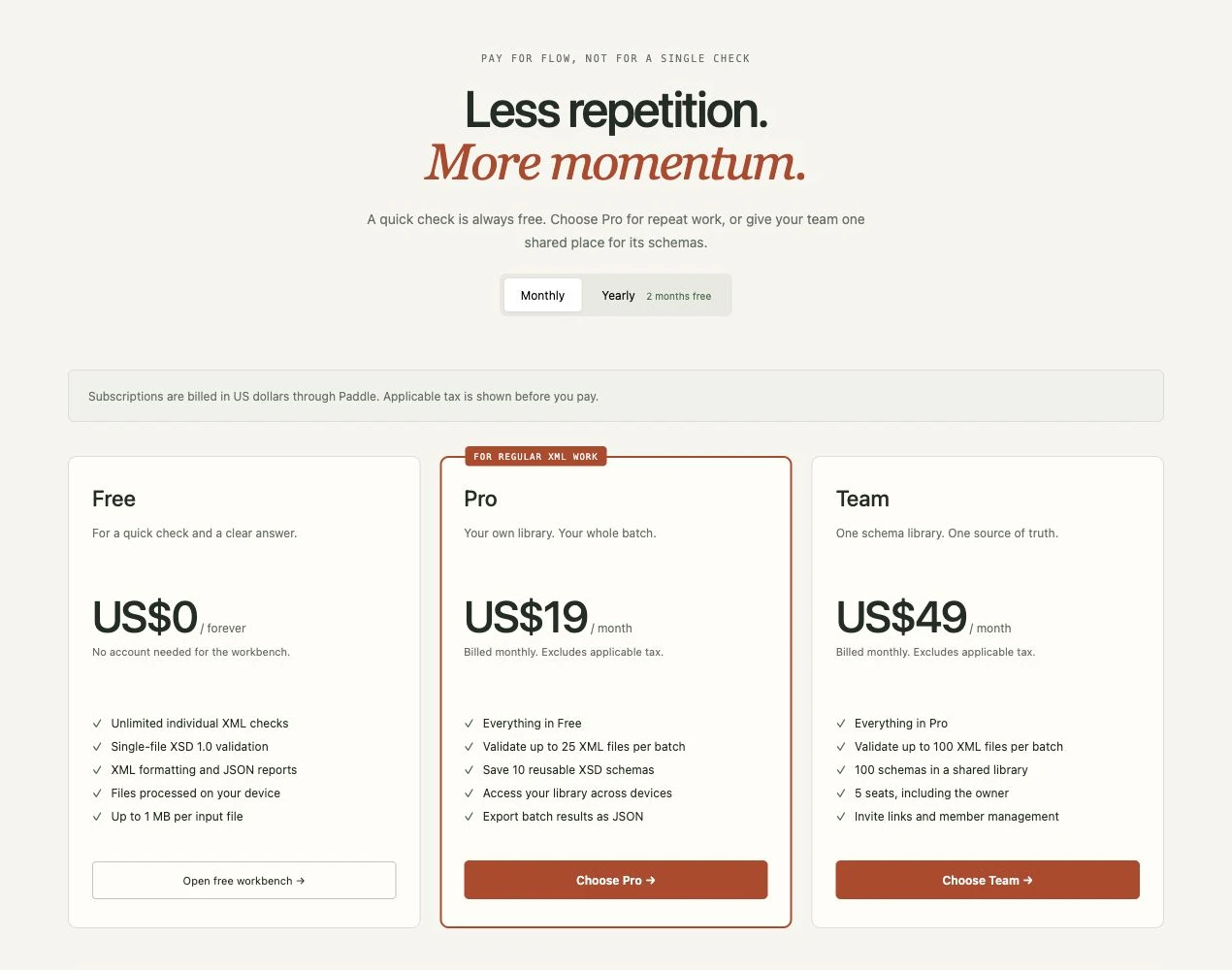
Pricing checked on 26 October 2026
Published prices are in US dollars. Applicable tax is added at checkout. Annual prices are charged once per year, not monthly.
| Plan | Monthly | Annual | Main limits |
|---|---|---|---|
| Free | $0 | $0 | Individual checks; local projects and exports; up to 10 MB XML and 1 MB per schema. |
| Pro | $19 | $190 | 25 XML files per batch, 10 saved schemas, one seat. |
| Team | $49 | $490 | 100 XML files per batch, 100 shared schemas, five seats including the owner. |
The yearly saving is $38 for Pro or $98 for Team compared with twelve monthly payments, before tax. Local and server checks accept up to 10 MB XML and 1 MB per schema; project schemas allow 10 MB total. Check the current pricing page before buying.
Paddle is the live checkout provider. Google, GitHub and email/password sign-in are available; email accounts require verification. Sandbox payment flows were tested during setup, but we did not complete a new real-money purchase, refund or full billing cycle for this review. A visible checkout is not proof of a completed paid customer journey.
What stays on your device, and what does not
XML syntax checks, schema validation and formatting run in the browser using libxml2 and WebAssembly. XML document contents are not sent to a validation server. Saving a schema is different: that explicit action uploads the XSD to your account, and Team schemas are shared with that workspace.
Account authentication, payments, server requests and limited aggregate usage measurement still involve services outside the local editor. “Local validation” does not mean “the entire website has no network activity.” Read the privacy policy for those boundaries. The AI/MCP endpoint exposes public documentation; it cannot validate documents or read saved schemas. A separate consent-based HTTPS validation API and Python CLI are now documented at xsdhub.com/developers.
Update: local multi-file schemas tested
On 26 October 2026 we added and tested a local project loader: XSD files, folders and ZIP archives, with a main-schema selector and editable dependencies. Automated checks covered includes, namespace imports, nested relative paths, missing files, blocked URLs, DTD rejection and ZIP size limits. Browser checks confirmed a real ZIP loaded successfully, valid XML passed, an invalid value failed, and malformed dependency errors named the schema file.
The multi-file suite now passes 53 checks, plus six ZIP checks. This remains our own product and our own build verification, not an independent assessment or proof that every industry schema works. Projects can now be saved on the device with five revisions and exported. Account libraries still store individual schemas. Optional advanced server modes upload documents only with explicit consent.
Update: projects, XSD 1.1 and an API
The 26 October 2026 update adds local project saving with five revisions, text comparisons, dependency navigation and export. Browser checks verified saving, comparing and restoring a project. Optional isolated server engines support XSD 1.1, a second XSD 1.0 implementation and ISO Schematron with XPath 1.0. Upload permission is explicit; these modes are not browser-local. Request contents are not logged, and temporary files are removed after processing.
Our own engineering checks passed 100 selected W3C XSD 1.0 cases in both engines and 88 selected XSD 1.1 cases covering assertions, type alternatives and open content. These are selected cases, not the complete W3C suite or certification. Thirteen advanced-engine checks also passed, including DTD, external resource and path-traversal rejection. Server checks of 1, 5 and 9 MB XML passed. The API and Python CLI provide a route for automated checks, subject to the documented rate and processing limits.
Update: cloud projects, schema tools and public imports
Pro and Team now save complete schema projects with up to 50 cloud versions. Local saving retains five revisions. Projects can be exported, edited in file tabs and inspected through a dependency graph. A schema-aware comparison reports structural changes; it does not certify compatibility. The example generator validates its candidate with the local XSD 1.0 engine before allowing it to replace the XML.
The public HTTPS importer fetched our two-file demonstration schema and its dependency in a live browser test. It downloads an explicit snapshot; validation does not silently retrieve remote resources. Private network addresses, authenticated URLs and DTDs are blocked. Both engines agreed on the included live order example. A selected corpus of 100 W3C XSD 1.0 cases plus 20 practical cases passed in both engines; this is not full conformance certification.
We also checked tenant isolation, stale-version protection and cloud revision handling in automated route tests. A previous live browser check saved and reopened a cloud project. Two-worker batch reuse, ordered results and oversize rejection passed automated tests. The final browser file-picker test was blocked by our automation extension, so that particular end-to-end interaction remains unverified. The downloadable CI starter's valid and invalid examples returned the expected CLI exit codes against the live API; we did not execute a hosted GitHub Actions job.
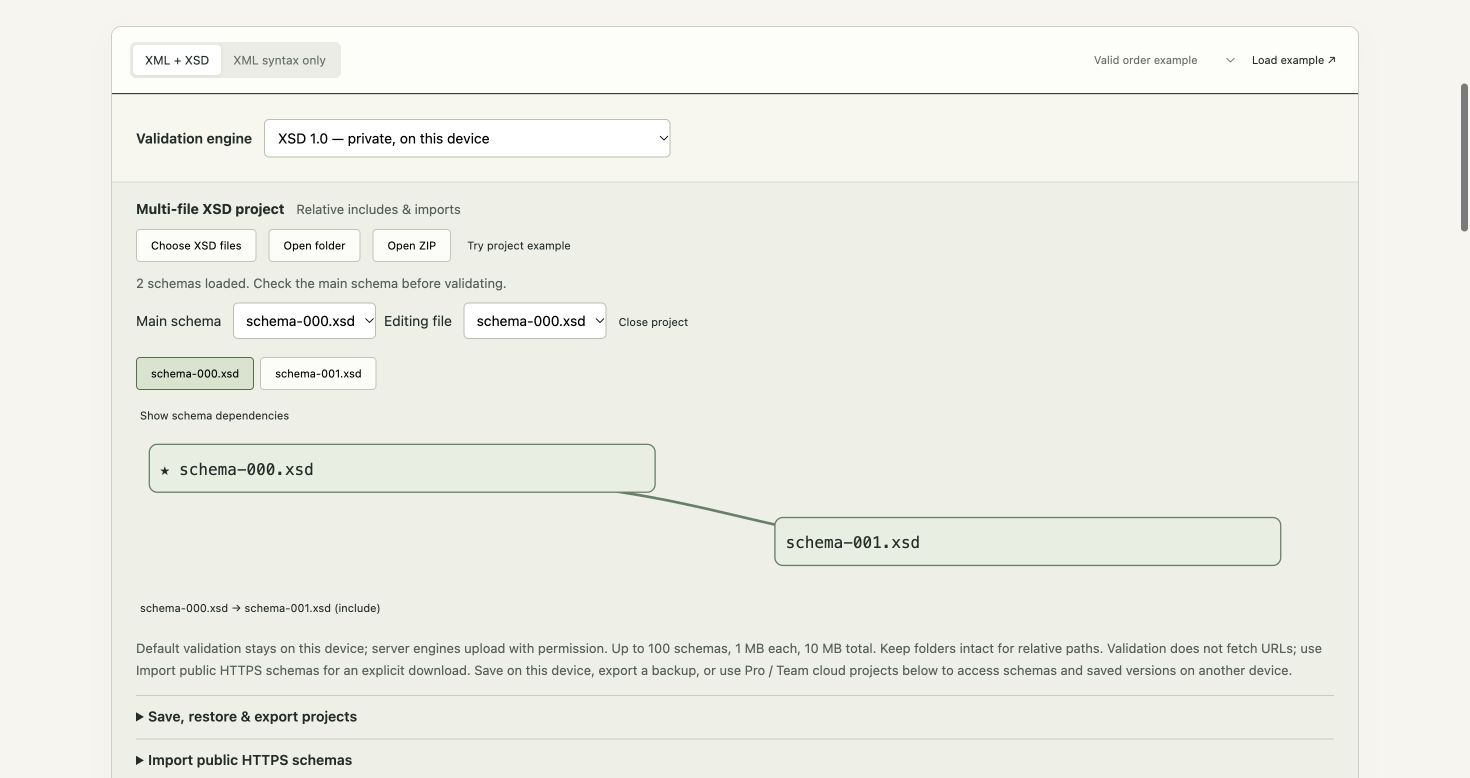
Current limits: XML up to 10 MB, each schema up to 1 MB, project schemas up to 10 MB, and 20 files per remote import. Schematron uses XPath 1.0. Complex example-generation constraints may require a hand-written document. No enterprise SLA is offered.
The limits we would want to know before paying
- XSD 1.0 with local dependencies: load XSD files, a folder or a ZIP and choose the main schema. Local imports and includes are supported. Optional server modes add XSD 1.1 and Schematron XPath 1.0 with explicit upload consent. An explicit public HTTPS importer downloads schema dependencies as a snapshot. Private network fetching and DTDs remain blocked.
- Small inputs: XML inputs allow 10 MB, schemas 1 MB each, and projects 100 schemas / 10 MB total. Paid local batches use two reusable workers; server batches are limited to ten files and the documented request rate.
- Not a business-rule engine: a schema pass does not prove invoice arithmetic, regulatory compliance or acceptance by your trading partner.
- Shared library, not a full collaboration suite: Team includes five seats and invitation links. Do not assume real-time co-editing, enterprise SSO or emailed invitations.
- No automation API for validation: the public MCP service reads guides and capabilities. It does not replace a CI validator.
- Incomplete checkout safeguards can require support: a pending checkout for a different plan or an uncertain payment state is blocked rather than silently opening a second payment.
Our own audits found and fixed issues around old test subscriptions, duplicate checkout attempts, expired Team membership and linking an account with a pending Paddle checkout. Those fixes are useful evidence of improvement, not a reason to call a new product flawless.
Who should use it, and limits to check
Good fit: developers, integration staff and technical operations teams checking small XML exports against XSD 1.0 schemas, including local multi-file projects, especially when they want a quick browser tool and examples that explain the failure.
Check these limits: if you need inputs above 10 MB, XPath 2.0 Schematron, an enterprise SLA or a validator certified for a specific industry standard. If you only need an occasional syntax check, start with Free; there is no need to subscribe merely to validate one document.
Our conclusion
The strongest part of XSDHub is the direct path from a concrete XML error to a corrected example. Its value is a focused, local check with clear limits. Whether the paid library and batches are worth the price depends on how often you repeat that work. Test your actual schema with the free workbench first.
Open XSDHub Read the product listing
Published by AIBuilder Marketplace. Product owner: Daniel Haket. Ownership disclosed above. Tested and pricing read: 26 October 2026. No customer rating, sales claim or independent endorsement is implied.